After a devastating storm on Thursday, April 9, 2020, by the weekend we were pulling ourselves together. We closed off parts of the house in order to preserve what heat we had from the woodstove. We had several buckets of snow melting for flushing the toilet. Our wood stove sits in an old fireplace, which limits our ability to cook on it, but we had a shallow, wide pot for heating water, a small skillet in which to cook eggs, and another shallow pot to heat or simmer food in.
We shut the kitchen away from the heat, trying to keep it near refrigerator temperature to spare our food, opening the freezers only when absolutely necessary.
We assembled flashlights and candles. We filter our drinking water in a big five-gallon bucket. Our water comes from an old hand-dug well, and it’s sweet and good, but we’re careful to filter. The bucket had not been filled before the power went out, and our pump is electric, so we knew we’d need water. Bottled water has been very difficult to find in the stores and if it is available, we can only buy a gallon or two at a time.
Our laptops had nearly full charges, but our cell phones were low. We figured out how to make a hot spot with my partner’s phone, but it drained the battery quickly, so we hastily made calls and sent e-mails to our loved ones and shut it all down. We called the power company again. This time the recorded message gave no estimated time of the power coming back up and advised us to “prepare for a multi-day event.”
I was desperate for a hot shower. My hair, never civilized in the first place, is badly in need of a cut, which I can’t get right now because of coronavirus restrictions. I felt like a dirty, disheveled steel wool poodle. Yikes!
We made a plan for me to go to a friend who still had power on Sunday, take a shower, get some water, and charge our laptops and cell phones.
Two friends showed up with their kids to take a walk with us on Saturday, and we went up the hill, our usual approximately 3-mile walk. For the initial few yards the road is paved, but then reverts to dirt. We saw tree damage everywhere, and evidence of large downed trees having been cut up and removed from the road in several places. Many trees were suspended on the lines, and there were long stretches of line draped around and over the road and ditches, snarled up with tree debris. We saw no sign of power or tree service trucks.
Every other house had a generator running.
Photo by Ashkan Forouzani on Unsplash
Shortly after our friends left, one of them called to tell me four staff in the rehab building at the hospital, where we’ve all been working, have tested positive for COVID-19, and we’re all on a mandatory 14-day quarantine, after which we are furloughed until further notice. The building is shut down.
This was sobering news. I’ve been turning myself inside out trying to get hours at work, doing shifts in screening tents, working at a screening table, even doing things like putting together trauma packs — whatever needed to be done. In a way, it’s a relief to just be out of work. At least I can count on it! On the other hand, I felt concerned about my colleagues in the building. We don’t know who is sick.
How the hell was I going to keep the house clean and protect my partner without power and hot water? And if I’m in quarantine he has to go out and buy groceries and expose himself.
Shit.
In addition, we heard of another storm coming, this one with heavy rain and high winds. More than 200,000 people lost power during the snowstorm, and most of us were still down. Countless damaged and leaning trees were balanced precariously, held up by their neighbors, branches and crowns tangled together.
We read as long as we could by daylight, and had another early night in bed.
Photo by Gary Bendig on Unsplash
On Sunday morning (Easter Sunday) I loaded up the car with water jugs and our tech and went to my friend’s house. On the way, I saw one lone power truck from an out-of-state company with one lineman in the truck and another in a personal vehicle. They were trying, I knew, but coronavirus has complicated everything.
My friend was ready for me, and we plugged everything in to charge. I had a wonderful hot shower, washed my wild hair and felt much better. I sat on her living room floor drinking tea and dealing with my e-mail, looking at the weather forecast and headlines. We filled various containers with water and loaded them into the car.
On the way home, about a quarter of a mile from our house, I came across a tree service truck taking a tree off the line. Out here in Maine, when the power goes down the first responders are the tree service people. When they start working, we know the power company is not far behind them. I felt like cheering.
As we unloaded the water, my partner told me he’d been seeing both tree and power trucks going back and forth, and we dared to hope we might be up and running sooner rather than later. We decided to take a walk. When we returned, I wandered over to look at our shattered maple while my partner went in the house. He stuck his head out the door and called to me that the power was back on.
We discovered we still had no Internet. We called our Internet provider and got a recorded message: “If you’re calling from Maine, please hang up. If you’re calling from other service areas, please stay on the line.”
Great.
A few minutes later, the friend and coworker with whom I’d spent the morning called to say she was achy and feverish and going into the ER to get tested, per hospital staff protocol.
Shit.
We turned on the hot water heater and I got to work. I was determined to get done what I could before the next storm arrived. I put on a mask, as I’d been exposed to my friend so closely, knowing it was probably too late to protect my partner, but feeling I must do what I could. As I scrubbed and scoured and wiped with bleach, I worried about my friend being alone, sick and scared. I worried about my partner. I worried about other friends and coworkers and their families.
I worried. And cleaned. And worried.
By the end of the day, the house was in order, everything was fully charged, we had lots of extra water, and we were set to deal with another outage if it came.
That night, before I slept, I read by electrical light and was grateful. As I drifted off to sleep, I wondered what Monday would bring.
Thursday morning, I went to town with my mask, met one of our egg suppliers and bought several dozen eggs, visited the grocery store and thanked the young man sanitizing grocery carts and controlling the number of people allowed inside. One of my sons is doing the same work in Denver, and as I went back to the car with loaded plastic grocery bags dangling from my hands, I thought of him.
On the way home it began to rain.
April 10, 2020
An hour later, snow was falling in thick, wet clumps, filling the air and coating every surface it touched.
Six hours later, as night fell, we had several inches of snow and the air swirled with flakes, smaller and harder now as the warmth of the day faded. The power began to flicker as we watched TV. We turned off our computers and unplugged them.
At bedtime, I cracked a window open and crawled under the covers to read. The power stuttered over and over, making our carbon monoxide detector beep and my office electronics in the adjoining room click and clack.
I turned out the light and thought of the smothering weight of the snow on the roof above me, how quickly it was accumulating and how typical that an April storm just before Easter would be the worst of the season. Plows passed by, their lights shining through my unshielded windows, illuminating my room in flashes and moving stripes of light.
Sometime around 10:00 p.m. the power went out for good. The house was abruptly silenced, but the night outside was filled with sound and movement. The storm was like an immense creature padding around the house, breathing in erratic gulps, thumping, pawing, scrabbling. The trees groaned and soughed in their wooden throats, the merciless blanketing snow pressing down on their bodies and limbs.
At 12:40 a.m. a long, slumping crash filled the night. I lay, tense and fearful, listening. Was that part of our roof? Had the deck torn away from the house? I turned on my small LED reading light, thrust myself into robe and slippers and went downstairs.
Dark. The lights we usually leave on in the kitchen and living room were out, of course, along with the bathroom nightlight. Outside the large window over our dining table, nothing but soft, formless white, except for a great black shadow between the barn and the trunk of a 200-year-old maple alongside the driveway.
A black shadow, taller than a man and longer than a car. A black shadow in a white night. I strained to see clearly, but it was impossible to make out any details. I let my eyes move up the tree trunk. Was the top of the tree still there, or had it fallen away?
I went back up the stairs, feeling sick and pretty sure we’d lost the tree. Had it hit the barn? If so, there was nothing I could do about it.
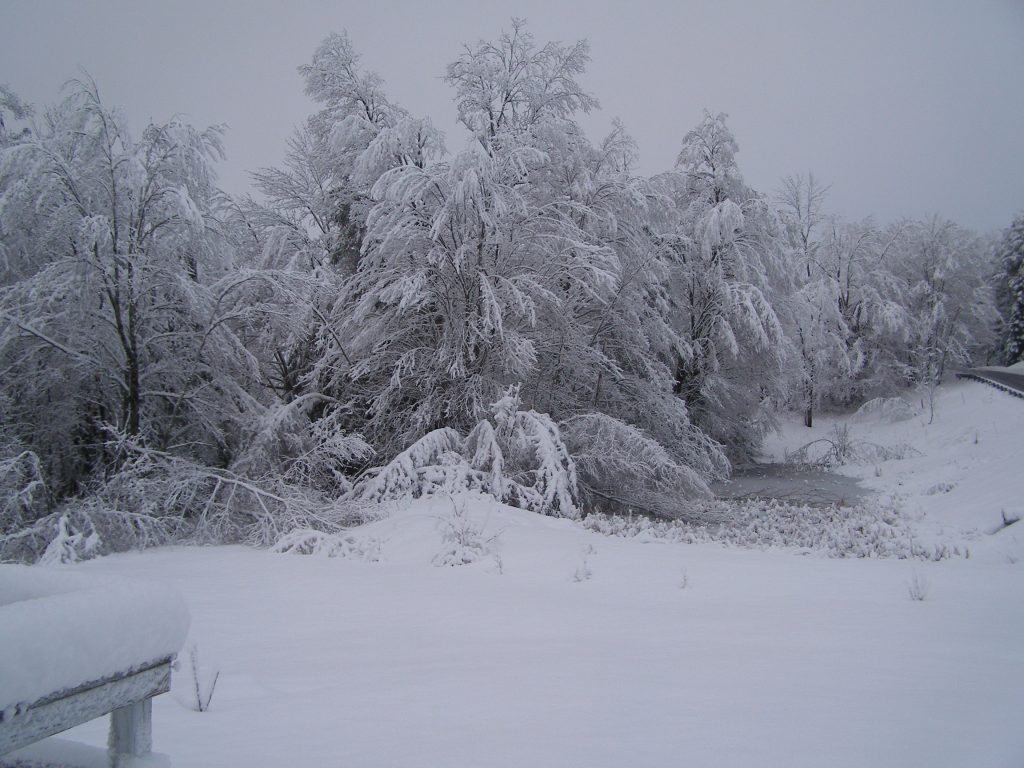
Pond, April 10, 2020
I lay in bed, listening to the storm and the beleaguered forest. It was like a battle between the violent, inexorable snow and the patient, giant trees. Creaks, cracks, booms, explosions, and the muffled sound of crashes and heavy bodies falling filled the night. I knew some of what I was hearing was transformers blowing and electrical noise, but I couldn’t tell how much. I wept for the trees as the storm rent and tore at them, bearing them down with its cold, white weight.
I checked my small battery-operated clock at 3:30 a.m. Dawn was not far away. I felt calmer, and now I heard only the hush of heavy snowfall. The weight on the roof above my head felt less ominous. I blew my nose, flipped over my pillow and turned onto my side, finding sleep at last.
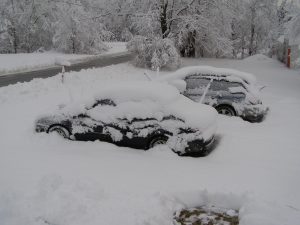
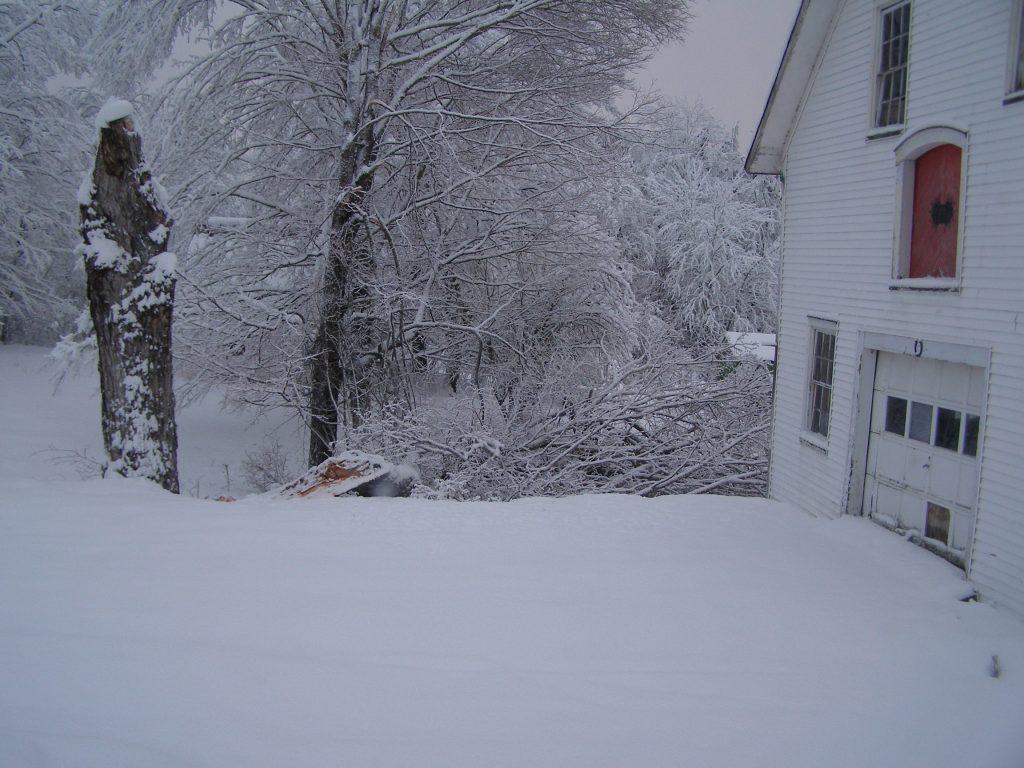
At 6:30 a.m., my partner and I looked out the front window at the shattered maple, which had fallen onto an old apple and snapped it like a toothpick, as well as tearing all the limbs off one side of a younger, healthier maple near it. The fallen tree did not hit the barn, or our cars, or the house.
Downed maple, April 10, 2020
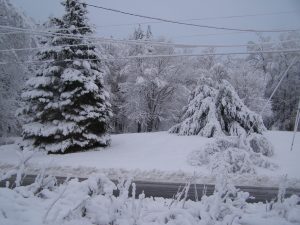
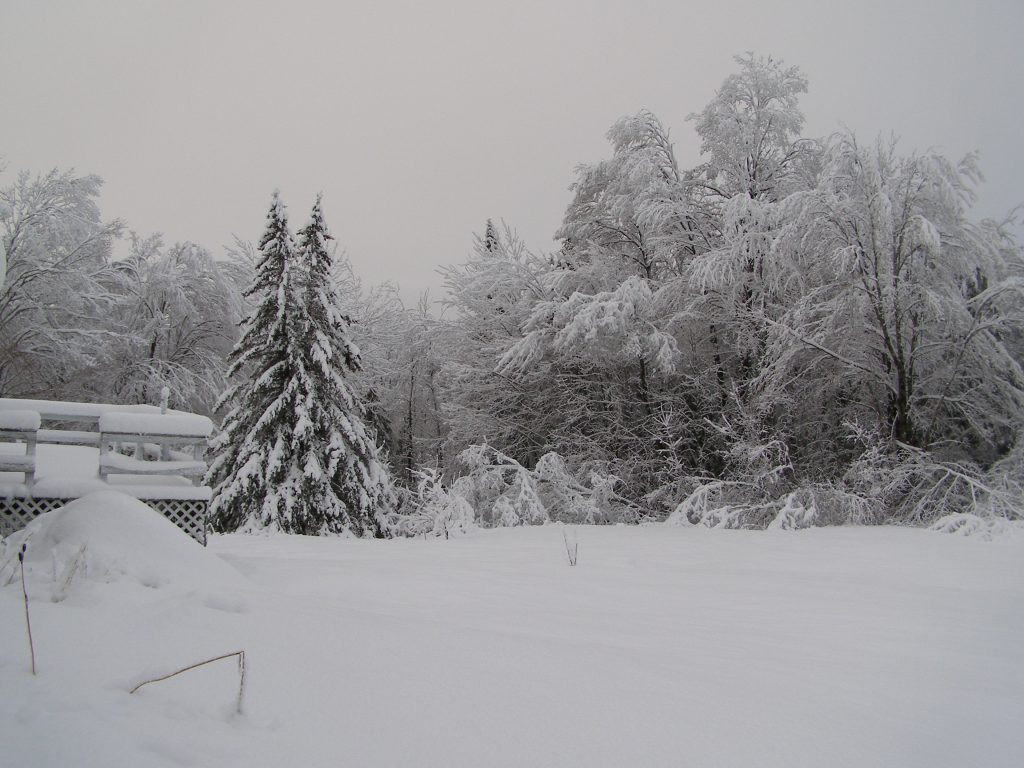
Fourteen inches of heavy snow had fallen, and it was still snowing, though lazily. We went from window to window, seeing trees split, snapped and torn in every direction. Several had fallen across our pond. Our favorite swamp maple, every year the earliest to turn and the most intensely colored, had split down through the trunk, each heavy branch peeling away like a banana peel until it rested on the ground. Shrubs, branches and wires hung flat and low, bowed with the terrible weight of the clinging snow. Many trees were broken but still clasped in the arms of their neighbors.
My partner called the power company on his cell and got a recorded message saying the estimated time of power returning was 11:15 p.m. the day before! Not encouraging.
We spent most of the day in the living room, near the wood stove, each with a blanket and a book. Clouds surged across the sky, bringing periods of heavy snow interspersed with lighter showers. Plows and sand trucks went by, but we saw no tree service or power trucks. We boiled water on the wood stove for tea, scrambled eggs, heated soup, fed the fire. I felt thick-headed and wretched — too much crying, too much devastation, too little sleep. We had no power; no Internet; no more than a trickle of water, inadequate to flush the toilet. Our cell phones were not fully charged.
I felt utterly cut off and isolated, and too tired to make any sensible plans to help myself.
Before it was fully dark, I went to bed, lit a candle, and reread Rosamunde Pilcher, the most comforting author I know. After blowing out the candle, I lay absorbing the quiet. The storm was over. The injured, dead and dying trees were silent, now beginning the long work of rotting or healing. I knew we had months of work in front of us, too, with chainsaw, hatchet, splitter and wheelbarrow. We will not need to buy firewood this summer.
I turned onto my side and fell into a dark well of sleep.
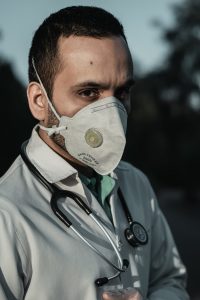
We’re seeing people masked on the streets, in the stores and in workplaces. At the same time, I’m noticing how effectively coronavirus has stripped away the pseudo self of so many people.
Photo by Chris Barbalis on Unsplash
Masks on. Masks off.
Pseudo self is a survival mask, often developed in childhood from the feeling that who we really are is unlovable. Some people create a false persona for power and control. Think of the wolf pretending to be Little Red Riding Hood’s grandmother.
We all have a pseudo self to some degree. Most of us can deal with difficult family members, coworkers and others with a modicum of manners, tolerance and kindness most of the time. We can cooperate and collaborate when required. We can be professional. Hopefully, we also know how to be real with those we trust and love; how to be angry, how to be sad, how to let off steam.
The difficulty with pseudo self occurs when we lose touch with who we really are and our mask becomes permanent rather than something we choose to take off and put on. Creating a pseudo self and retreating behind it permanently means we’re never properly seen, never properly known, never properly connected.
Masks on. Masks off.
Coronavirus is stripping away pseudo selves and revealing the truth of who we are, how we operate, what our hidden agendas and priorities are, our paranoia, our fear, our anxiety and compulsivity, our rage, our unfinished business and our relationships with money and authority. We are distracted and distressed, and our nice, shiny, well-behaved and civilized pseudo selves are slipping, even as we don masks.
Photo by Emma Backer on Unsplash
This reveal is fascinating, and it’s everywhere, in our homes and workplaces, in our communities and on social media and TV. Especially on TV. Blame games. Competition rather than cooperation. Gaslighting. Ignorance on display. Lies. Distortions. Conspiracy theories. Disinformation. Paranoia. Ill-concealed fear.
You just can’t fix stupid, and stupid is what I’m seeing behind quite a few pseudo selves.
Masks on. Masks off.
Our leaders seem to feel we’ve reached a Y in the road. Are we more interested in political power and the economy, or are we more interested in saving lives? Some turn one way. Some turn another way. Right now, that stark (and false) choice is not hidden behind distractions and polished bombast. It’s right out there in front of us in every update and news conference.
Are we a global people who cooperate to save lives, or are we separate, competitive political entities who try to outbid one another for inadequate resources? Are we human beings concerned with dignity, quality of life and compassion, or are we robotic consumers addicted to a bloated, unsustainable capitalistic system? Do we care more about the lives of those around us or our own entitlements?
Do we share power, or do we grab all we can get during this crisis?
Masks on. Masks off.
I wonder if we’ll ever fully be able to grasp the ways in which this pandemic will reshuffle our personal decks. What are we learning about our families, friends, neighbors, coworkers and leaders? What are we learning about ourselves, the ways we deal with stress and anxiety, our resilience and adaptability, our priorities and concerns? What are we learning about what really matters to us and to those around us?
How will enforced working from home and non-traditional education change the way businesses and education work when the pandemic is over? How much bigger will we individually become as so many of us learn we are not our work? Coronavirus is giving us a crash course in being rather than doing or having. How many will graduate from this experience with a stronger, more peaceful sense of self? How many will fail to graduate?
Unexpected, stressful times like these bring out the real in us. We can’t prepare for such times or see them coming. We can’t pretend our way through them. Our choices and beliefs are visible to others. We are revealed. We are seen. And so are they.
Masks on. Masks off.
Photo by Sam Burriss on Unsplash
The masks we wear for protection against the coronavirus conceal much of the lovely expression of the face. As I interact with masked people, I feel bereft and disconnected, unable to fully communicate and connect. I miss seeing the faces of my friends, colleagues and the strangers around me. Something about masks feels dehumanizing and isolating.
Still, I think this is another gift of coronavirus, this stripping away of all the nice-nice pretty-pretty pretense. I’ve always loved real, my own and the real of others. I suppose pseudo self has a useful place in a social context, but only a limited useful place. The ability to be authentic, to my mind, is far more useful and productive. Coronavirus is a great leveler. It doesn’t care about our clothes, our hair, our makeup, our bank account, our title or position, or our presentation in general. It doesn’t care about our politics or whether or not we believe it’s real. It doesn’t give a damn about the economy. All we are is a potential place in which to thrive and multiply. Our pseudo selves cannot shield us, hide us or help us survive this virus.
This pandemic is a fact. It’s real. It’s happening. Masks on or masks off, our authentic selves are showing. I see you, and you can see me.
Nice to know you. Be well. Stay safe. Raincheck on a hug or handshake.
My emotions are running free and fierce these days. There’s the tumult and chaos outside the small bubble of my life and my attic aerie, and at the same time there are singing threads of gold weaving through the much darker pattern of fear, uncertainty and loss. My gaze shifts from gold to darkness when I raise my eyes from my own step-by-step choices and routine.
Photo by NASA on Unsplash
I have a strange thought that coronavirus has brought with it many gifts.
I came across this article about nurturing creativity in our children, and enjoyed the metaphor of meeting the flame of creativity with a bucket of cold water or a breath of wind. Although the author here is talking specifically about children, it seems to me we’re witnessing a flowering of creativity from people of all ages on every side.
I’ve long insisted creativity belongs to everyone. Since the dawn of our species, we’ve been artists, makers, dancers, drummers and innovators of symbols in order to create language. One of the most destructive aspects of a rampant capitalistic culture is that we are discouraged from innovating for ourselves and encouraged to go out and buy something someone else (someone qualified to do so) has designed and produced. The cultural belief is if we can’t sell what we make for money, our creativity and innovation are worthless. Refer again to the article about writing’s “dirty secret” in one of my recent posts.
Most of us can’t possibly compete with the unlimited fame and resources of the rich and influential to advertise and promote our product, and we don’t try, under normal circumstances. We know who’s in charge. We know who has the powerful connections and the money. It’s not us.
Our present circumstances are not normal. I am delighted and awed to see, every day, hundreds (at least) of people are rediscovering or perhaps discovering for the first time their flexibility, their resilience, their creativity and their innovation.
Photo by Vladislav M on Unsplash
It’s notable for every article I find online about making DIY facemasks there’s an article saying they’re not good enough, they won’t work, and citing all the reasons why it’s either a bad idea or a pointless one. I have yet to see the “it’s not patriotic” spin, but doubtless it will come. Cold water on creativity, indeed.
I rejoice to see people are making facemasks anyway! Facemasks in layers. Facemasks with makeshift filters. Facemasks that can be washed and reused. Not facemasks as a magic bullet, but to help remind us not to touch our faces and to protect others from our droplets, since it appears many of us may be asymptomatic and infected.
After all, a non-commercial facemask isn’t going to make anything worse, and it might provide some protection for us and those around us, so why not? We do not currently have the personal protective equipment we need in this country to battle this pandemic. That’s a fact. Ask any doctor, technician or nurse in a hospital. At the hospital I work in we are strictly rationing masks and we haven’t admitted a single COVID-19 patient. Yet.
Photo by Dinh Pham on Unsplash
I observe with interest many of the innovators out there are not leaders (I use that term advisedly). They’re regular people, out of work, frightened, wondering what will happen next, trying to care for and protect their families and communities. They don’t have connections. They’re not rich or famous (or infamous). Just people. Marvelous, adaptable, curious, creative people are making masks, hand sanitizer, face shields, ventilators, etc., etc. Virtual concerts. Virtual birthday parties and get togethers. Hand written letters of appreciation and signs held up outside windows for quarantined loved ones. Birthday parades of neighborhood cars.
I had a boss once who was competent, intelligent, experienced and organized. I appreciated her in many ways. Then, one day, something tragic and sudden happened at work, and she did not know what to do. She was unable to take a leadership role. She fell apart right in front of me. There was nothing in our standard operating procedures, nothing in our binders and protocols, addressing the situation. She was undone because there were no guidelines and she was strictly a by-the-book person. She was not flexible or creative.
It so happened that the event that occurred was something I had a lot of experience with; a colleague and I took charge of the crisis so other lives would not be lost. It was a hideous few hours, but we contained the situation and dealt with it. It left us all deeply scarred.
I was reprimanded later for taking control, for not “staying in my place” as a subordinate, for daring to direct those ostensibly in charge during the crisis!
This reminded me of the value and power in being able to adjust, adapt, think on one’s feet, and throw away (at least temporarily) the rule book.
Sometimes our leaders are unable to lead. Sometimes the rule books give us no useful guidance.
Photo by Viktor Jakovlev on Unsplash
Sometimes we just have to proceed with our own experience and good sense and do the best we can, knowing others might actively discourage us from doing so!
But Frodo Baggins (unexpected hero and leader) does live, and he’s just a regular person like you and me. Sometimes we get no permission, no validation and no support for our innovation and creativity, because many people are better at throwing buckets of cold water around than they are at gently fanning the flame of an idea or plan.
Those who can only operate inside the box are naturally threatened and outraged by those of us who like to color outside the lines, but the ability and willingness to color outside the lines is what is going to get us through these times, as it got us through the World Wars, 911 and other terrible events. We are faced now with uncertainty, shortages, financial collapse and a crisis threatening such monoliths as public education and public health, not to mention our taken-for-granted personal freedoms.
Yet this tiny crowned virus is reminding us what it means to be human and encouraging us to reclaim powerful parts of our humanity. We are makers, creators. We were that a long, long time before we were consumers. We may be in the middle of personal and institutional financial collapse, but we can still make and create, and we are. We are. We are beautiful.
In 2018, I wrote about making offerings. This morning I looked at my list of possible topics for this week’s post, but realized none of them really grab me at the moment; I’ve been thinking again about making offerings.
Photo by Erik Mclean on Unsplash
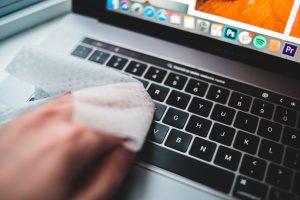
The reason offerings are in my mind is because I’m struggling, like so many of us, to find new routines and priorities without expiring from boredom, losing my mind, or allowing futility to paralyze me. It occurred to me, as I did my daily wipe down of our kitchen with bleach wipes while the bacon was cooking this morning, to think about what seems like endless disinfecting as an offering, or perhaps even a prayer, for my loved ones and for all of us on the planet.
As I go about my days, fear for my loved ones, near and far, dogs me. I know it’s not useful. I know watching what’s happening in Montana, Colorado and New York, as well as here in Maine, is not helping them. But what do we do with our love for others, near and far, during times like these?
I’m sure I’m not the only one who already feels that they never want to clean, wipe or disinfect anything ever again. I’m sure I’m not the only one marveling at how many thousands of things we touch a day (including ourselves) and feeling overwhelmed with trying to avoid this tiny, invisible, persistent, deadly virus.
While I cleaned the counters with the smell of bleach in my nose, while I rubbed away at the fridge, the freezer, the washing machine, the microwave, the toaster oven, the coffeepot and the teakettle, I imagined millions of people all over the world at home, at work, in hospitals, in businesses, doing the same thing, day after day. I imagined all those people with fearful and heavy hearts for their loved ones, doing their best, taking whatever steps they can for themselves and those around them, day after day.
Later, after breakfast, I disinfected surfaces in the bathroom, another new daily chore. Then I came up to my attic aerie and here, too, I will wipe down every surface I can with bleach wipes before I go to work.
Photo by Nathan Dumlao on Unsplash
At work, though only staff have used the pool for the last couple of weeks, I will don gloves and pitch in to do our daily disinfecting of chairs, benches, handles and knobs, light switches, soap and hand sanitizer dispensers, keyboards, telephones, counters, desks, chairs, fans, remote controls, pens, handicapped door buttons . . . We did that yesterday. We’ll do it today. It will be done tomorrow.
Is there any point? Is it helping? Will it keep us and those around us well?
So many questions, and no answers.
I know some people can shrug and say whatever will be will be. I recognize the truth in that, but I can’t not try. I must do what I can, even with no guarantee it’s useful, even without support from others (emotional labor, anyone?), even though I myself sometimes wonder why I’m working so hard. It’s simply what I can do.
And I’m not alone. There are people in Montana, New York and Colorado, people just like me, perhaps with loved ones in Maine (!), who are making their best effort, dogged, determined, and putting one foot in front of another. Or perhaps I should say disinfecting one thing after another, washing their hands, and social distancing. They undoubtedly are asking the same questions: Is there any point? Is it helping? Will it keep us and those around us well?
So, today, as my choice is to once again disinfect surfaces here at home and this afternoon at work, wash my hands over and over again, and social distance from my partner, my friends, my colleagues and strangers, I’m allowing myself to dwell on my loved ones as I disinfect and wash and distance, to remember their faces; to pray for their safety and health; to love them as hard as I want to; to cry, even.
Photo by Ashkan Forouzani on Unsplash
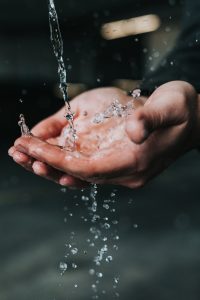
Perhaps in the moment I’m washing my hands in Maine someone in Montana is washing hers, thereby sparing my asthmatic adult son. Perhaps in the moment I’m social distancing in the line in the grocery store, another person is staying six feet away from someone I love in Colorado.
Let my fear be an offering, and my tears. Let my work be an offering. Let my chapped hands and the smell of bleach and disinfectant be an offering. Let my love, my reverence for the cycles of life and death, my faith and my hope be an offering. Let my self-care be an offering. Let my willingness to do whatever it takes be an offering.
Websites store cookies to enhance functionality and personalise your experience. You can manage your preferences, but blocking some cookies may impact site performance and services.
Essential cookies enable basic functions and are necessary for the proper function of the website.
Name
Description
Duration
Cookie Preferences
This cookie is used to store the user's cookie consent preferences.
30 days
These cookies are needed for adding comments on this website.
Name
Description
Duration
comment_author
Used to track the user across multiple sessions.
Session
comment_author_email
Used to track the user across multiple sessions.
Session
comment_author_url
Used to track the user across multiple sessions.
Session
Statistics cookies collect information anonymously. This information helps us understand how visitors use our website.
Google Analytics is a powerful tool that tracks and analyzes website traffic for informed marketing decisions.
ID used to identify users for 24 hours after last activity
24 hours
_gat
Used to monitor number of Google Analytics server requests when using Google Tag Manager
1 minute
_gac_
Contains information related to marketing campaigns of the user. These are shared with Google AdWords / Google Ads when the Google Ads and Google Analytics accounts are linked together.
90 days
__utma
ID used to identify users and sessions
2 years after last activity
__utmt
Used to monitor number of Google Analytics server requests
10 minutes
__utmb
Used to distinguish new sessions and visits. This cookie is set when the GA.js javascript library is loaded and there is no existing __utmb cookie. The cookie is updated every time data is sent to the Google Analytics server.
30 minutes after last activity
__utmc
Used only with old Urchin versions of Google Analytics and not with GA.js. Was used to distinguish between new sessions and visits at the end of a session.
End of session (browser)
__utmz
Contains information about the traffic source or campaign that directed user to the website. The cookie is set when the GA.js javascript is loaded and updated when data is sent to the Google Anaytics server
6 months after last activity
__utmv
Contains custom information set by the web developer via the _setCustomVar method in Google Analytics. This cookie is updated every time new data is sent to the Google Analytics server.
2 years after last activity
__utmx
Used to determine whether a user is included in an A / B or Multivariate test.
18 months
_ga
ID used to identify users
2 years
_gali
Used by Google Analytics to determine which links on a page are being clicked