by Jenny Rose | Mar 16, 2017 | Connection & Community, Emotional Intelligence, Shadows

Photo by Ian Espinosa on Unsplash
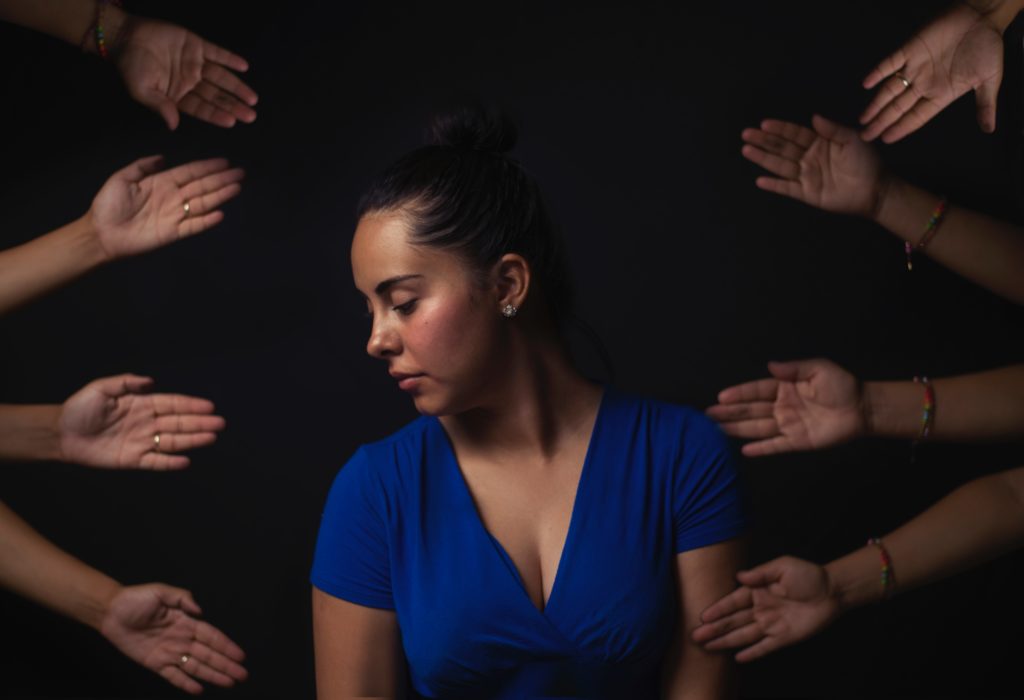
Projection is a defense mechanism used to displace the responsibility of one’s negative and unacknowledged feelings, behavior, beliefs and choices by attributing them to someone else.
The goal of projection is to create a distraction that helps avoid ownership and accountability. The victim becomes the focus, and is manipulated into taking responsibility for the abuser’s behavior, beliefs and feelings.
For example, an obviously angry parent confronts and accuses their child of hating them. The child, in fact, loves the parent, feels disliked by the parent, and walks away feeling ashamed and guilty for hating their parent, even though that’s not their feeling. For the moment, the parent has successfully displaced their own self-hatred onto the child.
Another example is a friend talking to another friend about her experience of a chaotic yet transformative life event that’s picked her up and set her down in a different place. The speaker is accused of being negative and making her friend feel stressed and upset, in spite of the speaker’s attempts to be clear about the exhilaration and joy of her experience. The speaker walks away with her friend’s displaced inability to deal with change and loss of control, her own joy forgotten.
Projection is a common defense mechanism, and most of us use it to one degree or another. It’s not necessarily a Big Evil. On the other hand, projection can be a subtle and cruel blame-shifting game of power-over, and some people who employ this tactic intend to win at any cost. Their victim and the world at large are blamed for everything that’s wrong or feels bad. The projector is an innocent victim of the machinations and manipulations of others, the general unfairness of the world, and bad luck.
People who use projection as a weapon can have a devastating effect in our lives, but I’ve been even more devastated by my own use of projection, and this is a skill the culture has actively and systematically taught me to perfect.
I’ve been brainwashed since I was a child to believe all people share my desire for peace, compassion, and cooperation. I’ve been led to believe all others share my empathy, my thirst to learn and grow and my priorities for healthy connection. I’ve been taught the Golden Rule, the application of which ensures being treated with love and kindness. We treat people the way we want to be treated, and voila!
Furthermore, as a female, it’s my responsibility to be a representative of all these values. If I fail to exemplify peace, empathy, loyalty and kindness towards others, I fail to be a good daughter, wife, lover, friend, mother and woman.
It’s also my job to be the keeper and carrier of feelings the people around me don’t want to deal with. It’s what I’m for.
No one ever suggested to me how dangerous it is to project my own value system onto another person, and I only just discovered this for myself recently. As it gradually dawned on me, I struggled for a time to find an alternative way to look at the people around me. If I don’t approach others with all my naïve projections, then what? I don’t want to assume everyone is destructive and dangerous, either!

Photo by rawpixel.com on Unsplash
Then it occurred to me our approach to strangers (or even those we think we know) needn’t be either/or, friend or foe. A stranger is a stranger. An unknown. It’s not necessary or useful to project anything onto a stranger. The Golden Rule still applies and I conduct myself authentically and respectfully and pay attention as I interact with an unknown person. I’m learning not to manufacture stories, make assumptions or project. I inquire, listen, watch and take responsibility for my own feelings and behavior.
Projection is a complex technique and can be very hard to see when it’s lurking under the bed. However, in this house we’re skilled at pulling all sorts of monsters out from under the bed (metaphorically, of course) and letting the cat sniff at them. Once identified, projection is perfectly manageable.
Projection, like gaslighting and mice, leaves tell-tale signs.
- Any conversation about a challenging issue (money, parenting, fidelity, keeping one’s word, the nature of the relationship, why you got hit) winds up being about why it’s all your fault.
- You’re accused of something (a feeling, lying, cheating, stealing, being demanding, interrupting) that’s not true.
- In spite of your best efforts, communication isn’t successful. You can’t get your point of view heard and you feel chronically disempowered.
- After an interaction, you feel ashamed and guilty.
- No matter what you do, you seem to be continually hurting someone you care about.
- You don’t experience reciprocity; the more loyalty, understanding, empathy, love, gratitude and forgiveness you extend, the more drained and alone you feel.
- You feel like a disappointment, a failure and a burden.
- You’re always bleeding; you had no idea what a terrible person you are.
- You feel manipulated, used, disliked, and angry, which increases your guilt and shame.
- You feel confused, baffled and bewildered. Every time you turn around you seem to get sucker punched, literally or figuratively.
- You don’t feel safe.
- Your trust is damaged.
- Your boundaries are chronically violated.
- Your priorities, feelings and values are disregarded, if not brutalized.
- Your needs are not met.

Photo by Volkan Olmez on Unsplash
Abusers and personality disordered people who employ projection invariably give themselves away, right in plain sight, because at some point they project onto others something so bizarre the victim and/or onlookers have an Aha! moment and recognize the manipulation. For example, someone with sexual boundary issues accuses someone else of an assault that never happened. A thief projects stealing onto someone with scrupulous integrity. A liar accuses an obviously honest person of lying. A rageholic accuses everyone else of being angry while they put their fist through a wall.
Another common projection is “You don’t care!” when in fact we care so much we feel terminally ill, and we still can’t make it work.
Shame and guilt have enormous isolating power. One of the best defenses against projection is to verify someone’s stated perception of you and your behavior. I had a boyfriend who accused me of “always interrupting.” I was crushed. It was a heated, angry accusation blowing up out of nowhere, and he’d never given me that feedback before. I’ve studied good communication techniques for a long time, and communication is something I care about doing well. Furthermore, I frequently had the experience that he interrupted me, but I tolerated it because I loved him.
My choice (after I stopped crying) was to ask other people in my life if they had this experience with me and get a reality check. I had a couple of close girlfriends whom I knew would tell me the truth. If it was true, I wanted to know so I could change that behavior.
They thought I was nuts. One of my best friends, who had years of experience of me in groups as well as one on one, said she appreciated the way I always held space for others to speak.
I didn’t cry anymore and I immediately dumped that projection. Not long after that the relationship also ended.
Another good defense against projection is to name the behavior and refuse the projection. There’s no need to fight, raise your voice, cry, argue, persuade, explain, justify or throw something. Those are all distractions from the fact that the abuser is employing a toxic tactic that’s about them, not you. Let them escalate — it’s their game. You’re don’t have to play.
“No. That’s not how I feel. That’s a projection.”
“No. That’s not what I did. That’s a projection.”
“No. That’s not what I said. That’s a projection.”
Stand your ground, look them in the eye and refuse to get distracted from their behavior, no matter how juicy the bait they dangle. Hang up, disconnect, block, delete, walk away, disengage. If you can’t get away from them, repeat a simple statement like the ones above as many times as you need to.
Projection can be abusive and toxic. It’s essential that we recognize it, both when we employ it and when others use it against us. Good boundaries go a long way to disabling projection, and so does the work of authenticity. We can’t control the behavior of others, but we can learn to recognize and excavate our own projections and take responsibility for our choices and feelings, which makes us far less vulnerable to this tactic.
All content on this site ©2017
Jennifer Rose
except where otherwise noted
by Jenny Rose | Dec 15, 2016 | Connection & Community, Emotional Intelligence
Last week, my partner and I went to the movies and saw Arrival. Without giving any spoilers, I found it a stunning story about communication, among other things. It was the communication piece that really grabbed my attention, though.

Photo by Jason Rosewell on Unsplash
Ever since then, I’ve been thinking in a newly focused and intentional way about communication — what it means, how it looks, where it breaks down and how to do it well.
The truth is, I don’t want to know how to do it well. I want to know how to do it perfectly.
Another truth is I’m always thinking about communication, because I’m always working on my book, on this blog or on relationships, and they all involve communication. My partner says there is no relationship without communication, and I think he’s right.
As regular readers know I am wont to do, I pulled out my Random House Collegiate Dictionary to give myself a starting place. Anyone who’s used a dictionary knows there are often multiple meanings for any given word, so I made a list of the definitions I liked, cut and pasted a little, and came up with this (emphasis is mine):
Communication:
- To give or interchange information to/with one another.
- To express one’s true thoughts, feelings and moods easily.
- To have or form a connecting passage.
Although I’m intellectually satisfied with this definition, it feels incomplete and inadequate. In fact, it makes me mad. If only effective communication was this easy and simple! Instead, it seems to be one of the most desperately difficult things we do, and we must communicate if we are to manage life in today’s world.

Photo by Bewakoof.com Official on Unsplash
How many ways does communication break down for us in a day? Are we even aware of all the ways it breaks down? How often are we communicating something completely unintentional?
At the same time, have we ever, in the history of humankind, had so many devices and forms of communication at our disposal? Have we ever had access to so much information and so many other people?
So why aren’t we happier, more authentic, more secure and sure of our worth? Why are so many of us starving for healthy, fulfilling connection? What’s missing?
If I knew, I would fix it in my relationships, but therein lies one of the problems.
This is the part that always sneaks up and bites me in the ass.

Photo by Toa Heftiba on Unsplash
Not everyone wants the level and quality of communication I do. Generally, I don’t take this cold little fact personally, but among my nearest and dearest it does feel personal, absolutely. I feel utterly and completely rejected and shut out, in fact.
Another problem is that not everyone is capable of the level and quality of communication I am. Many people carry terrible damage or experience disability that prevents them from being able to participate in touch, in sex, in eye contact and nonverbal cues, even in conversation. I can tell you from personal experience it can be very, very difficult to sort out those who want to and are unable to from those who simply don’t want to. In the end, it doesn’t matter, it all comes to the same thing. When communication is limited, relationship is limited.
Limitation frustrates me, whether it’s my own or imposed by others. I can do more. I want to do more.
A third issue is that communication is two-edged. It’s an enormously powerful skill and ability, both constructively and destructively. We all know people who use communication as a weapon, not a tool. Sometimes, a simple, ominous clearing of the throat can be far more terrifying and damaging than a blow. Both actions are communication. Even worse are people who deploy words saying one thing and demonstrate action that says another, like the abuser who says he loves you while he hits you. This is called gaslighting, and I’ll write about it in the future. It needs a post all its own.
A fourth point is we don’t have enough silence in the world. Silence is the cup that holds communication. It takes time to write, to create, to speak, to hug, to make love, to nurse an infant. It takes time to nurture a friendship, a lover, a child. Sitting with the ill or dying takes time and quiet. Listening takes time and presence. Our slavery to technology and stimulation has all but eliminated uninterrupted time for our relationships with ourselves, let alone with others.
And that brings up a fifth aspect. If we don’t, won’t or can’t communicate effectively and honestly about who we are, what we need and want and the truth of our thoughts and feelings, we can’t form a connecting passage, to quote the above definition. We’re not even connected to ourselves.
As though all those things didn’t make communication a big enough hairball, we have to remember who we are. We’re human, which is to say each one of us carries stories, beliefs, expectations, memories, scars and bleeding wounds that get in our way every time we communicate, even with (especially with) those we care deeply about. We all have painful triggers. We all get hijacked. We make assumptions. We misunderstand, deny, obfuscate, conceal. We filter through our particular history and experience. Few of us have any training in effective communication. We can tweet or text a sentence or two, but ask us to do more and we’re at a loss. For one thing, we don’t have time to deal with it.
We also have rules about communication, individual rules, tribal rules, cultural rules. We have rules about acceptable language, rules about keeping secrets, rules about being indirect, rules about protecting others, rules about loyalty and duty, rules about privacy, rules about what we’re willing to reveal to whom, rules about who we trust and don’t.
Even the words we choose can make or break communication. Here’s an example out of my own life I’m feeling particularly resentful about at the moment.
I’m a woman, a partner, a sister, a daughter and a mother. I love wholeheartedly and I’m very clear about how important healthy relationship is to me. I know the people I love well, and I try hard to accommodate their personalities, preferences and idiosyncrasies. I’m not Miss Fixit. I’ve no investment in protecting people, and the four men in the world who I love most are unbelievably capable and intelligent adults.
When I say, “What can I do to help? “Is there anything I can do to help?” or “Is there anything I can do for you today?” I’m not implying they can’t manage their lives, dammit! I’m giving a message of love. I’m saying, “I’m here. You matter to me. I’m glad to lend you support. I’d love to collaborate/cooperate/work with you.” I’m making a connection. I’m giving what I most want. Catch me being insulted if someone asks if they can help me figure out how to run the errands, take care of work and cook a meal!
My male partner says, with great patience, that I should use the word “assist” instead of help.
Seriously???? These four idiot men, who know me better than anyone else, need me to tippy-toe with my language in order to hear a message of love and support?
Never mind. I’m over it. Figure out your own damn life, and I’ll figure out mine.
Furthermore, catch me allowing any of them to help me, even though I know that’s connecting for them. They don’t need anything from me, I don’t need anything from them.
See how that breaks down?
And half of that is about me. I’ve been taught to be indirect in my language, I’m giving others what I want myself (this never works well, because the recipient rarely understands that’s what I’m doing), I’m coming across as relentlessly mumsy-wumsy and overprotective, and I’m assuming these four men are like me and won’t ask for help if they need it, but I’m the one who can’t ask for help, and now I’ve fastened myself more firmly in that position because they won’t cooperate with me and allow me to love them, so I’m not going to give them the satisfaction of…
And so on.
My conclusion about all this is that communication among human beings is a clusterfuck. It’s confusing. It’s messy. Most of us don’t know what the hell we’re doing and many of us are not that well intentioned in the first place. We have wildly varying degrees of ability with wildly varying aspects of communication. We try to hide, we misunderstand, we make mistakes, we don’t remember accurately and we’re often terrible at listening. We want to be right, we want to be validated and agreed with, and we want others to meet our needs quickly and perfectly so life feels simple and uncluttered, emotionally, at least.
I’m never going to do it perfectly, and neither is anyone else.
But hey, let me know if I can help you in any way!

Photo by Quino Al on Unsplash
All content on this site ©2016
Jennifer Rose
except where otherwise noted
by Jenny Rose | Nov 17, 2016 | Connection & Community, Emotional Intelligence
I haven’t enjoyed this week much. It reminds me of the week after 09/11, when I thought I would drown in the hate and despair around me.

Photo by Quino Al on Unsplash
I’m not on Facebook, but my partner is and I hear more than I want to about what’s going on there. I’m developing a pathological hatred of the news in any form, even as I obsessively read the Internet. I think about friends, family, acquaintances and a world full of frightening strangers with the power, strength and willingness to hurt others, including me.
I work at home as a medical transcriptionist, a fact I don’t talk about much because I respect the privacy laws in this country around medical information. My book of business is presently in Illinois, but I’ve also worked extensively in New York, Ohio and Alabama. I spend twenty-four hours a week typing dictated stories about strangers, a significant number of them experiencing physical and emotional pain and suffering from the current situation.
Here in central rural Maine, Native Americans in our community are victims of increasing hate crimes. Their people have been in this place for thousands of years.

Photo by Sue Tucker on Unsplash
It seems to me in the last week we’ve put on the table an infinite number of ways in which to divide ourselves from one another; an infinite number of ways to express hate, intolerance and blame; an infinite number of labels to weigh ourselves and others down with. None of it feels useful
I want to find ways to support what I believe in and reach out to other people. I want to do something, no matter how small, to make a difference in this, but I’m noticing something interesting about that. As soon as I communicate about some kind of action I’ve taken, someone cuts me down. I’ve been told wearing a safety pin is patronizing and indicates privilege; I’m not welcome in America; I’m going to burn in hell; and I’ve joined a hate organization (that would be MoveOn.org).
Maybe no one out there needs support, or wants to make a contribution to unity and respect, but I don’t really believe that. At any rate, I need support and I do want to make a contribution, so here are some thoughts about what would help me.
Here’s a graphic to contemplate as we go on:
Enough with the labels. We have to stop this. One thousand labels can’t define the complex creature a human being is. I maintain that what’s happening now is NOT about race, gender, religion, politics, immigration or socioeconomics. What’s happening now is about power — how we define it and understand it, how we use it and what we’ll do to gain it or overthrow it. I think the most important question to ask ourselves is if we support power-over others or power-with others. That’s really the bottom line. It’s at the heart of all the disagreements. The rest is just inflammatory and dangerous distraction.
Enough with the apocalyptic stories and predictions. The fact is nobody knows what’s going to happen now. We’re in uncharted territory politically, economically, socially and environmentally. Many people think that’s a good thing. Sure, it’s scary. The unknown always is. On the other hand, politics as usual wasn’t working very well for most of us in this country and change is an inevitable part of life. Blessing or disaster, the point is none of us know the future and we’ll all have to deal with whatever happens as best we can. Terrifying ourselves and one another with dire predictions, threats and stories won’t help anyone. Fear is terribly contagious and terribly ineffective in decision making, but it’s a useful tool for manipulation.
The best defense against fear and misinformation is to do our own research. All the people in the headlines right now are real people. They have lives, histories, Wiki pages, on-line organizations, quotes and podcasts. We can read about them. We can look at quality news organizations in other countries and what they’re reporting for a contrast to domestic news. Discerning between fact and opinion is important. We need to take responsibility for our opinions and beliefs.
It’s time to stop worrying about everyone else and clean up our own acts. Are our words and actions congruent? What do we believe, and why? What are our priorities? What kind of outcomes do we want for ourselves and our communities, however we define community?
We can’t change other people; attempts at doing so merely divide us more deeply. We must accept that not everyone agrees with us and stop wasting time in destructive argument. We don’t have to shoot one another in the head and throw scorn at those who disagree with us. We can use our energy to work for what we believe in and allow others to do the same.

Photo by tom coe on Unsplash
We don’t have to accept an invitation to fight. We can find communities in which respectful conversation and debate take place if we want to discuss an issue. Many of us don’t feel safe verbalizing, revealing or defending our views, but everyone can vote with their presence. If we’re uncomfortable or scared in a conversation, we can leave it. We can’t stop hatred, but we don’t have to be a part of it.
We can learn to express our thoughts, feelings and opinions in a way that allows others respect and dignity. We can learn to listen. We may disagree with people, but that doesn’t mean they have nothing important to say.
We need to root out sweeping generalizations. All white people are not living a life of economic privilege! All patriots are not Christians! All Muslims are not terrorists! All blacks are not criminals! All Latinos are not undocumented immigrants! All men are not rapists! All gay people are not child molesters! All Christians are not militants! First graders think in these black and white ways, not adults. We shackle each other with these assumptions.
There’s a lot of talk about privilege right now. It’s a slippery term, and I think the perception of privilege is really in the eye of the beholder. Here’s a very interesting self-test you can take. Some of the questions will help you appreciate the difficulties many people face. In case any one wonders, my score was a 44 — NOT privileged, according to this tool. Certainly very privileged in comparison to some people.
Going on from here. My daily crime.
All content on this site ©2016
Jennifer Rose
except where otherwise noted
by Jenny Rose | Oct 20, 2016 | Connection & Community, Emotional Intelligence
Last week I talked about balance as a first step to understanding reciprocity. This week I’ll refine my focus and discuss the term itself.
A few years ago I was in my car, either listening to an audio book or the radio. I was in the off phase of a painful and confusing on and off relationship. Whoever I was listening to asked the question: “Is he crying about you?”
Photo by Ian Espinosa on Unsplash
This was a real Aha! moment for me, because I myself was crying all the time and the answer to the question was no. I didn’t even need to think about it. I’d given him all the power. He was calling the shots. I wanted to be with him but he didn’t want to be with me — at least for the moment.
That was my first introduction to reciprocity. It didn’t come with context, language or tools, but that question was like a piece of grit in my eye and it continues to pop up in all my relationships.
Before we discuss it further, let’s define reciprocity. A 3-second internet search yields: “Exchanging things with others for mutual benefit.” Good enough.
What I understand now is that reciprocity is at the core of healthy connection and relationship. Whether we’re conscious of it or not, it matters. I see the presence of reciprocity as an indicator of equality. No one has power over anyone else. The playing field is level. Giving and receiving happen in balance. We see the needs of others as being as important as our own. Reciprocity is the old Golden Rule in action.

Photo by Alona Kraft on Unsplash
It sounds so easy. In fact, it is easy. A reciprocal relationship is a delight. Trust and respect are present. Drama and trauma are absent. Both parties show up with an intention to create healthy connection. Communication is loving, respectful and honest. Both parties take responsibility for their words, actions and choices. When we walk away from a reciprocal interaction we feel valued, understood, respected and connected — and so does the other party.
Reciprocity in relationships cannot be achieved if both parties are not internally balanced, which is why I started with balance last week. This is like boundaries. If we can’t manage our own boundaries within ourselves, we won’t have effective boundaries with others. If we don’t function well enough to self-care, make choices that reflect our priorities, and control our time and energy in a balanced way, we can’t create healthy, reciprocal relationships.
“Exchanging things with others” is not limited to concrete things. In fact, a commercial exchange doesn’t imply reciprocity at all. Reciprocal exchange means he heats water for my tea while I’m in the shower and I dry his socks in the dryer instead of on the line because he likes them soft. Reciprocity implies an equal but not necessarily identical contribution of time, energy, expression and caring. In many ways, it’s a subtle kind of dance. It’s a gift of ourselves to others.
Reciprocity is flexible, affectionate, creative, curious and cooperative. Reciprocity says: “What can I do? What do you need? What would be useful? What would create connection? Reciprocity requires we allow ourselves to be seen and we’re open to receiving as well as giving. It requires communication about what we want and what we can give.

Photo by Kevin Quezada on Unsplash
Sadly, I think many people have never experienced a truly reciprocal relationship with a human being, although many of us have with animals. If that’s true of you, then there’s an important question to explore.
Is it you or is it them?
What’s been true for me is that it’s both. I’ve only lately begun to truly self-care and develop a sense of being valuable in the world. Most of my life has been defined by my sense of failure. What this means is that I’ve been a people pleaser, which is to say inauthentic and without good boundaries and balance. Naturally, that created problems, as well as attracting all kinds of people into my life who were also dysfunctional.
I have no power to change the behavior of others, but I can certainly learn and grow myself. Having language and context for aspects of relationship is enormously helpful. Being able to ask the question “Is he/she crying about me?” forces me to take a wider view and keep an eye on reciprocity. It empowers me.
It’s a great mistake to assume everyone wants reciprocity. I always forget that piece. I can’t quite get my head around the fact that some folks have no desire to be in a relationship like this, but I know it to be true. I can’t explore that effectively, having a great longing for it myself, so I’ll leave that aspect alone, except to note it’s not effective to make up stories or have expectations and assumptions about another’s desire or intention in this arena. Reciprocity doesn’t exist without mutual consent and a willingness to share power. The good news is after you run into the absence of reciprocity (for whatever reason) enough times, you stop trying to force it.
It’s also worth noting there are many different forms of relationship, and lack of reciprocity doesn’t mean there’s no value in the connection. Not at all. The quality of our relationships declare and define themselves pretty quickly, it’s just that sometimes we’re so focused on our determination that things be a certain way, we don’t pause to consider what is actually present — and what is not. Denial is a powerful thing, and we can stay stuck in it for years.
Reciprocity is a high standard. If you decide you want it, many possible relationships will be disqualified in the early stages. On the other hand, if you accept nothing less than reciprocity in close relationships, the ones you do find will be joyful and vibrant, and you won’t have to cry alone in the first place, let alone wonder if your partner is, too.
(This is the second post in a series on reciprocity. See also Parts 1, 3, and 4.)

Photo by Evan Kirby on Unsplash
All content on this site ©2016
Jennifer Rose
except where otherwise noted
by Jenny Rose | Aug 25, 2016 | Power
Last month I posted about our power and ability to say both yes and no to others. This morning I’m thinking about another level of yes and no; that is the yes and no we say to life. At this level, the term ‘consent’ is useful. Consent means to “give permission for something to happen,” according to a 2-second search on Google.
Consent is a huge and complex topic and there’s a great deal of discussion about different aspects of it. For the purposes of this post, I’m using consent in the widest sense; the way in which we approach life.
Several interactions this week have made me think about the mysterious difference between people who consent to learn and grow and those who don’t. When I think about my observations, and people I’ve known, it’s clear to me the difference between these two kinds of people has nothing to do with age, sex, money, education, employment, intellect or family. It has nothing to do with the color of our skin or the god(s) we worship, or where on the planet we live, or what kind of horrors we might have endured.
I’m acquainted with a writer who sent me a piece in praise of stubbornness, a quality she admires (as do I) in herself and others because to her it means a determination to survive and do well, regardless of limitations, real and perceived. (Thank you, A!) We might mean the same thing by consent and stubbornness, or close to it. I see the ability to consent to learning and growth, over and over, no matter how many times we’re knocked down and cut off, as a kind of stubbornness — a refusal to give up, to close down, to conform to something that doesn’t work for us.
Without even trying I can identify seven people in my life, past and present, who don’t consent to the experience of life, the flow, the dance, the mystery and uncertainty, the synchronicity and the billions of invitations that arise for exploration, connection, understanding, growing and being.

Photo by Alex Iby on Unsplash
These folks are easy to spot. They resist. They argue with what is. They deny, distract, fall into various addictions. They don’t communicate effectively. They care about winning, being right and power-over. They have rigid stories and expectations. Everything that happens to them is a personal insult or a crisis. They’re victims. A good, deep question is a grave threat. To my eyes, they look miserably unhappy. They repeat the same patterns, over and over, dying a little more with each fruitless repetition. They do not consent. They refuse.

Photo by Cristian Newman on Unsplash
Every single one of the seven people I’m thinking of has had opportunities to learn, to grow, to change, to make different choices. They all had people in their lives who loved them and had information, tools and skills that might have enriched them. They all had people in their lives who valued them and wanted their contribution. They each had at least one person in their life who would have done anything to support them in learning and growing, and that person was me.
Most of those relationships are behind me now, because I have this unforgiveable quality of consent. My life now is based on the why, the what if, the whose rule is that, the help me understand. My life is about teach me, show me, share with me and what do you think? My life is about doing more of what works and letting the rest go. People who refuse and people who consent invariably have friction, because their needs are opposite. There’s just nowhere meaningful to go.
People who consent are not perfect or perfectly happy people. On the contrary, their lives have been filled with mess and miscalculations, abuse, addictions and other painful experiences, but they’ve learned from everything and everyone. People who consent don’t look at their lives with bitterness or frame things as mistakes. They see teachers, opportunities and fascinating things learned and yet to learn. People who consent are endlessly curious. They think about what they don’t know and question what they think they do know. They seek the hidden thing. They’re more likely to ask questions than proselytize or lay down the law. They’re not interested in power games or being right or winning. They seek to understand, to explore, to exercise choice, to manage their own power. They can laugh at themselves. They can and do say no, but they say it to protect their integrity and needs, not to shut out or control life.
People who consent choose happiness. That’s the most important one for me. I’m still reaching for that. I’ve always been a person who consents, but I’ve also chosen to stay limited in many important ways. As I’ve learned to discern between refusal and consent, I see that living life from a state of consent results in joy. Again, it’s got nothing to do with age, beauty, money, status or any of the things that the culture says we’re defined by. Joy, at the end of the day, is a simple thing, arising out of being at peace with this wild ride we call life. Joy is consenting to surrender, consenting to feel and experience, consenting to feeling fear and doing it anyway, consenting to give up trying to control the things we can’t control. Joy is composed of tears, blood, loss and disappointment, pain and growth. We already have it. It’s here, sitting on your shoulder as you read this and mine as I write.
All we have to do is consent.
Photo by Evan Kirby on Unsplash
All content on this site ©2016
Jennifer Rose
except where otherwise noted