This post has been simmering in the back of my mind for some while. I’ve taken my time approaching it because it seems to be something of a landmine for some people.
Photo by Ester Marie Doysabas on Unsplash
In simplest terms, to be grateful is to be thankful.
It’s easy to be thankful for the things we enjoy and that make us happy. Thankfulness can also be a matter of routine or ritual, as in the case of saying grace before meals, or a display of good manners, like thanking a service person.
Those are the smiling, kindly faces of gratitude.
But gratitude can also wear the aspect of a hag, and then we’re in darker, grittier territory.
Part of the experience of life and relationship includes pain and trauma, there’s no getting around it. We all have a haunted cellar in our soul in which we have suffered. Sadly, many people live in that cellar, picking their scabs, reopening their wounds, and competing with others to win the Most Victimized and Best Haunted Cellar awards.
I’m not suggesting our feelings of disillusionment, pain, rage, fear, shame, betrayal and self-pity are wrong or inappropriate, nor am I victim blaming or shaming, taking some kind of high moral ground, or minimizing the tragic challenges and traumatic experiences we face in life.
Our inevitable wounds are not the point. The point is what we choose to do with them. Do we heal them or not?
It’s important to acknowledge some people don’t want to heal. Some find the payoff for chronic bleeding too seductive to want to stop it. I don’t understand this, but I know it’s so, and I respect that choice.
We can be a motionless victim or we can practice gratitude and allow it to sweep us forward. We can’t do both.
If we do want to heal, we have to give up blame. This is a big thing to let go of, and some will choose not to. Again, that’s a choice I can understand and respect. It’s also a dead end. If we insist on holding tight to our blame, we’ve cut ourselves off from the possibility of full healing. As long as we blame others or ourselves, we’re refusing to acknowledge our own responsibility and power.
Blame and responsibility are not the same thing. When I say responsibility, I don’t mean we’re necessarily responsible for our trauma. I mean our responsibility for how we handle it, and our responsibility for our feelings. Taking responsibility for our lives is empowering. Blame leads us into an endless loop of victimhood and/or self-hatred.
We can use addiction, compulsion, and other self-destructive behaviors to numb, distract, or forget our wounds, but none of those coping mechanisms help us reclaim our power.
Healing takes time and patience. Sometimes it takes years, or even decades. There is no shortcut around our feelings. We often need support. Healing can be a messy, exhausting, ugly, extremely vulnerable business.
Healing, like relationship, is a crucible, a dark womb in which we transform our wounds into scars. Gratitude is one of the agents of that transformation, but it can’t show up until we’ve begun to actively work through our feelings.
Photo by ivan Torres on Unsplash
Gratitude and forgiveness are often hand in hand. Note I did not say forgetfulness, but forgiveness. Scars are permanent reminders of our journey, but they need not be a matter of shame. We can choose to view them as medals of honor. We can choose to relate to others out of the empowerment and wisdom our scars represent rather than the wounds that caused them.
In every experience there is something to learn. We learn about ourselves. We learn about others. We learn about the way the world works. We learn about power. Learning makes us bigger, stronger, wiser, more effective, and more powerful in our lives. If what we learned is bitterness, we’re still blaming. We haven’t taken enough time, or found the right support, or finished the journey from wound to scar. Bitterness does not grow gratitude. It’s not empowering. It makes us small and shrivels our hearts.
We can’t control what other people do, but we can choose to see those who hurt us as teachers, learn the lesson, graduate, and be grateful. We can look back on the most uncomfortable experiences in our lives as the most meaningful and growthful.
Our culture encourages us to be dissatisfied with our lives as they are. We’re trained from childhood in longing and envy rather than in gratitude. The truth is if we can’t be thankful for what we have right now, this minute, we won’t be thankful for more money, a different body, a different job or house or car.
Thankfulness is acceptance of whatever our circumstances are in the now, even if they’re difficult and we need to change them. Especially if they’re difficult and we need to change them. If our lives aren’t working and we know it, we can be grateful for accepting what is (we’re miserable) and take advantage of the opportunity to learn to manage our power in such a way that we can make positive change. Misery is highly motivating.
So often we have an ideal in our heads, or a set of expectations, that keeps us reaching for more, or different. The practice of gratitude requires us to settle down and take a good long look at what we have, what we are, and where we are. What is there to learn? What can we be grateful for? Expectations are devoid of gratitude, because they don’t reflect reality.
Photo by Evan Kirby on Unsplash
Gratitude takes strength and courage, especially during dark times of pain, fear, and despair. It’s also one of the most powerful choices we can make. It leads us into the light. It comforts our raw feelings. It keeps us focused on joy, and the simple gifts in each day.
In seeking gratitude, we go deeper than we’ve gone before, far beyond the fact of our wounding. We reclaim our power, not over what happens to us, but how we use such events and circumstances to water and feed our best selves. To feel gratitude is to come fully into peaceful alignment with our lives, whatever they have been, whatever they are now, whatever they might be.
All right. I’m thoroughly exasperated by this “I refuse to live in fear” bullshit. Here’s an open letter to all those wannabe heroes out there.
Photo by Joshua Fuller on Unsplash
Fear is defined as “an unpleasant emotion caused by the belief that someone or something is dangerous, likely to cause pain, or a threat.” (Oxford Online Dictionary)
The ability to feel and recognize our fear is an enormous advantage, one we were evolved to experience. If our ancestors had been unable to feel and respond to fear, none of us would be alive today. The inability or unwillingness to listen to fear is a sure way to get deselected.
Yes, fear is an unpleasant feeling. Get over it. It helps us make choices that keep us alive. One of the best books out there on fear is Gavin de Becker’s The Gift of Fear. Another author who understands the importance of fear in survival and resilience is Laurence Gonzales. A list of his work is on my resources page.
Photo by Khoa Pham on Unsplash
Asserting that we refuse to be fearful is like saying we refuse to observe, learn, and use neurological information like “hot,” “cold,” “sharp,” and “pain.” Babies can do this, people!
Fear is pro-life and a rational response to a possible threat. Ignorance and denial are not. Responding appropriately to fear is a powerful life skill. It makes us tough. Willful ignorance and denial are weak and impotent,
I’ve written before about the OODA loop, an acronym for resilience that includes Observing the situation, Orienting oneself to the situation, Deciding how to respond and Acting. People with slow or broken OODA loops stand with their mouths agape watching tsunamis roll in, volcanoes erupt, shooters aiming at them and cars heading for them at speed, and they die.
Evolution in action.
Photo by Mar Newhall on Unsplash
“I refuse to live in fear” is pathetic nonsense. A more truthful statement would be “I refuse to be told what to do,” or, even better, “I’m shit scared and I don’t know how to deal with it.” Or how about “I’m afraid to face reality?” I suspect those are all closer to the truth. Denialism is not a successful life strategy, and neither is willful ignorance.
When I see people masking, I see resilience, adaptation, responsibility, a desire to mitigate the spread of coronavirus, and common kindness and courtesy for the most vulnerable among us. I see people learning and doing their best in a scary, difficult, rapidly changing situation. When I see unmasked people wearing pitying smiles or having toddler tantrums when asked to mask, I see a bunch of fearful pantywaist boneheads waiting for Darwin Awards.
You just can’t save people from themselves.
It’s hard to face reality. I get that. I’ve spent plenty of time in denial myself. The fact is, we can’t control life and death and the ebbing, flowing activity of viruses, which vastly outnumber us. There is no one to blame. Viruses do not conspire against us. We’re not that important. Learning curves are messy, and we can’t always get clear answers, nor do we “deserve” them. We are not the Kings of the Universe, above the natural laws that govern life. We are not entitled to be comfortable. Our needs, feelings and lives are not more important than anyone else’s, now or across the whole span of human history. Our beliefs don’t change what’s real.
Real life takes guts. I’m sorry if you don’t have them, but don’t pretend that’s courage. It’s not.
Nobody has asked me to live in fear, and I don’t, but I’m exceedingly grateful to live with the advantage of fear, because I’d like to go on living for a while. Fear is power, and I’m certainly strong enough to manage it. I’m also tough enough to deal with wearing a mask.
So go ahead. Refuse to “live in fear.” Throw tantrums. Be abusive. Display your ignorance on social media and elsewhere. Make the most of your contempt and outrage. Argue with what is. Increase the spread of coronavirus. I can’t stop you.
But you’re not a hero. Your cowardice is showing, and I’m embarrassed for you.
I’ve been rereading James Herriot, who was a Yorkshire veterinarian. It’s been a long time since I last read him. His books are filled with love, affection and humor for the animals and people he spent his life with, but there’s another thread running vividly through all his books, a thread of place. He loved Yorkshire, the hills, moors and Dales, the little towns, the seasons and remote old stone farms, walls and buildings. Every page communicates his gratitude and contentment with his life and the place he worked. He and his wife raised two children. He worked all hours, and it was hard work. He was qualified before antibiotics and what we think of as modern medicine. He made very little money, but he was rich in love and contentment.
Photo by Greg Ortega on Unsplash
Dr. Herriot knew how to live deeply. One of his greatest joys was to pull over during his rounds and sit in the heather with his dog, drinking in the air, the view and the silence.
As I’ve been reading Herriot, the Fourth of July holiday has come and gone. I’ve never liked it. I hate noise and crowds. Fireworks are terrifying for many animals, both domestic and wild. They’re also dangerous and a fire risk. My idea of a really good Fourth is a nice, drenching three-day rain during which I stay peacefully at home.
This year, in addition to the usual associations, we have a pandemic. Each of the holidays this summer seem to be dividing the country more and more painfully, and all the hype and noise around escalating infection rates, distortions, denials, lies, economic concerns and travel concerns made me feel particularly anxious and miserable this year.
My Be Still Now practice has developed nicely. I’ve done it every morning for more than a month and it’s become a useful and enjoyable habit. It occurred to me, as I was sitting over the holiday weekend, that during this time I have an experience of depth. As I breathe and watch my thoughts move across my consciousness like clouds across the sky, I sink down to another kind of being, below the sound of boats, campers and ATVs passing the house, below my agonized empathy for animals, below my fear of fire, and below my general anxiety about the pandemic.
Photo by Erik Stine on Unsplash
In the space of sitting, I move beyond and beneath clock, calendar, distraction, and compulsion. There is only the peace of breath, sun and rain, birdsong, wind, growing things, and the cycles and seasons of this place and my life. I feel peaceful and content. There’s nowhere I need to go and nothing I need to do. It’s all right here, right now.
We all have access to this deep life, but it seems the modern world conspires to keep us away from it. We are assaulted by so much noise, so much seductive glitter and shine, so much chaos and so many voices. Clocks, calendars and screens rule our lives, as do the numbers in our bank accounts and on our bills and credit cards. We are completely caught up in short-term, surface activity.
To live deep is to remember geologic time and rediscover patience and perspective. To live deep is to climb into the mossy throat of an old well, filled with sweet water that knows ferns and frogs and underground springs. Living deeply takes us to the roots of things, the quiet musk of earth, mycelium, mineral and microorganism. We enter the endurance of bones and seeds, the long memory of stone.
Most of all, living deeply takes me below my thoughts and into my feelings. In that deep space I find all the women and children I have been and all the wounds I’ve neglected. Without thoughts attached to them, my feelings are intense, yet simple. I discover an affection and empathy for my fears, old and new. I gain intuitive understanding and insight into my behavior and choices.
Photo by Ludde Lorentz on Unsplash
I meet myself in the depths, my most primal, innocent, wise self. I put my arms around myself, kiss my own shoulders. Gratitude wells in me, along with comfort and love. Creativity and inspiration blossom. I rest.
This deep time anchors my day. I usually sit for less than an hour. Even 20 minutes of retreat below the surface agitations of life provide me with balance and peace. Living deeply prevents me from speeding and helps me control my compulsions. It helps me stay conscious as I make choices about how much media I allow into my life, how much distraction, and how much noise. It opens me to the simple joys of working in the garden, sitting in the sun, watching the trees move in the wind, listening to the birds, and playing with our two kittens.
James Herriot had fears, inadequacies and troubles, just as we all do. He knew a thing I’m only just learning, though, and that is the skill of downing tools and simply being, welcoming the joy of uncomplicated presence and feeling gratitude for the experience of life in all its magic and mystery.
The meaning and experience of life is not on a screen, on a calendar or clock, or in dollars and cents. Those are but glimmers on the water, the topmost leaves on a tree, a passing cloud, ephemeral and only meaningful because we make them so.
The real stuff of life is slow, deep, quiet and timeless. We carry it always within us, but no amount of doing or having can unlock it. The key is being, just that.
On an impulse, I Googled “intimacy” this week. My partner and I frequently talk about connection, and I think a great deal about relationships, past and present, trying to understand the psychological dynamics of being human.
I expected a simple definition. I found a lot more than that.
Photo by Jonathan Simcoe on Unsplash
The older I get, the more disgusted I am with public education. Why don’t we teach emotional intelligence to kids? Why do we fail to provide an adequate education in biology, sexuality, complexity and holistic management? Why don’t we model and teach critical thinking skills and how to research properly? And why, oh why, are we not taught about connection, love and intimacy before we become adults? Aaargh.
Intimacy turned out to be a rabbit hole, and I started taking notes and bookmarking sites. I read an article about eight kinds of intimacy. Count ‘em. Eight! Before I even read the piece, I knew I was in new territory. The simple definition of intimacy is closeness, but I never thought of closeness as having so many different facets. Well, of course it does, we all know that, but I didn’t know there was any kind of a theoretical model which broke intimacy down.
So I clicked, and read, and made notes. I’m not going to rehash the article. You can read it for yourself. However, here are the categories of intimacy in this particular model:
Physical
Emotional
Spiritual
Intellectual
Experiential
Conflict
Creative
Sexual
It wasn’t clear to me whether these were listed in any particular order of importance. The article was written by a woman. That’s important, because males and females are very different in their language, styles, agendas and motivations.
The piece doesn’t propose whether all these forms of intimacy are equal, which I appreciate, because I suspect we each want and need an individual balance of these eight pieces, and we’d probably list them in different orders of importance.
Photo by Andreas Fidler on Unsplash
The first thing that really strikes me is the discernment between physical and sexual intimacy. The blurring and confusion around the boundaries between the two reflect what I see as our cultural brokenness around sex and sexual expression. Rape culture is inherently distorted and unhealthy for men and women. I’ve written about touch before. Where are the lines between sexual and physical intimacy? Are there solid lines, or are they more fluid, depending on context and the people involved? How do things like trust and consent factor in? It seems terribly complicated and fraught with potential for misunderstanding, manipulation and abuse. When I read or hear the word “intimacy,” I think about sex, but this model demonstrates many other facets of close connection, including nonsexual physical touch.
As I’ve looked over this list for the last couple of days, it seems clear to me that our ability to participate in healthy intimacy is only as robust as our ability to be intimate with ourselves. Without the foundation of a loving, connected and authentic relationship with ourselves, nothing else works. If we don’t explore, accept and validate our own physical, emotional, spiritual, creative and sexual needs, we’ll never be able to share these intimate facets with anyone else.
Conflict intimacy really caught my eye. Huh? What does that even mean?
It means the ongoing experience of successfully managing tension, disagreement and conflict. It’s closely tied to experiential intimacy (the history of experience we build in relationships) and emotional intimacy (which requires trust and authenticity). I’m charmed by this one. I never would have come up with it on my own, and I wouldn’t have recognized it until the last few years with my partner, who is the first person I’ve ever been intimate with who behaves like an adult.
All my life I’ve wondered why simply getting along seems so impossible. I’m willing to listen, negotiate, try to understand, be tolerant and be authentic. Why can’t two people who are connected and have some degree of mutual history and commitment simply talk things through?
They can. If both are responsible adults who are prepared to be honest and vulnerable. It’s not hard at all. It’s interesting, stressful and brings up a lot of uncomfortable feelings to manage conflict, but it’s also a marvelous way to deepen understanding and, well, intimacy! Working out conflicts is every bit as useful and connecting as I always thought it could be. It also gives relationships stability and deep roots. I have absolute faith that my partner and I can manage any conflict or disagreement, whatever happens.
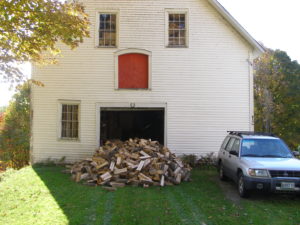
Experiential intimacy is complicated. My partner and I run into this all the time. A good example is stacking wood, which we’ve recently been doing as next season’s firewood is delivered. For him, stacking wood is a task based on a lifetime of skill and experience. He has a system in the barn where we store wood. He sorts it according to age, he stacks it just so, and the whole thing is carefully planned and managed.
Wood Delivery
Me? Stacking wood is an opportunity for connection, for us to do something that helps sustain our life together. The task is nothing but an excuse for good exercise and together time. I’m happy to take orders and let him have total control. (Stop laughing! In this case, I am!)
So we have wood dumped in the driveway, and I’m all excited because we’re going to spend several hours together stacking it. After breakfast, he goes into his office to do his morning thing and I go upstairs into my aerie to do mine. I get immersed in writing, or a book, or a rabbit hole like intimacy, and lose all track of time. At some point, usually because I have to pee or want another cup of tea (could these be related?), I come back to consciousness and discover the music is on, the barn door is open, and he’s happily stacking wood without me! I drop what I’m doing, grab my gloves and go out to join him, usually just at the point he’s ready to take a break.
This has happened many times, and every time I’m pissed off and feel rejected. Every time, we talk about it, and he’s sorry. “I forgot to call you,” he says.
He forgets because to him it’s a task to be done competently. I’m hurt because to me it’s a chance to do something together, and that’s always my priority. The competency and skill involved mean nothing to me. I want the connection.
Same activity, but entirely different ways of experiencing it.
It works the other way, too. He likes to share certain movies and TV series with me. For him, that’s important connection time — experiential intimacy. It can be for me, too, but sitting through yet another Star Trek or Star Wars or superheroes spectacle is at best boring and at worst overstimulating. It’s something I do out of love, but I’d rather stack wood together.
Photo by Annie Spratt on Unsplash
Another aspect of intimacy highlighting the confusion between men and women is creative intimacy. At first glance, I assumed this meant sharing our creative selves in our relationships, but that’s not quite how it’s defined. Creative intimacy is showing our affection for one another creatively. At this point I checked to see the sex of the writer of this piece and found it was a woman, which I would have predicted. In my experience, things like surprises, unexpected cards and gifts and other small (or large) playful tokens of appreciation and affection are much, much more important to women than men. A special card means a great deal to me, but my partner hardly notices such a demonstration. I know this because I sent him one — once! I got tremendous fun and pleasure out of it, but he was unimpressed. Watching the latest Star Wars with him would have meant more. Sigh.
I once spent a couple of weeks planning a birthday surprise for an intimate partner. Few things have given me as much pleasure. I went to his workplace and taped a card to his steering wheel before filling the cab of his truck with balloons. I couldn’t wait for his reaction.
He was furious. He said I had humiliated him. I was beyond crushed. I never again tried to do anything like that for him or anyone else. It left a deep scar.
Intimacy is one of those tricky aspects of relationship that’s probably equally longed for and terrifying. We fear losing ourselves, being vulnerable, being authentic. We long for connection that feels safe and real, for people in our lives we can trust and rely upon. We’re terrified of spending our lives alone, yet we resent having our freedom limited. Old traumas or health issues damage our ability to participate in physical or sexual intimacy. We have no emotional intelligence. We have no spiritual life. We avoid conflict at all costs.
We’re lonely. We’re lonely. We’re lonely.
Intimacy is one of our primary needs, but it’s messy and complicated, and now I wonder if it means different things to different people. We use the word, but there’s no consistency about what, exactly, we’re talking about. Is a relationship “real” if one or more of these elements is missing? How many of these aspects must be present to keep different kinds of relationships viable, and in what combination and balance?
I experience committed relationship as one long negotiation and contest of generosity. It’s hard work. The rewards are great, and such a connection requires ongoing, consistent investment; investment in ourselves. What do we need? What do we want? What can we say about what doesn’t work for us in relationship? What are our deal breakers? How do we manage conflict and uncomfortable feelings like anger and fear? What are our priorities? What are our expectations of ourselves and the other? How do we maintain healthy interdependence? What is our strategy for obtaining resource, help and support outside the relationship? How do we repair trust, manage the peace treaty of tolerance, practice forgiveness and manage power?
What does intimacy mean to us? How are we prepared to create and participate in it? What kinds of intimacy are we unable to offer? How close is too close? How distant is too distant? How will we handle the ways all these elements of intimacy might change over time? (They will.) How does intimacy show up in all our relationships — friends, family, romantic partners and community?
When I was 20, life was so simple. Intimacy was sex, and sex was mostly enjoyable. I didn’t find out until it was too late that sex is perhaps the most one-dimensional aspect of intimacy, and certainly not the longest lasting. When I was married at 21, I could feel some mild concern and eye-rolling from my family. I heard quite a bit of the “marry in haste, repent at leisure” thing. But no one stepped forward to give me resource and education about human connection. No one talked to me about the intricacies of a longstanding, committed relationship. No one had any emotional intelligence or a clue about its importance. No one talked to me about romance or expectations or intimacy. How could they? None of them knew about any of those things. No one had taught them.
Well, better late than never. I’ve learned a lot since I was 20.
I’m fascinated with thresholds, the ground between us, the spaces between, and the edge of chaos. The void between one thing and another is filled with unknown possibility.
Photo by Jeremy Cai on Unsplash
Tarot cards appeared in the fourteenth century, when they were used primarily for play. Sometime in the eighteenth century, the cards began to be used for cartomancy. Tarot cards are archetypal (they illustrate recurrent symbols), and countless modern decks are available, some of which are beautiful works of art.
When I work with the Tarot, I use a common classic 10-card spread called the Celtic cross. One of the richest and most enigmatic parts of the Celtic cross spread are the seventh and eighth cards, representing the querent as he/she sees him/herself and the querent as others see him/her.
I’ve learned, after decades of working with the cards, to pay close attention to what lands in those two places. If the cards have similarities, I know I’m living with reasonable authenticity. I’m staying grounded in who I am, and I’m showing up in the world and in my relationships honestly. I have a sense of being at home, of belonging in my own life. My connections feel solid and healthy.
If the cards are wildly opposing, however, I think carefully about what’s going on. In emotional intelligence coaching, this gap is key. Whatever is hidden between our own authentic experience and how others see us can be excavated, examined, healed, released, and/or renewed. The most effective coaches coach to the gaps.
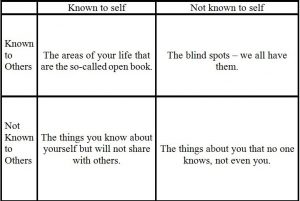
In psychology, this idea is expressed with the Johari window, a model used to illustrate the relationship between ourselves and others.
Johari window
What’s in that square of the Johari window that nobody knows, not us, and not others? What lies in the cleft between the way we see ourselves and the way others see us? What possibility or potential sleeps or hibernates there, waiting to wake up or be discovered? What insight and information are we missing as we look at others and ourselves?
Here are some possibilities:
We have crafted a highly-polished and highly-defended pseudo self and our authenticity is buried underneath it.
We are keeping too many secrets out of shame or fear; our authenticity is blocked. We are trying to stay safe.
We are low in our ability to emotionally express ourselves.
We have no idea who we really are; we accept the expectations of others about what we should or must be and try to fit those definitions.
Our closest connections are not healthy; those around us are employing abusive tactics like gaslighting, projection, smear campaigns and chronic blaming. We know who we are, but we’re overwhelmed by what they say about who we are. We’re in the wrong place, connected to the wrong people.
We ourselves are a Cluster B disordered person; we are unable to have insight into why we do what we do or the ways our behavior and choices affect those around us. We think of ourselves as victims and blame others.
We are too fearful to explore ourselves or others or ask or answer questions.
It doesn’t matter if we approach these kinds of questions via a mystical route or a more science-based path, to be human is to ponder about who we are and what we are for; to strive to make meaning out of our lives and experience.
We believe we know what we know, and we spend a lot of time defending that knowledge. We’re much less comfortable with what we don’t know, and some people refuse to explore that terrain at all.
Photo by Bryan Minear on Unsplash
For me, however, that uncharted territory, both within and without, is where all the good stuff is. The cracks and crevices, the blind and blank spots, are filled with the possibility and potential of insight and clarity. Healing is there, though it may come about through cautery or amputation. Growth is there, though it might mean our bones ache and we must alter our lives to accommodate that growth.
As humans, we are social, and we need others in order to survive and thrive. When I consider the rift between how I see myself and how others see me, I remember the power we each have in the lives around us, and the power those around us have on us. We can’t change other people, or save them (especially from themselves), but we can and do have influence on others. When we believe in the good things in others, we are making a difference. When we choose to manipulate or tear down others, we are making another kind of difference. This is the line between friends and frenemies.
It makes me squirm to understand the people around me know things about me I’m blind to, and see me in ways I can never access. I feel exposed and vulnerable. Yet the same is true for everyone. If my friends feel the same kind of affection and willingness to allow me to be who I am that I feel for them, I’m both humbled and grateful, but I’m still squirming — just a little!
Photo by Nicole Mason on Unsplash
I learned long ago the people I want to be closely connected to are willing to live with some degree of authenticity. My best friends have been those who told me the truth; the ones who let me know when I’m off the rails, or otherwise acting like an idiot. If we can’t tolerate feedback from others, we lose a quarter of the Johari window; a quarter of our available experience, potential, strength and growth.
Likewise, if we are unable or unwilling to give honest feedback to others, they lose a quarter of their Johari Window.
It’s only in the tension of connection we become greater than the sum of our parts, greater than we could ever be on our own. The powerful friction and shaping that occurs in relationships forces us to explore, discover, question, learn, unlearn, adapt and adjust more than we would ever do in isolation.
Websites store cookies to enhance functionality and personalise your experience. You can manage your preferences, but blocking some cookies may impact site performance and services.
Essential cookies enable basic functions and are necessary for the proper function of the website.
Name
Description
Duration
Cookie Preferences
This cookie is used to store the user's cookie consent preferences.
30 days
These cookies are needed for adding comments on this website.
Name
Description
Duration
comment_author
Used to track the user across multiple sessions.
Session
comment_author_email
Used to track the user across multiple sessions.
Session
comment_author_url
Used to track the user across multiple sessions.
Session
Statistics cookies collect information anonymously. This information helps us understand how visitors use our website.
Google Analytics is a powerful tool that tracks and analyzes website traffic for informed marketing decisions.
ID used to identify users for 24 hours after last activity
24 hours
_gat
Used to monitor number of Google Analytics server requests when using Google Tag Manager
1 minute
_gac_
Contains information related to marketing campaigns of the user. These are shared with Google AdWords / Google Ads when the Google Ads and Google Analytics accounts are linked together.
90 days
__utma
ID used to identify users and sessions
2 years after last activity
__utmt
Used to monitor number of Google Analytics server requests
10 minutes
__utmb
Used to distinguish new sessions and visits. This cookie is set when the GA.js javascript library is loaded and there is no existing __utmb cookie. The cookie is updated every time data is sent to the Google Analytics server.
30 minutes after last activity
__utmc
Used only with old Urchin versions of Google Analytics and not with GA.js. Was used to distinguish between new sessions and visits at the end of a session.
End of session (browser)
__utmz
Contains information about the traffic source or campaign that directed user to the website. The cookie is set when the GA.js javascript is loaded and updated when data is sent to the Google Anaytics server
6 months after last activity
__utmv
Contains custom information set by the web developer via the _setCustomVar method in Google Analytics. This cookie is updated every time new data is sent to the Google Analytics server.
2 years after last activity
__utmx
Used to determine whether a user is included in an A / B or Multivariate test.
18 months
_ga
ID used to identify users
2 years
_gali
Used by Google Analytics to determine which links on a page are being clicked