by Jenny Rose | Oct 12, 2017 | A Flourishing Woman, The Journey

Photo by Autumn Mott on Unsplash
I love autumn, and autumn in New England is particularly poignantly beautiful. The leaves, oh the leaves! It’s as though the trees release their passion in one final gasp of ecstasy before their long sleep. The colors stun the senses with their beauty; it’s almost too much to absorb. Yet the trees’ splendor is fleeting. Inexorably, the leaves fall like golden tears, like blazing sparks, and as they fall the greatest power of all is revealed: The true shape of things.
The green and fiery sea of the forest and fields recedes. Lichen-covered rocks bare themselves. Trees stand or lean in bony beauty, gnarled and hollow, smooth and upright, each species clad in its own color and texture, but now the colors are russet and ivory, shades of brown and grey touched with black. Thorns and stems become semi-transparent cover for winter-colored birds and animals.
The bare forest is everything it is and nothing it is not.
I, too, am becoming reduced to my essential self. Confusion, guilt and shame are loosening their hold on me and drifting away, and I make a resting place for them in my writing. I look back in my memory and, for the first time, begin to see the true shape of things. All the words that weighed me down and kept me small, all the gaslighting and controlling, all the lies and distortions, are responding to some miraculous internal seasonal shift and slant of light. I am bursting into triumphant understanding, and then letting go, letting all that does not serve me fall away. My true shape emerges, and it’s strong and clear-seeing and wise. It always was.

Photo by Erik Stine on Unsplash
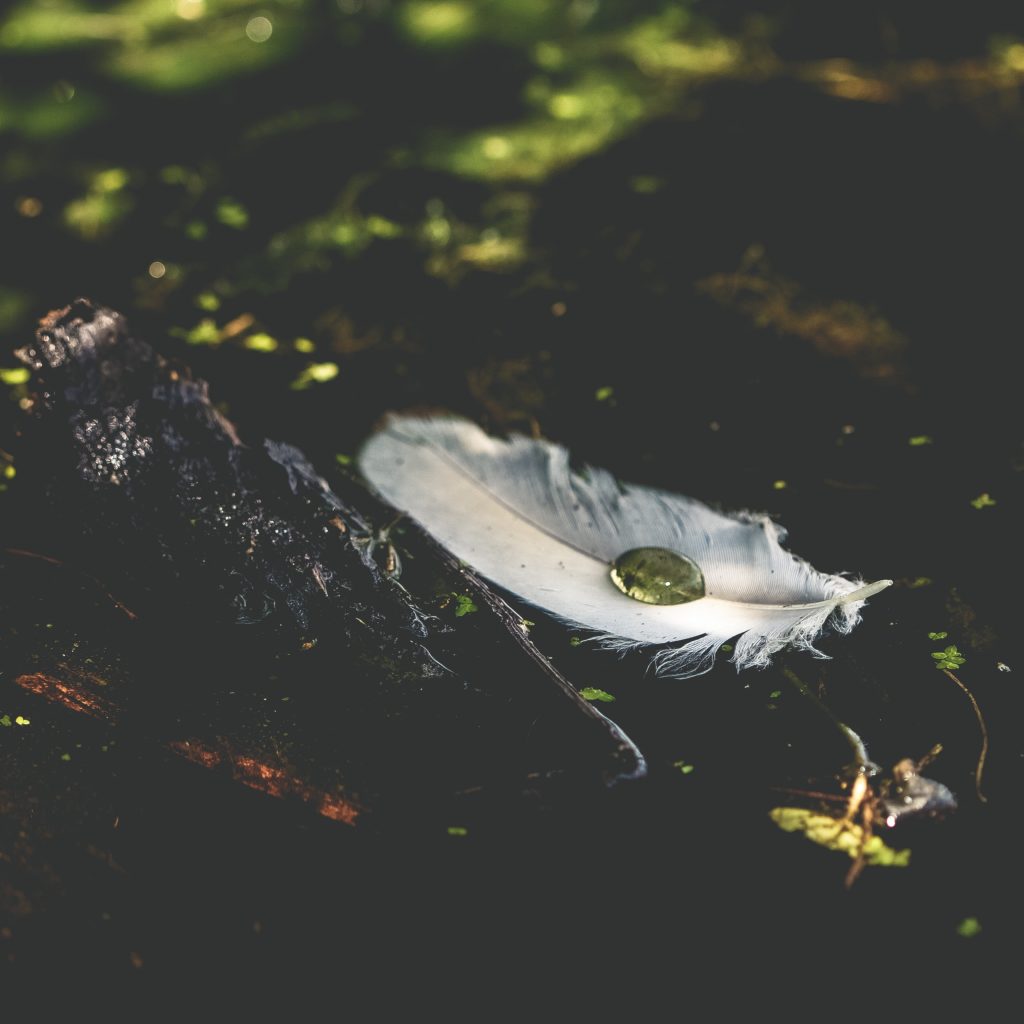
Now I begin to see the true shape of things. Now begins a season without pretense, unencumbered by expectations. Now the lineaments of my feelings lie bare. The landscape of my life becomes stark and uncomplicated, a walk through winter woods where a feather is a feather, a quill a quill and a swatch of fur on a thorn exactly what it is, not more, not less, not something else entirely. I reclaim the dignity of my own perception, intuition and experience.
It does not surprise me that traditionally this is the time of year when the veil between the worlds thins, ghosts walk, legends come to life, ancestors are honored, and we acknowledge that which haunts us. I do not fear my ghosts. Indeed, they’re old friends and companions. My bogeymen were flesh and blood concealed beneath dazzling costumes of false power, fearful only as long as their true shape was hidden from me.
Some fear the fading light, endings and truth. Some prefer the riot of distraction and confusion. Some refuse to see or know the true shape of things. My own courage is not strengthened by distraction, no matter how beautiful or seductive. My courage is a thing of unadorned simplicity, spare and clean as bone.
The leaves fall, ravishing, rapturous. At last, the true shape of things emerges from the blaze, pure and indestructible, and I embrace it like a lover.

Photo by Vanessa von Wieding on Unsplash
All content on this site ©2017
Jennifer Rose
except where otherwise noted
by Jenny Rose | Aug 17, 2017 | Connection & Community, Emotional Intelligence, Shadows
A good thing happened recently. I declined to take poisoned bait.
The bait arrived in the form of a terse email from an individual with whom I’ve recently done business. I’ve never met them in person. I approached our business transaction with a willingness to negotiate, share power, cooperate and communicate directly, thoroughly and clearly. I saved all documents, contracts and emails regarding our business, and upon successfully (in my view) concluding our interaction, I moved on with a sense of gratitude, satisfaction and relief.
More than a month later, I had an email expressing frustration and blame.
It felt like a slap in the face, unexpected and hurtful.
My immediate impulse was to strike back, followed quickly by the thought that I hadn’t communicated well and I could fix things by explaining myself (again). Obviously, I had been misunderstood.
Then I decided to pause for a day or so and think carefully about this.
The fact is, I have a longstanding deeply-rooted pattern of believing I’ve been misunderstood due to my inept communication. This belief keeps me firmly locked in escalating attempts to explain and be heard and understood. What I’ve failed to perceive, over and over again through the years, is that I’ve frequently been in relationships with people who had no interest in explanations. They were deliberately fostering misunderstanding, drama and conflict because it fed them in some way.
This, by the way, is a very common strategy of narcissists, psychopaths and borderline personality disordered people. I’ve written previously about projection and gaslighting , two tools frequently used to control others.
Deliberately keeping another in confusion and on the defensive, constantly changing the goalposts and passive aggressive tactics like the silent treatment are all baited hooks I’ve eagerly swallowed and writhed on for years. Words can’t convey the anguish and erosion of self that occurs in the context of this kind of long-term abuse. I’ve crept away from relationships like this as nothing more than a cracked shell of woman, my sexuality and femininity withered, my emotions torn to shreds, my body impoverished and barren, and firmly convinced of my own worthlessness, ugliness and inadequacy.

Photo by Hailey Kean on Unsplash
A perfect set-up to fall for it all over again.
And again.
And again.
But not this time!
This time I had hard evidence. Over and over, I checked the timing of contract and closing, emails sent and received, all the fine print. It was all right there, the date my responsibility ended and the date after that of a sudden dissatisfaction I was expected to fix.
I concluded I’d done nothing wrong. On the contrary, I’d consistently demonstrated the kind of integrity I aspire to in every interaction. I went above and beyond. I provided explanation, suggestions for resolution and alternate options, along with names and numbers of possible local resources.
That email was bait.
So, a couple of days later I took a deep breath, opened my email and replied with sincere wishes for happiness and success. One sentence. Then I signed off and hit “send.”
This happened about three weeks ago, and I’ve been thinking about it ever since. It’s a small thing, but it reveals to me how very far I’ve come in healing, growth and wisdom. I now know that I have the power to decline an invitation to struggle. I recognize poisoned bait for what it is. I know it conceals a hook, and that hook no longer tempts me. I don’t need to waste any energy in defense or repeated explanations. I don’t choose to revisit old bones of contention and chaos. I accept that people think what they think, make up and believe the stories they make up and believe, carry the assumptions they carry, and none of it has anything to do with me.
Misunderstanding certainly occurs, but it’s not that difficult to clear up, given two adults who intend to. The trick is to identify as quickly and accurately as possible if the person I’m interacting with is an adult who to intends to clear up misunderstanding. In the case of my email, that person was only peripherally in my life and we’ll probably never interact again, so I didn’t bother. However, we all have people in our lives with whom we have ongoing connection. In those cases, I use a single question to clarify “misunderstanding.”
“Is there anything I can say or do to clear this up and repair our relationship?”
This direct, simple question seems to encourage surprisingly honest answers, albeit answers I haven’t wanted to accept or believe. However, if the answer is some variation of “no,” then everything immediately becomes blessedly clear. I want to repair. They don’t. Continuing to engage is a waste of our mutual time and energy, and if any kind of a hook remains dangling, I know it’s a manipulation. They’ve made up their mind, and I have no power there.

Photo by Joshua Earle on Unsplash
The words on the screen fail to convey the annihilating heartbreak attendant on understanding that someone you care about and even love doesn’t value your relationship enough to make repairs, but arguing with what is has never worked for me, and I think we owe it to ourselves and others to pay attention when people tell us who they are, no matter how devastated we might feel or how much we want to deny what we hear.
I don’t think of this as too-sweet maiden, politically correct, starry-eyed liberal ideology. Neither is it a religious thing for me, or some kind of higher moral ground tactic. It’s not about making nice and giving others the benefit of a doubt, turning the other cheek, or making excuses for why people do the things they do. It’s also not a blanket rejection. I’m perfectly prepared to turn aside into another conversation, activity, or form of connection. I’m also perfectly prepared to walk away.
No. This is about dignity. It’s about wisdom. It’s about self-defense and self-care. Explaining oneself once, apologizing if warranted, taking responsibility if appropriate, is healthy, adult behavior. Distortions, refusing to hear or accept explanations, verbal or physical threats or violence, scenes, emotional meltdowns and shame and blame games are signs and symptoms of dangerously abusive relationships, and I’m no longer available for those.
I’ve changed my diet and I don’t take that poisoned bait anymore.
I’ve had a bellyful of it already.
My daily crime.
All content on this site ©2017
Jennifer Rose
except where otherwise noted
by Jenny Rose | Jul 20, 2017 | A Flourishing Woman, Body

Photo by Leon Liu on Unsplash
Last night we danced. I’m patiently and persistently attempting to root a dance group into this community. It’s taking time, but I hope in the end to have a healthy core of four or five women with whom to share this sacred practice.
As I danced, I remembered an old friend with whom I danced in Colorado. She used to often say, at the end, as we sat in a circle holding hands, “It’s so good to be in the body.”
Not in the head, where family and other relationships, financial and political complexities, expectations, rules, to-do lists and all our internal voices reside, but in the body, right now.
Our bodies contain a childlike innocence and a wisdom beyond words. They communicate to us the truth about how things are with us via feeling and sensation. Patiently, they carry us through our lives, our most loyal and faithful companions. Persistently, we neglect, abandon and abuse them.
Somewhere along the way, we’ve learned to reject, be ashamed of and hate our physical being and experience. Now we’re to the point where bodily functions tied to being biologically female are a matter of political incorrectness and a hate crime. Social pressure is increasing to eradicate the very words that define female physical experience.
But dance is for everybody in every body, and the spiritual practice of dance has taught me to honor, protect and care for my physical self in new ways. There are no labels in dance, no gaslighting, no power-over that seeks to diminish or limit my physical history or expression. Dance is wordless, so there are no language police. Dance is the freedom to belch, to fart, to wiggle, to jiggle, to giggle, to cry, to shout, to play and to sweat.
Allowing my body to be and joyfully inhabiting it has been a powerful act of self-love. It means allowing my hair to grow as it will, where it will, in the color it is. It means moving with dignity and pride. It means gratitude, for my life is a journey mapped onto my flesh. Every mole, freckle, stretch mark, scar, lump, bump, line, wrinkle and vein holds part of my story, and I honor story.
Being in my body is a powerful act of surrender, not to what the culture says I must be or not be, not to what I think I should embody or not embody, but to what I am. Simply that. The unique, miraculous complex system of genetic material, living tissue, viruses, bacteria and chemical processes that I am.
Allowing my body to be is a peace treaty. My body is not for the pleasure or evaluation of others. It’s not for sale. My body and I owe nothing to anyone, not explanation, apology, conformity, obedience and especially not shame. I refuse to go to war over gender, sexuality or political correctness ideology. I decline to support or participate in self-hatred or hatred of other bodies. The power of my body transcends the judgements, criticisms and opinions of others.
The deepest language I know is of the body. Words are inadequate to my passion, to my love, to my creativity. Spoken and written language fails to convey the richness of my body’s capabilities.
The tick crawling high on the nape of my neck along my hairline, the feel of its tiny claws stirring each hair as it seeks a good place to fasten on, gives me a physical experience so vivid and visceral it cannot possibly be conveyed in words. My skin shrinks, telling me what the sensation is before I examine the cause with my eyes. Undisturbed hair around its path rises, quite automatically, in response to the small but ominous trespass. It feels solid and smooth as an apple-seed between my thumb and finger as I pinch it off. It hurries up and down a bookmark, chestnut colored, as I transport it down the stairs, almost as though it knows it’s been seen, recognized and a death sentence passed.
We come out of our favorite restaurant after a meal on a hot, humid day and find a snake clothed in brown and green, voluptuously twined around our right front tire. My partner stoops and grasps it and it curls and writhes as it dangles from his hand, twisting between the newly-laid black tar and the heavy sky, glaring with sun, humid as a steam bath. My partner takes it into a nearby field and as he comes back he holds out his hand with a rueful expression, showing me beads of bright red blood, dazzling as rubies, on his finger, and two parallel shallow cuts that sting, he says, like paper cuts.

Photo by Leon Liu on Unsplash
Last night I danced with the tick, the snake, the rasp on my knee from falling on the front cement steps, their uneveness hidden by the encroaching hostas, blooming now on thick, fleshy stems, their lavender flowers plundered all day by bumblebees.
I danced with the rattling air conditioner lodged into a window of the recreation center activity room. As usual, we traded the rise in heat and humidity in the room with the lower and quieter fan setting.
I danced with a dead fly on the wood floor, trying to avoid stepping on it with my bare foot. I danced with a living large black ant, bewildered, crawling across what must have seemed like acres of flat, featureless terrain, also not wishing to step on it, but too involved in the flow of the music to stop and take it outside.
I danced with my breasts and belly and thighs, with my feet and elbows and wild hair. I danced with trickles of sweat and a wet upper lip. I danced with my tattoo and swaying earrings and sliding silver bangles. I let myself go. I let myself be. I let myself sink into my body as though sinking into a lover’s arms, for I am my body’s lover, and it is mine.
I danced, and remembered again how good it is to be in the body.

Photo by David Hofmann on Unsplash
All content on this site ©2017
Jennifer Rose
except where otherwise noted
by Jenny Rose | Jun 1, 2017 | Authenticity, Emotional Intelligence, Needs
Life coaching transformed my experience in several powerful ways. For me, however, there’s one central concept underlying all the new language, ideas, strategies and choice-making that has so reshaped myself and my life.
Every one of us has needs, and we’re driven by trying to get them met.
Duh, right? Written on the page like that, it seems ridiculously obvious. It’s not, though. It’s enormously complex and it affects every single choice we make. Let’s excavate a little.
In my old life, I defined needs as things like oxygen, water, food and shelter. Needs meant to me the necessities of survival. Anything else was wants, or even undeserved privilege. To need more than I have at any given moment is inconceivable to me, even now. To want more than I have is shameful. I’ve spent my life with an internalized voice that informs me I should be damn grateful for my resources, because it’s so much more than many others have, and I’ve done nothing to deserve my good fortune.

Photo by Jan Phoenix on Unsplash
It’s undeniably true that I’ve had advantages because I’m white, I’m educated, I’m able-bodied, employed and have the ability to feed myself. I have access to potable hot and cold running water. I have a roof over my head. I have access to health care.
Are these realities of my life a matter of shame? Does wanting the roof over my head to stop leaking make me a privileged elitist? Does it assist anyone who has less than I to go hungry, or stop trying to earn a few dollars?
Privilege is a hot word right now in social discourse. It’s a word that shows up in discussions around gender and sex, racial issues, economic issues and geopolitical relations. Privilege is an important discussion, but the word has been used so frequently, especially as an insult, it’s losing its meaning. Show me any two people anywhere and I’ll show you several different ways in which each one has resources and experiences not available to the other. Privilege is a word pointing to competition for power, and our definitions of power are distorted into insanity. Privilege is too often used as a meaningless black and white label expressing more about the speaker than it does the target.
Do you have a cell phone? I don’t. You’re more privileged than I am. Are you male? I’m not. You’re more privileged than I am. Are you Caucasian? I am. I’m privileged. I’m literate. Definite privilege from my point of view, but according to some, this makes me elitist (another severely overused word). I had and have access to vaccinations. I think this makes me privileged. An anti-vaxer thinks it makes me wrong and stupid.
And so it goes.
Have you noticed how quickly we’ve gone from the simple idea of human needs to politics — social, sexual, economic and geo?
An Internet search defines a need as a “necessity; a thing that is wanted or required.” As I said above, I disagree with the “wanted” part. How do we decide what’s required? Who gets to define that? Requirements take me back to the my basic list: Oxygen, food, water, shelter. I’m convinced anything else is a want.
During life coaching, I was referred to The Center For Nonviolent Communication. They have a needs inventory posted that exploded my definition of needs.
Photo by Cristian Newman on Unsplash
The first thing I noticed about the needs inventory is that my needs list occupies only a small fraction of the whole. Secondly, with the exception of food, water, shelter and sex, the inventory transcends anything that can be bought or sold. It’s not about stuff, money, biology, ethnicity, education, religion or “privilege.” In fact, it’s not a list that points out differences at all. It’s about intangible needs we all have in common. All of us. You, me and them.
The first, second, fifth and tenth time I read this list, I cried. I printed it out and stuck it between the pages of my journal. As I worked with it, I felt deeply angry, terribly sad and a kind of furtive relief. Some unknown person or persons had written an inventory expressing the deepest, most secret desires of my heart, desires I wasn’t really even conscious of. I couldn’t afford to be conscious of them.
Was it possible other people wanted what I did? Was it okay to want these things, even normal?
The first time my life coach said to me, “You have a perfect right to get your needs met,” I felt so enraged I nearly hung up on him. It was the biggest, most outrageous lie anyone had ever said right to my face. I told him to never say it to me again.

Photo by Nicole Mason on Unsplash
If I knew anything, it was that I had no needs, and if I ever did entertain such a criminal, inappropriate, shameful and downright stupid thing as a need, it would never, ever get met. My job in life was not to have needs. My job was to meet the needs of those around me. I was terrible at that job, failed it every day, had no hope of ever doing it well, but that’s what I was for in the world.
The second grenade my coach threw was this: “Your needs are as important and not more important than anyone else’s.”
In the following months and years, right up until this day, I’ve been trying to come to terms with the transfiguration of some of my most deeply-rooted and fundamental beliefs and rules. Understanding needs has hung the formerly invisible elephant in my living room with neon lights. I’ve reframed my history and my past and present relationships. Coming to terms with my needs has enriched my relationship with myself and others is astounding ways.
I realize now my needs have always been present, driving my behavior, just as the people around me have been driven by their needs, but I think few of us have access to that central information and understanding. This is ironic, because I’ve always been well aware of what other people want from me; what they expect. What I now understand is what some people want — compliance, submission, adhering to rules and expectations — is surface behavior masking the simple need for personal power.
As I said earlier, our relationship to power is so diseased and distorted we’re all affected by a kind of cultural insanity. We believe power-over will fill our need. We believe hate, projection, physical brutality and force, name-calling, labeling, gaslighting, dishonesty and manipulation will give us what we need.
Power-with is often sneered upon, or used as a Trojan Horse within which the true desire for power-over hides. Once we understand the needs inherent in all human interaction, it’s not hard to discern the difference between power-over and power-with. If it’s accepted that one party’s needs are as important, but not more important than another’s, that’s power-with. If, on the other hand, one individual, group, political movement or any other social or individual entity demonstrates persistent tactics seeking to take power away from someone else, that’s power-over.
Humans make a lot of noise. We create language, slap on labels, pick up and pass on meaningless bits of jargon and ideology. We deny, distort, and cling grimly to our beliefs. We freely use humiliation, contempt and aggression to shut each other up and try to threaten others into believing/behaving in the way we want them to. We fight fiercely to get our needs met, no matter the expense to others. Our win is based on someone else’s loss. This is the environment of power-over.
Humans are also remarkably flexible and resilient. We can be curious. We can think critically, synthesize information, study things, make observations. We can develop the great strength of learning how to be wrong. We can demonstrate heroism, compassion, kindness and generosity. We can be elegant and meaningful communicators. We can create deeply connected communities including people, animals, plant life and the environment. We can aspire to a world in which the words “privilege” and “elitist” lie down to rest because competition has been discarded in favor of cooperation. Everyone’s needs have equal importance, and no one is allowed to overrun another. Success is demonstrated by win-win. This is the environment of power-with.
I have needs. Trying to get my needs met underlies my choice making, my behavior and my motivation. It even underlies the kind of music I like. It’s a great big elephant in the center of my experience, and it requires food and water, room to roam and attention.
Skim over the needs inventory. Choose one aspect of your life: Job, relationship, what have you.
Now, in the deepest, darkest privacy of your mind, ask yourself, “Are my needs being met?” Don’t think about the answer. Feel it.
Behold the elephant!
(See the next post for more on needs.)

Photo by Graham Hunt on Unsplash
All content on this site ©2017
Jennifer Rose
except where otherwise noted
by Jenny Rose | Mar 16, 2017 | Connection & Community, Emotional Intelligence, Shadows

Photo by Ian Espinosa on Unsplash
Projection is a defense mechanism used to displace the responsibility of one’s negative and unacknowledged feelings, behavior, beliefs and choices by attributing them to someone else.
The goal of projection is to create a distraction that helps avoid ownership and accountability. The victim becomes the focus, and is manipulated into taking responsibility for the abuser’s behavior, beliefs and feelings.
For example, an obviously angry parent confronts and accuses their child of hating them. The child, in fact, loves the parent, feels disliked by the parent, and walks away feeling ashamed and guilty for hating their parent, even though that’s not their feeling. For the moment, the parent has successfully displaced their own self-hatred onto the child.
Another example is a friend talking to another friend about her experience of a chaotic yet transformative life event that’s picked her up and set her down in a different place. The speaker is accused of being negative and making her friend feel stressed and upset, in spite of the speaker’s attempts to be clear about the exhilaration and joy of her experience. The speaker walks away with her friend’s displaced inability to deal with change and loss of control, her own joy forgotten.
Projection is a common defense mechanism, and most of us use it to one degree or another. It’s not necessarily a Big Evil. On the other hand, projection can be a subtle and cruel blame-shifting game of power-over, and some people who employ this tactic intend to win at any cost. Their victim and the world at large are blamed for everything that’s wrong or feels bad. The projector is an innocent victim of the machinations and manipulations of others, the general unfairness of the world, and bad luck.
People who use projection as a weapon can have a devastating effect in our lives, but I’ve been even more devastated by my own use of projection, and this is a skill the culture has actively and systematically taught me to perfect.
I’ve been brainwashed since I was a child to believe all people share my desire for peace, compassion, and cooperation. I’ve been led to believe all others share my empathy, my thirst to learn and grow and my priorities for healthy connection. I’ve been taught the Golden Rule, the application of which ensures being treated with love and kindness. We treat people the way we want to be treated, and voila!
Furthermore, as a female, it’s my responsibility to be a representative of all these values. If I fail to exemplify peace, empathy, loyalty and kindness towards others, I fail to be a good daughter, wife, lover, friend, mother and woman.
It’s also my job to be the keeper and carrier of feelings the people around me don’t want to deal with. It’s what I’m for.
No one ever suggested to me how dangerous it is to project my own value system onto another person, and I only just discovered this for myself recently. As it gradually dawned on me, I struggled for a time to find an alternative way to look at the people around me. If I don’t approach others with all my naïve projections, then what? I don’t want to assume everyone is destructive and dangerous, either!

Photo by rawpixel.com on Unsplash
Then it occurred to me our approach to strangers (or even those we think we know) needn’t be either/or, friend or foe. A stranger is a stranger. An unknown. It’s not necessary or useful to project anything onto a stranger. The Golden Rule still applies and I conduct myself authentically and respectfully and pay attention as I interact with an unknown person. I’m learning not to manufacture stories, make assumptions or project. I inquire, listen, watch and take responsibility for my own feelings and behavior.
Projection is a complex technique and can be very hard to see when it’s lurking under the bed. However, in this house we’re skilled at pulling all sorts of monsters out from under the bed (metaphorically, of course) and letting the cat sniff at them. Once identified, projection is perfectly manageable.
Projection, like gaslighting and mice, leaves tell-tale signs.
- Any conversation about a challenging issue (money, parenting, fidelity, keeping one’s word, the nature of the relationship, why you got hit) winds up being about why it’s all your fault.
- You’re accused of something (a feeling, lying, cheating, stealing, being demanding, interrupting) that’s not true.
- In spite of your best efforts, communication isn’t successful. You can’t get your point of view heard and you feel chronically disempowered.
- After an interaction, you feel ashamed and guilty.
- No matter what you do, you seem to be continually hurting someone you care about.
- You don’t experience reciprocity; the more loyalty, understanding, empathy, love, gratitude and forgiveness you extend, the more drained and alone you feel.
- You feel like a disappointment, a failure and a burden.
- You’re always bleeding; you had no idea what a terrible person you are.
- You feel manipulated, used, disliked, and angry, which increases your guilt and shame.
- You feel confused, baffled and bewildered. Every time you turn around you seem to get sucker punched, literally or figuratively.
- You don’t feel safe.
- Your trust is damaged.
- Your boundaries are chronically violated.
- Your priorities, feelings and values are disregarded, if not brutalized.
- Your needs are not met.

Photo by Volkan Olmez on Unsplash
Abusers and personality disordered people who employ projection invariably give themselves away, right in plain sight, because at some point they project onto others something so bizarre the victim and/or onlookers have an Aha! moment and recognize the manipulation. For example, someone with sexual boundary issues accuses someone else of an assault that never happened. A thief projects stealing onto someone with scrupulous integrity. A liar accuses an obviously honest person of lying. A rageholic accuses everyone else of being angry while they put their fist through a wall.
Another common projection is “You don’t care!” when in fact we care so much we feel terminally ill, and we still can’t make it work.
Shame and guilt have enormous isolating power. One of the best defenses against projection is to verify someone’s stated perception of you and your behavior. I had a boyfriend who accused me of “always interrupting.” I was crushed. It was a heated, angry accusation blowing up out of nowhere, and he’d never given me that feedback before. I’ve studied good communication techniques for a long time, and communication is something I care about doing well. Furthermore, I frequently had the experience that he interrupted me, but I tolerated it because I loved him.
My choice (after I stopped crying) was to ask other people in my life if they had this experience with me and get a reality check. I had a couple of close girlfriends whom I knew would tell me the truth. If it was true, I wanted to know so I could change that behavior.
They thought I was nuts. One of my best friends, who had years of experience of me in groups as well as one on one, said she appreciated the way I always held space for others to speak.
I didn’t cry anymore and I immediately dumped that projection. Not long after that the relationship also ended.
Another good defense against projection is to name the behavior and refuse the projection. There’s no need to fight, raise your voice, cry, argue, persuade, explain, justify or throw something. Those are all distractions from the fact that the abuser is employing a toxic tactic that’s about them, not you. Let them escalate — it’s their game. You’re don’t have to play.
“No. That’s not how I feel. That’s a projection.”
“No. That’s not what I did. That’s a projection.”
“No. That’s not what I said. That’s a projection.”
Stand your ground, look them in the eye and refuse to get distracted from their behavior, no matter how juicy the bait they dangle. Hang up, disconnect, block, delete, walk away, disengage. If you can’t get away from them, repeat a simple statement like the ones above as many times as you need to.
Projection can be abusive and toxic. It’s essential that we recognize it, both when we employ it and when others use it against us. Good boundaries go a long way to disabling projection, and so does the work of authenticity. We can’t control the behavior of others, but we can learn to recognize and excavate our own projections and take responsibility for our choices and feelings, which makes us far less vulnerable to this tactic.
All content on this site ©2017
Jennifer Rose
except where otherwise noted