by Jenny Rose | Jun 15, 2017 | Authenticity, Emotional Intelligence, Needs
I was absent last week in order to take a trip back to Colorado and finish selling my house. On the road, I thought about my last post and the second part of coming to terms with needs. Discovering, admitting and identifying one’s needs is, alas, just the beginning of what I suspect is a lifelong journey.
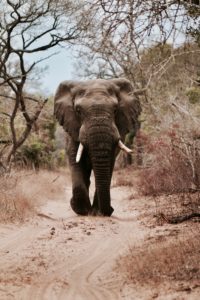
Photo by Will Shirley on Unsplash
So, to recap my last post, we all have needs, and we’re all driven by our needs, whether or not we’re aware of them. If we’re not aware of our needs or those of others, great big elephants are standing in the middle of our living rooms, invisible to us until we run into them, or they step on us. Our relationships and lives don’t work well and we have no clue why.
One of the trickiest parts of thinking about needs is taking responsibility for them. If we look at the needs inventory, consent to recognize and admit our needs and make a list of them, it seems logical to begin to evaluate how well our needs are being met by others.
Here’s the thing, though. All the people around us have needs too, some identical to ours and some different. That doesn’t mean we’re responsible to meet all those needs, and they’re also not responsible for meeting our needs.
Newsflash! Having a right to get our needs met and understanding our needs are as important but not more important than everyone else’s doesn’t guarantee our needs will actually be met by … anyone.
This seems unfair to me. Excavating my own needs and acknowledging them, even to myself, was a lot of work. I was annoyed when I realized nobody much cared what my needs are. They’re too concerned with their own! What’s the point of this aspect of emotional intelligence, then?
First of all, it’s about adulting. Grownups know who they are, including understanding what they need. Those of us who aspire to adulthood are required to possess this kind of self-knowledge and accept responsibility for communicating our needs to others, not because anyone has an obligation to meet them, but because we’re willing to know ourselves and allow others to know us, too.
Needs are inextricably enmeshed with boundaries. I have a long history of ineffective boundaries, frequently resulting in me choosing the needs of whoever I was with over my own. Paired with another person with bad boundaries, this quickly becomes an unhealthy, unhappy relationship. One of the words we use to describe such a connection is codependent.
The second point about working with needs is understanding our satisfaction and enjoyment of connection with others is directly related to the degree to which our relationships help us meet our needs. This is complicated by the fact that feeling love for someone doesn’t imply our needs are well met in relationship with that person. For example, media-driven portrayals of romantic love don’t address needs at all outside the realm of sex, and sex is not enough to create sustainable, healthy long-term relationships.
Thirdly, we humans have a great propensity to self-destruct when our needs are not well met. We use strategies like substance addiction, sexual acting out, eating disorders and cutting to manage the painful dysfunction of not getting our needs met. Sadly, the culture focuses on fixing the behavior rather than the cause — the unmet need.
Fourthly, making friends with our needs connects us to our power. When we understand what’s not working in our lives and why, we’re empowered to make better choices on our own behalf and create the kind of life we want. We build boundaries. We learn to be more authentic. We learn to be responsible, which is another way of saying we learn to manage our own power.
Another aspect of needs is that they change. Our needs change as we age, as we grow, as we move through our lives. Not only do needs change, we can be wrong about what we think we need and discover, accidentally, needs we never recognized we had.
I said this was tricky, remember?
Having our needs met is not a black-and-white experience. No one person can meet all their own needs or all the needs of another, no matter how beloved. Expecting any single person to meet all our needs puts an unbearable burden on that person and the relationship. Human beings need healthy community because community helps us all meet most of our needs most of the time.
So how many of our needs must be met for a relationship or a life to be healthy and effective? I don’t think there’s a formula for this. I suspect every case is different, because we’re all unique individuals. We have several core needs in common, but we don’t all need the same things to the same degree.

Photo by Anna Dziubinska on Unsplash
For example, think about noise. I’m very sensitive to noise. Prolonged and unrelieved exposure to traffic, loud music, television, crowds, airplane and car noise or even a beeping alarm unhinges me. First I’m frantic, then I’m exhausted and then I’m ill. I have a primary need to control the noise in my environment. I hate crowds, parties, loud restaurants and cities.
Other people don’t seem to even notice noise levels. Many millions live in cities with a constant background of noise quite happily. I was struck by how many people live along the interstate system as we drove from Maine to Colorado and back again. I couldn’t live beside a freeway for a day without losing my mind. Life would literally not be worth living for me.
If my need for a low-noise environment doesn’t get met, nothing else will work for me. I can’t function in a noisy environment, period.
On the other hand, I’ve always believed order in my environment was also an essential need. I’ve lived in such a way that I’ve controlled housekeeping, cleaning, etc., except for private bedrooms and workspaces romantic partners and children have had. Before I came to Maine, I was sincerely certain I couldn’t live happily in disorder, dust and clutter.
Much to my surprise, chagrin and irritation, I’ve discovered I can, at least temporarily. The old farmhouse my partner and I are living in is falling down and loaded with (to my eyes) junk and clutter, most of it undusted for years. I often feel frustrated and resentful about this. However, our relationship is meeting my needs in ways they’ve never been met before, and getting so many needs met balances out the squalor (my interpretation) in the house.
Managing my needs has become a kind of dance. After much practice, I now maintain a friendly relationship (mostly) with my needs as they ebb and flow. I’ve learned to tell others when my needs are not met without apology or justification, as well as communicate what I need simply and directly. I’ve got some beautiful boundaries in place. I’ve learned to ask others what they need, not because their needs are my responsibility, but because I want to support them in getting their needs met. I’ve let go of expectations that anyone is obligated to meet my needs, but I treasure and nurture those relationships in which my needs are met naturally.
I also have precious people in my life whom I dearly love who don’t meet many of my needs, and that’s okay. Those connections are based on other things. I probably don’t meet many of their needs, either, but it’s not for lack of love and it doesn’t mean anyone is bad or wrong.
Managing needs takes a lot of mess and clutter out of my life. If something’s not working, I notice it right away and a little contemplation leads me quickly to the bottom line — what need is not getting met? Where and how am I feeling disempowered? What can I do to help myself and who do I need to have an honest discussion with?
Photo by Bewakoof.com Official on Unsplash
Taking action when there’s a problem, communicating carefully and authentically and taking responsibility for my own needs invites those around me to do the same. Some people will accept the invitation and some won’t. We can’t control what anyone else does or doesn’t do. However, we can choose which connections to put energy into and which to bless and release, and we can commit to managing our needs effectively and appropriately for our own sake as well as the sake of others.
All content on this site ©2017
Jennifer Rose
except where otherwise noted
by Jenny Rose | May 11, 2017 | Emotional Intelligence, Feelings, Happiness
For many years, I’ve been a story teller. I’ve told stories in nursing homes, schools, at seasonal events and in women’s circles. I think of stories as medicine, as guidance, as blueprints for living. Old stories from cultures around the world contain information we’ve forgotten or lost about how to live well.

Photo by Syd Wachs on Unsplash
It’s striking how often I share a familiar and oft-told story with an audience that suddenly turns out to be what I most need. Oral stories, if written on a page, look static and lifeless. They’re not. An oral story lives. It twists and turns and wriggles unexpectedly in the mouth. Every time I tell a story it’s a different telling than I’ve ever done before. Every time I tell a story I’m different than I was the last time I told it. Every audience is different.
I’ve discovered blogging is like that. As I blog, I think of the reader. I blog to make an external connection. As I create posts, though, I also discover deepened connection with myself. My writing reveals my truth to me, and shines a light on the places where I’m not living what I know is my truth.
Last week I posted about quitting. In essence, I gave permission to all of us to change, to grow, to seek happiness in our work and in our lives. Ever since I resigned from my job (last day will be Saturday) and wrote that post, I’ve noticed an internal feeling of rediscovery, freedom and fizzing joy.
I only worked 20 hours a week at that job, but the choice to force myself to do it, even though it didn’t make me happy or meet my needs, cast a shadow of apathy over the rest of my life. It dulled my response to my own distress. It fed all those powerful voices that tell us there’s no help for it. We have bills to pay. We have responsibilities, duties and obligations. The most sinister voice of all says this is the best we can hope for or deserve.
I was empowering fear, not love.
All of a sudden, I’m operating with new clarity, the kind of clarity that the right story at the right time brings. This week I’m acutely aware of what’s working well for me and what’s not. I feel my power to choose afresh. I’m not motivating out of fear. Somehow, fear is taking a vacation. I’m motivating out of curiosity, pleasure and the desire to actually be happy.
For me, this is a crime of immense proportions.
I want to be happy. It occurs to me this isn’t a childish pursuit. It’s the pursuit of real personal power.
I follow a blog by Dr. Sharon Blackie, who is a writer, psychologist and mythologist. I’m reading one of her books, The Long Delirious Burning Blue, which has a passionate delicacy I haven’t experienced in a new read for a long time.
Dr. Blackie recently returned to the place she calls home in Connemara, Ireland, and her last couple of blog posts are about taking a walk with her dogs on the land that she loves.
Photo by Takahiro Sakamoto on Unsplash
That’s all. Taking walks. She posts pictures of the lochs, a stream, the bog and the mountain. There are pictures of her dogs, and I imagined wet, muddy paws and soft black and white coats tangled with leaves and stems. I think these posts are among the most joyful and powerful things I’ve ever read, not because Dr. Blackie is an extraordinary scholar and writer, which she is, but because she writes as a woman who’s come home to the place she belongs after a long time away. Her delight and reverence for the land and the life it supports radiate from every word and picture.
That’s how I feel this week, but my homecoming is internal rather than external.
I’m familiar with some of my terrain. Over the years, I’ve learned some of what I am. Always, though, there have been caverns, edges and deep forest I haven’t explored. Perhaps I knew all of myself before my memory in this lifetime begins, but if so, I’ve forgotten.
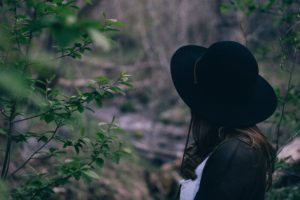
Photo by Cameron Kirby on Unsplash
This week I’m a wanderer, an explorer, a solitary traveler in my own psyche. I leave my well-worn internal paths to roam under trees. I follow the sound of water. I read my own spoor and run my hands over moss-covered rocks. I hunt in vernal pools for singing frogs the size of my toes. I wade through bogs of memory, getting my feet muddy and losing my shoes.
I’ve found old, abandoned structures smelling of rot and damp where birds nest and bats cluster. I’ve stumbled upon shallow graves where, once upon a time, I discarded and abandoned parts of myself. I’ve tripped over fallen idols, are now covered in a lacy blanket of ferns, found forgotten altars and pulled mats of dead leaves out of fountains I haven’t seen in years so clear water can flow again.
I’ve found shed skins whispering and rustling with memory, nearly invisible overgrown paths, and ruts and scars from old burns, floods and landslides.
I suddenly remember the happy feeling of waking early in the morning and going straight outside. I release myself from the expectation that I’ll work well in the last third of the day, a thing I’ve never in my life been able to pull off. I listen to music I love. I read what interests and moves me. I write lists and journal entries, blog posts and edits for my book.
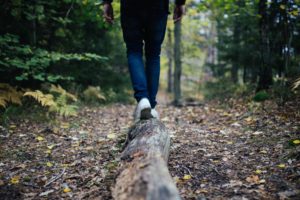
Photo by Jon Flobrant on Unsplash
Like Dr. Blackie’s dogs, I follow what catches my attention. I move along scent trails, noting the passage of all my selves, spiraling from what I’ve been to what I’ll become and back again. I dance from thought to thought, from word to word, from dream to dream. I cast myself into a wider pattern of life.
It’s not that I don’t want to do anything. On the contrary, I want to do a hundred things. I want to do much more than I did when I was structuring my time and energy around my job. I can hardly wait to get out of bed and see what the day brings. I want to play outside, take care of tasks inside, read, write, watch the birds at the feeders, stretch, dance, swim, listen to music, make a list and check things off, be present in my relationships, make new friends, pursue intriguing new connections, earn money joyfully, and see how much I can want and how gloriously I can dream.
I’ve written about leaving home before, and in that post I wrote that in some counterintuitive way leaving my old external home in Colorado allowed me to begin to finally come home to myself internally and reclaim my power. I’ll never think of home solely as a one-dimensional place in the world again. Home is not just a house, not just a beloved landscape, but the place where my dearest friend, my most passionate lover and my most loyal companion reside, along with my deepest power. Home is my own wide-flung arms, my own pulse and breath, my own joy. Home is me, myself.
Somewhere along the way, we forgot that the most important things are also the simplest. There’s great power in being happy. If happy is missing, life is muted and apathetic at best. This is when the power of boredom and the power to quit come to our aid. This is when choice becomes something we must fight to reclaim as if our lives depend on it … because they do.
Claiming the power of happy. My daily crime.

Photo by Senjuti Kundu on Unsplash
All content on this site ©2017
Jennifer Rose
except where otherwise noted
by Jenny Rose | Apr 20, 2017 | Power
I came across a prayer to Baba Yaga recently. I’ve spent a lot of time with Baba Yaga, who is a supernatural female figure out of Slavic European folklore. I’ve told stories about her for years, and she’s an important character in my book. She’s a powerful life-death-life-death figure and has many names, among them Storm Raiser, Primal Mother, Lady of Beasts and Mother of Witches. In spite of our long acquaintance, I’ve only lately begun to love her.
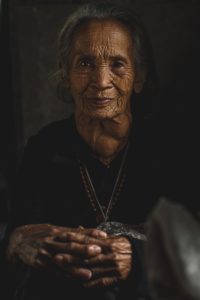
Photo by ivan Torres on Unsplash
Sometimes I think the most important thing to understand about life is power. It structures every single relationship, most of all our relationships with ourselves. Power creates wars, cults, murderers, abusers, tyrants, rebels and perhaps angels.
I believe we have a great longing for our individual mislaid power, such a longing that we’ve lost track of what it is or how to recognize it in our hunger and desperation. I don’t know how else to explain our mindless obedience to the media, to our culture, to our religions, to the almighty “they” who instruct us how to live, how to eat, what to believe, how to look, how to buy and how to be.
At this time in my life, and at this time in my country’s history, I cling to Baba Yaga, because she represents sanity in a world becoming more insane by the day. The prayer reminds me of what true female power is — and is not.
True female power wastes no time on despots and bullies who conceal their fear and impotence behind dishonesty and the willingness to use force. It’s not her business to prop them up. They have nothing she needs and they’re not worth her attention, for they shall not endure.
True female power is real. It’s authentic. It’s not bound by chains of political correctness, manners, fear or ideology. A woman in her authentic power is, according to need and whim, a child, a wild woman, a bitch, a seductive temptress, a crone, and a creature of magic. Obedience and compliance are not in her nature.
True female power seeks the hidden thing, within and without. She pares away layers, stories, masks, facades, dreams, visions, expectations, and shoulds. She’s a persistent poker, prier and meddlesome busybody in holey tennis shoes. She opens drawers, boxes and jars, looks behind forbidden doors and never stops asking questions. She refuses to shut up, close her eyes or pretend, and views everything by the stark light of a fiery skull without flinching. She doesn’t need anyone to agree with her, and she doesn’t need everyone to agree with her. She doesn’t argue with what is. The truth cannot escape her.
True female power doesn’t prostitute for love and validation. Baba Yaga eats sulfur to make her farts more momentous and fertilizes her body hair to make it grow more abundant. She’s hairy legs and iron-tipped fingers and teeth sharpened on bones. She takes a lover when she feels like it, but she kicks him out of her bed before dawn and doesn’t offer breakfast. Her body is not for sale, her hair is the color it wants to be, and she has no use for a painted mask over her face.
True female power is a teacher of magic. She teaches the sorting of one thing from another, cleansing, lighting a fire, the alchemy of cooking. She’s the power of the cauldron, the cup, the womb and the growing seed. She’s the wisdom of bone and blood, seed and water, life and death. A woman in her authentic female power learns to feed and nurture the magic of her intuition and creativity. She knows they are the most priceless jewels she will ever have.
True female power feels huge, deep feelings of rage, grief, joy and lust. When fear accosts a woman in her power, she spits in its eye and knocks it down on her way forward. An authentically powerful woman knows how to cause earthquakes with her dance, bring rain with her tears, melt rocks with her passion and sow stars with her joy. She allows no one to make her small.
True female power expresses all her fine feelings. She shrieks, curses, cackles, stomps, grumps, slams and mutters. She will not be silent. She stays up all night drumming and dancing if the mood takes her, and sleeps all day when she wants. She collects secrets, stories, marbles and insults with equal enjoyment. In fact, she says and does exactly what she wants to do and say.
(Yes, I said marbles.)
True female power is ancient and enduring. It’s coarse silver hair, aching bones, pearly stretch marks, lumpy thighs, scars and wrinkles and cracks and crevices. A woman in her power bleeds, first red and then the invisible silver blood of wisdom that arrives when the children of her body have become ghosts living only in her memory. A woman in her full authentic power smiles kindly on the young and beautiful, because they are not yet capable of her wisdom.
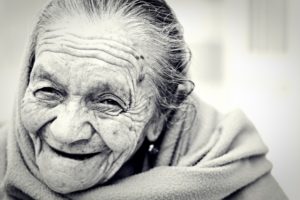
Photo by Cristian Newman on Unsplash
True female power knows how to live through the night alone, how to wander in the desert, how to go underground and live in a cave among the roots of life when necessary. She survives the conflagration, the invasion, the prison sentence, the betrayal, the loss, the beating, the chaos, the flood. A woman in her authentic power is rooted in the stars, in the trees, in the mountains, in the sea and in the earth. She welcomes cycles and seasons. Change is her strength. She knows how to bide her time and let die what must, because she knows her power will endure in women who come after her.
A woman in her power is not confused. She knows there’s no authentic power in money or position, youth or beauty or hairless legs. She knows her wellspring of power is internal and if she can’t find it, no one will. True feminine power defines her own success, her own goals, her own agenda, her own spiritual practice, her own beauty and her own rules.
Baba Yaga’s specialty is too-good maidens of all ages. That’s how I met her. When the Baba is finished with such a maiden, she’s either saltier and wiser or dead. Baba Yaga eats the dead ones with vinegar to cut the sweetness.
It’s a good time for prayers. Perhaps it’s always a good time for prayers. Here’s mine:
Baba Yaga, Grandmother, we offer you our sweat, tears, blood, milk and urine. Initiate us into life and death with our own blood and bone. Lead us back into love for ourselves, our bodies and our earth. Help us, your daughters, find our authentic feminine power again.
All content on this site ©2017
Jennifer Rose
except where otherwise noted
by Jenny Rose | Apr 13, 2017 | Emotional Intelligence, Fear, Feelings
Last week I came down the steep stairs from my little attic aerie, sat in a chair in the living room and cried while I asked my partner if he thought I would ever have a less effortful experience of life.
It’s not that anything was really wrong. What I was feeling was an old, familiar feeling of trying to manage my life and myself as efficiently as possible and feeling worn out and unsuccessful.
Photo by Bradley Wentzel on Unsplash
Trying. Manage. Efficiently. What am I, a machine?
I was tired that evening, and worried about diminished workflow and subsequent diminished paycheck. I wasn’t seeing a way out of my work/income situation, which is a place I’ve been in for several years.
One of the things I did last week during a work shift devoid of work was join She Writes, an online community for, obviously, women writers. I’d been procrastinating about doing so for a long time.
For years, I’ve been trying to find a writing community, both locally and online. I’ve joined a professional local organization, but their programs are rarely offered up here in Central Maine, as Portland is their headquarters. I’ve tried, unsuccessfully, to find beta readers for my first book. I put up an invitation to start a writer’s group at the local library and didn’t get a single call. I tried a give and take partnership with another writer so we could read one another’s work and provide feedback, but my partner had other priorities and needed to drop out.
And, of course, I need to work for that paycheck, so my time and energy are largely gobbled up by my financial needs rather than the joyful work of my life. This produces a chronic background tension that grinds away at my soul.
Anyway, I decided the time had come and I was ready to join She Writes and see what possibilities might open up through that community. I had to apply to join.
I knew they wouldn’t take me.
They accepted me (probably some kind of mistake) and the day after I sat in the chair and cried, I had another shift with no work and began exploring She Writes. I came across a blog post titled “The Only Reason to do Anything is Love,” by Bella Mahaya Carter, and had an epiphany.
Engaging with life from a place of love rather than fear is not a new idea for me, or probably for anyone reading this. It’s the kind of thing we hear and read all the time. I would have said I do that. It’s always my intention to show up in the world with love, which is to say kindness, compassion and respect.
The wording of Carter’s post, however, indicates motivation, an internal thing, not external action. Make choices with love, not fear. Decide what to do based on love. Do nothing for fear.
Right, I thought. I treat others and myself well. Of course.
Why?
I treat others well because I think it’s effective and I’m afraid of violence, hatefulness, rejection and just plain crazy.
I treat myself well because I’m afraid to be unhealthy, unable to earn a living and/or unable to be independent.
Photo by Milada Vigerova on Unsplash
It’s all for fear. It’s not for love.
Furthermore, treating myself well doesn’t equal loving myself. I caretake my physical form like a good property manager takes care of a rental. I exercise, eat well, brush my teeth, wash my body and take care of injuries.
What I think about myself is that I disappointed my parents, drove my brother nuts (not literally!), failed two marriages and made unforgiveable mistakes as a parent. I think I’ve never made a successful career or had a good enough job. I think I’m ridiculously hard to live with. I think I eat too much, use too much hot water in the shower, like obnoxious music, try too hard and am too sensitive. I think I’m unattractive and few people want to hug or touch me. I think I’ve spent years writing a 300,000-word book that, for all I know, has less value in the world than a roll of cheap toilet paper. On sale.
Those are some of the things I’m conscious of. When I look at my fear-based choice making, it appears I also think if I don’t hold my own feet to the fire at all times I’ll become a lazy, irresponsible, selfish slacker; demanding, mean, dishonest and greedy.
Carter’s post made me realize I could hardly think of a choice, any choice, whether important or mundane, that I haven’t made based on some kind of fear. Ever. From earliest memory.
The greatest motivator in my life is and has always been fear.
Not only that, but I’ve created a whole pantheon of idols I obsessively and ceaselessly worship in order to avoid the vengeful, punitive God I’ve made out of fear. I make daily bloody and brutal sacrifices of time, energy and life to appease them, but insatiable fear just gets more and more powerful. Here are some of the idols:
I read that post on Friday. There and then I decided to start making choices based on loving and believing in myself rather than fear of consequences and see what happened.
Without leaving the chair, I asked myself what the hell I was doing messing around with a job that wasn’t meeting my needs and I was unhappy in.
On Saturday I applied and tested for a job as an independent contractor to do transcription for an online company.
On Sunday I applied and tested for a job as an independent contractor to do transcription for a second online company and was hired on the spot. I also wrote the publisher of She Writes Press and asked for help with the next step for my book manuscript.
On Monday, when I ran out of work, I began getting qualified (via testing) to do various kinds of transcription through my new job and looked up the resignation process from my current medical transcription job.
Yesterday the second online business hired me.
This morning She Writes Press wrote me back with support, suggestions, a recommended professional who might read the manuscript, and what it would cost.
The fear is not gone. In fact, it’s louder than ever because I’m challenging it on so many fronts at once. The difference is I’m not standing nose to nose with it right now. Playing with the new toy of making choices based on what’s loving for myself gives me another option, which means now I can make a real choice.
Fear is not a bad feeling. We need it to survive. It’s just that mine has grown bloated and swollen on all the power I’ve given it over the years. The bigger it gets, the more space it takes. At this point I’ve become its thing. It thinks it can do as it likes with me.
It’s wrong.
I’ve had a belly full of life based on doing things out of fear. It’s exhausting, demoralizing, joyless and hag-ridden. It doesn’t work well and I’m sick of it. When I think about it rationally, I know I don’t need to beat myself with a stick through every day for fear I’ll become lazy, selfish, etc., etc. If I was going to turn into any of those things I would have done it long ago.
How would it be if I used regard for myself as a motivator and refused to do or not do out of fear? What might a life based on doing things out of thinking well of myself look like? What if I stopped giving anything to fear?
The funny thing is life looks much the same. The difference is largely in the outwardly invisible motivation behind my choices. Am I going to relax with music or a video and stretch because that’s the right and responsible way to treat my tiresome physical needs after a long day sitting in which I earned inadequate money, or am I going to do it because I love the way it feels after a tiring day in which I worked hard, whether I earned money or not?
Life is crazy right now. Everything feels like it’s in transition. I hardly know what to concentrate on in any given moment, there’s so much on the table. Even so, now when I run out of energy in the afternoon I spend a few minutes writhing between making a choice between demanding more from myself out of fear or doing something pleasurable and relaxing. So far, every day I’ve managed to choose rest and relaxation after another wild day.
It appears I’ve begun a new practice. I didn’t know that evening I sat in the chair and cried I was standing on an important threshold. I didn’t know by the end of the week I’d have not one but two new jobs. I didn’t know I was going to finally get serious about putting my manuscript into a professional’s hands and risk failure and rejection. I didn’t know in just a couple of days I was going to begin making a habit out of rolling out of bed and stepping into the day’s embrace with curiosity and a resolve to think well of myself as I navigate, rather than wondering fearfully what would happen next and whether I would manage it adequately.
So far, so good.
Nothing more for fear.
Photo by Stephen Leonardi on Unsplash
All content on this site ©2017
Jennifer Rose
except where otherwise noted
by Jenny Rose | Apr 6, 2017 | A Flourishing Woman, Creativity
Walking on our 26 acres, my path winds around open fields and keeps me out of heavy woods and brush, where ticks are waking. It’s grey and overcast, not raw but damp, a combination of snow and rain coming down and turning my already wild hair into a mad woman’s wig. The surface of the snow is glazed hard in most places, but when I get close to the tree line or streams that trickle down to the river, I punch through it and sink. Walking on the thick layer of leaves under and among the trees is like walking on a sopping sponge. My socks are sodden inside my winter boots.
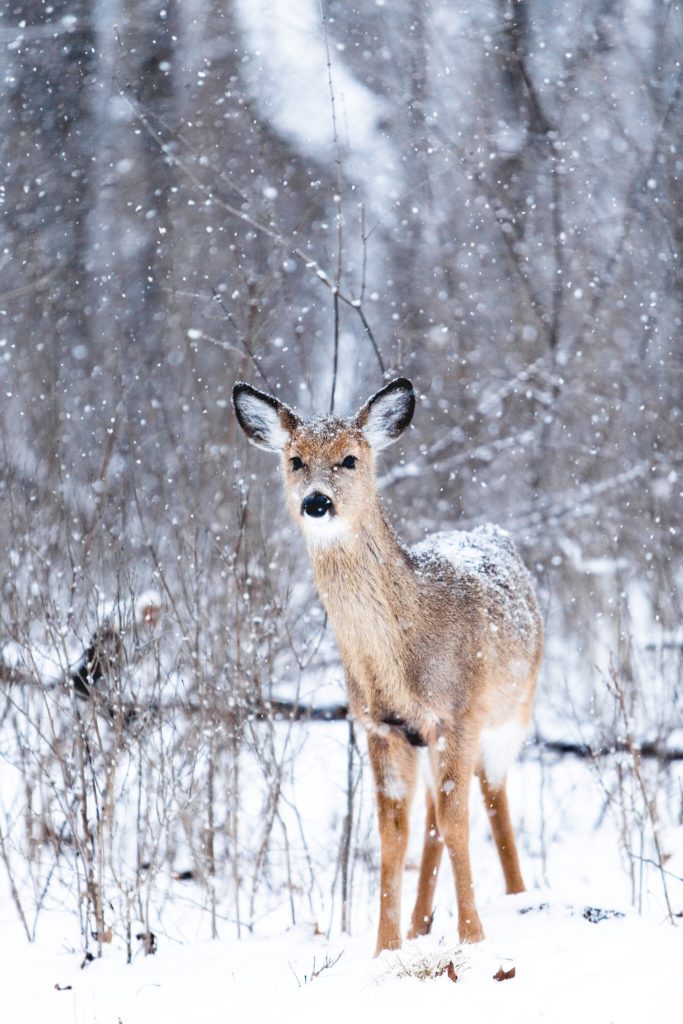
I see thickets where the deer have slept, melting the snow with their warm bodies, lying out of the wind in the shelter of trunk and branch. I imagine them rising to their feet, squatting in their awkward way to leave pellets and a splash of urine, and then stepping away through the snow with those delicate hooves and legs. Their spoor is everywhere.
Photo by Teddy Kelley on Unsplash
The medical transcription business is wildly unpredictable. One seesaws between frantic pleas from supervisors for overtime because of a sudden flood of work and the dreaded “no jobs available” message upon logging in. As I’m paid by production, no work means no money. Since the new year, work has been slow in the company and transcriptionists and supervisors alike are feeling the stress.
I’ve been thinking about my fear of not enough these days, and how small it makes me and my experience of life. One of the reasons I like to go out and walk is because it pushes against my tendency to curl up in corners and play hours of solitaire while I make up stories about living under bridges and berate myself for NOT PULLING MY WEIGHT and WASTING TIME.
The river is still ice covered, the edges yellowish and slushy. I see animal prints in the snow over the ice, but I wouldn’t dare try to walk on it. As I lean against a tree and look down at the ice-bound river, I hear a nesting pair of barred owls calling to each other, though it’s still early afternoon.
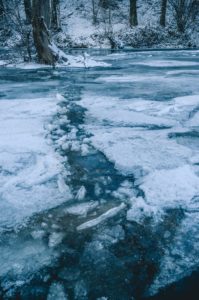
Photo by Vincent Foret on Unsplash
The truth is my medical transcription job is nothing more than a means to an end. It’s all about the paycheck. I take some modest pride in my ability to do an accurate, fast job, but I’m just a pair of skilled hands and ears. One day, when the job and I are finished with one another, I’ll leave no remnants of myself, no track, no scent, no spoor. It irritates me that it has so much power in my life when it means so little.
Water drops tremble on bare twigs and tree branches. The pussy willows are beginning to bud. Cloudy light washes the willow buds and water drops the same silvery grey and I have to draw near to tell the difference.
We’ve lately found a local lawyer to help us update our wills and take care of end-of-life paperwork. It’s made me think about all the fragments I’ll leave behind me, the furniture I’ve loved and polished; the mirror I’ve looked in since I was a child; the books I’ve handled and read in cars, in bathtubs, at tables, in beds and chairs and waiting rooms. All these things will be sifted through, separated, sold, passed on. What money there is will be divided and wind up in other bank accounts or hidey holes or cast back into the flow somehow. Perhaps whispers of me will cling to a few objects, but for the most part no one will ever know I passed this way.
OLYMPUS DIGITAL CAMERA
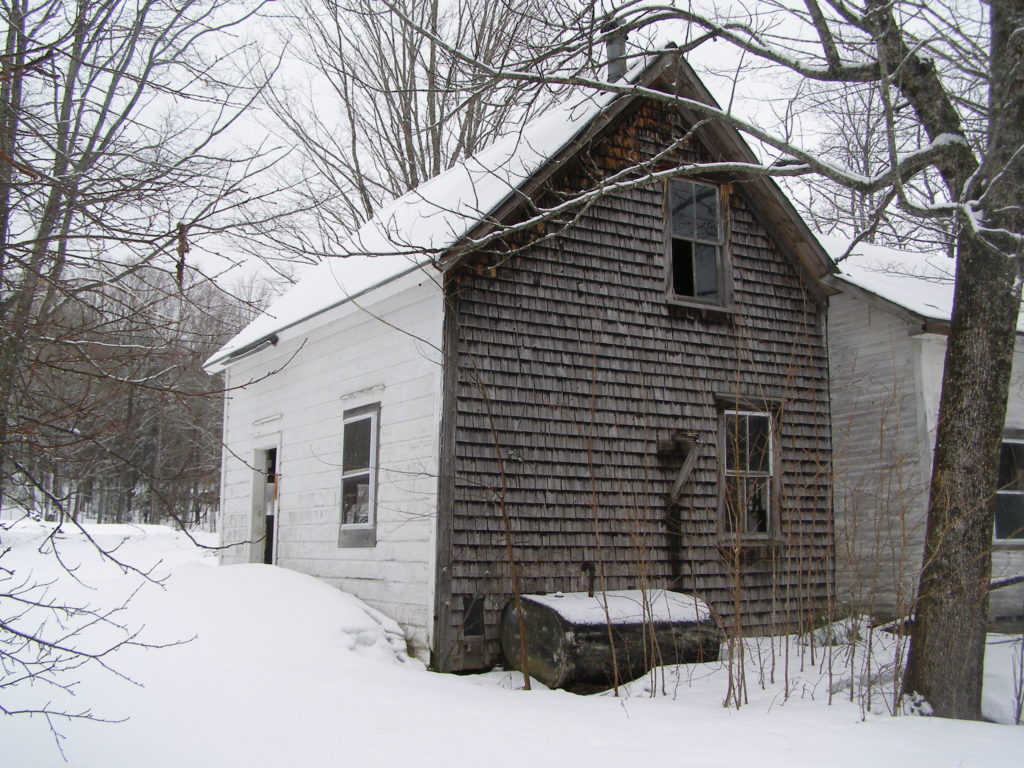
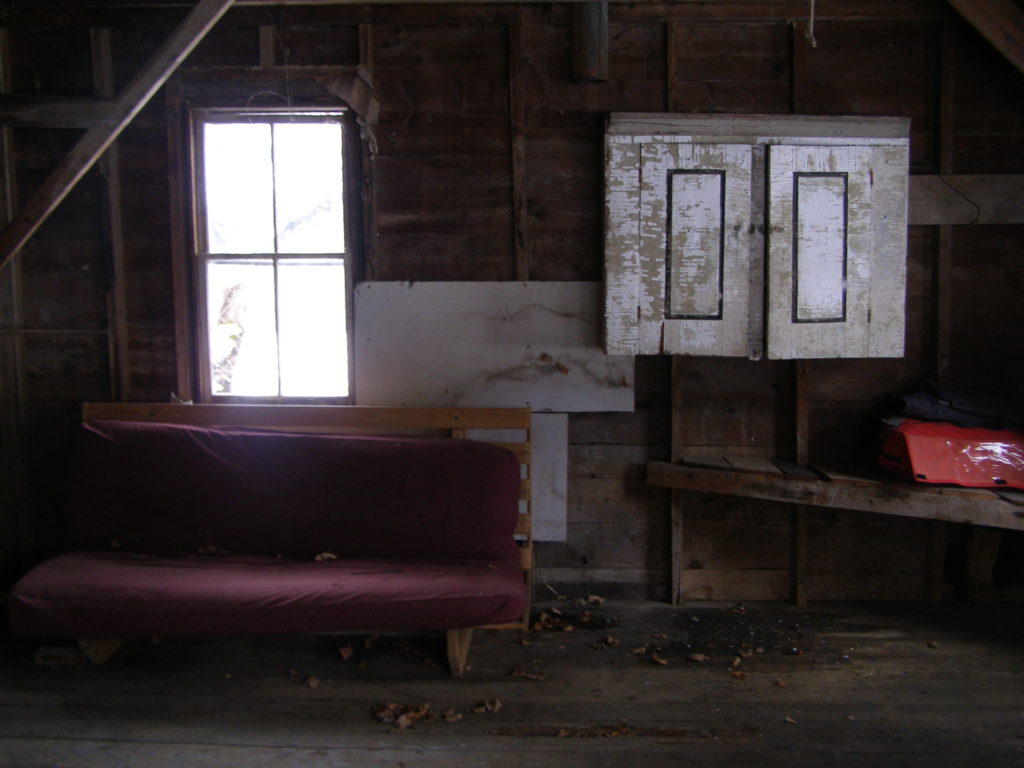
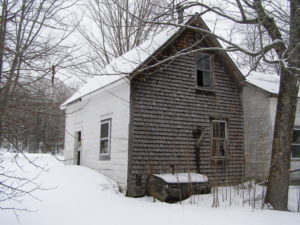
We have an old shed on the land and snow slide off the roof has blocked the door and partially pushed it open. I’m just able to squeeze in over a thick layer of ice on the threshold, formed by melting snow dripping off the roof.
We cleaned out and swept the shed last fall, but I find pages of paper blown all over the floor, pages of the first draft of my book manuscript. Last summer we had visitors who used the shed, and I’d hoped they would read and give me some feedback. They didn’t, and I’d never found the manuscript when I looked for it after they left, but the winter currents and drafts discovered its hiding place. Perhaps the wind read it as it ruffled through the pages with chill fingers.
It’s odd to see those scattered pages on the cold, splintered floor. The sight of them gives me a desolate clarity. Those written words are the most important thing I have. Working or not working, large paycheck or vanishingly small paycheck, all the objects I love and use and call mine — none of that is really who I am. None of it really matters, though it takes up space in my life. None of it contains the smell of my breath, the taste of my pain or the spoor of my love the way my words do. It’s as though it’s me lying there, discarded, damp and wind strewn, unseen, unread, unwanted. It hurts me.
As I gather up pages, I note where the snow has drifted through gaps in corners. Wrinkled beech leaves lie on a discarded futon, whirled in through the broken window above it. I open a ramshackle cupboard and find a roll of shredded toilet paper and evidence of mice at work, making the most of an unexpected bonanza of nesting material.
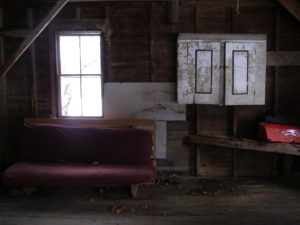
I find a bottle cap and cigarette butts on a window sill. More leavings. I know who stood there, smoking, looking out the window. I stood where he’d stood and picked up the butts, knowing his lips were around them, his long-fingered hand had carried them from pack to mouth and then stubbed them out in the bottle cap, a tiny ashtray. I wish for the nose of a wild creature so I could search for the cold, lonely ghost of his scent.
He was here. I am here. Deer crisscross this land we call ours. Mice go about the business of ensuring more mice, and the barred owls carry on their early spring conversation about mating, nesting, eggs and all those mice. We are so caught up in jobs and money and things. We give them so much meaning. The days go by and we alternately struggle and dance through them. But one day we’ll be gone, and we’ll all leave spoor behind, a scent or sign or footprint uniquely and simply ours.
These words are my footprints, my scent, my lingering warmth in the places I came to rest, my spoor. They are signs of my passage and the truest things I have to leave behind when I’m gone.
All content on this site ©2017
Jennifer Rose
except where otherwise noted