Is it possible to share our happiness? More specifically, is it possible for me to share the things that make me happy with others? I ask because my immediate answer to the first question is yes, of course. My immediate answer to the second question is no. Well, rarely. Let’s say rarely.
Photo by Kevin Quezada on Unsplash
Martin Seligman makes a statement in his book, Authentic Happiness, I’ve been thinking about for several weeks. He writes that seeking out others to share our happiness with, and telling them how much we value the moment “is the single strongest predictor of level of pleasure.”
I’ve struggled all my life with an intense desire to share my happiness with loved ones and an inability to do so.
It works well the other way. For me, one of the joys of connection is allowing myself to become enlarged by the presence of others. I’ve always loved being exposed to what those around me enjoy: new music, new movies, new books, new ideas and new ways of doing things. All my close relationships have made me bigger and contributed to who I am in this moment, and I’m deeply grateful for it.
But I rarely seem to find reciprocity. Or flexibility. Or curiosity. Or something. I’ve never been able to figure out why. Is it that the things that make me happy are stupid, or inappropriate, or boring? Is it something about me? Is it that some people don’t value sharing emotional experience and joy and I have a genius for wanting to connect with those kinds of people?
Photo by Bewakoof.com Official on Unsplash
Maybe some people have no happiness to share?
My inability to share my happiness and enjoyment with others has left me with a painful feeling of guilt, as though it’s disloyal or a betrayal if I enjoy something others can’t. Or won’t. Guilt turns me inward; I pursue my happiness in secret, stifling my longing to share it, struggling with feelings of rejection and resentment. I show up in their lives to share. Why don’t they want to with me? Am I needy? Demanding?
Around and around I go as I think about this, getting nowhere useful.
When I encounter a hairball like this in my life, I look at it through the lens of power dynamics. The fact is I know what makes me happy. I value experiencing the happiness and delights of others. Both are entirely within my power. I do long to share my own happiness, but sharing requires the participation of another, and that is not in my power.
Guilt and shame are not useful burdens to carry around. My happiness takes nothing away from anyone else. Making myself unhappy doesn’t ease someone else’s unhappiness. Hiding my happiness doesn’t seem like a useful choice. As for resentment, holding on to that only hurts me.
Another problem with my strong desire to share my own happiness is it reinforces people pleasing. I tie myself into knots thinking about exactly the right timing and approach in order to get someone else to be interested in sharing something I enjoy. Or I tie myself into another kind of knot trying to optimize what I think makes others happy, regardless of the personal cost to myself. If we can’t share happiness, and if something other than what I have to offer gives someone happiness, I disappear as much as I can so there’s maximum room for whatever I think is most wanted.
Photo by Evan Kirby on Unsplash
It sounds so easy. Find someone to share our happiness with. Tell them what the moment means to us. Enjoy the pleasure.
What am I doing wrong?
As I think about this, I wind up in a familiar place — with myself. Exploring happiness during these last weeks has made me newly conscious of my experience. Over the last couple of decades, I’ve gradually learned to befriend and care for myself, replacing old habits of self-destruction and self-loathing. I see now much of what I’ve done for myself, rather than waiting for someone to read my mind and do it for me, or give me permission to do what gives me pleasure, have been the same things that make me happy. It’s just not a word I’ve felt very friendly with or applied to myself before.
I’ve thought about all this during my Thanksgiving break. I spent hours and hours cutting greens and making holiday decorations. I thoroughly enjoyed it, and it was extremely stressful and uncomfortable. I enjoyed it because I love working with my hands, giving gifts, and sharing (there’s that word again) the glory of our evergreen trees and the spirit of the season. It was stressful and uncomfortable because I feel so much anxiety about sharing those things that give me such pleasure. Would I be making people uncomfortable, imposing a gift return obligation? Were the decorations ugly or inappropriate in some way? Would people already have wreaths and decorations and have no use for them? Were they too much? Too little? People probably can and have made or bought something much better.
This is familiar territory, as it’s always the background to posting on this blog. I push through it when I’m writing, but I usually talk myself out of giving spontaneous creative gifts. I decide whatever I want to do is a dumb idea, a waste of time, and, frankly, it’s too scary to be that vulnerable and risk rejection, misunderstanding, or making someone uncomfortable.
It’s too scary to share the things that make me happy.
Sigh.
Working with Seligman’s book and thinking about happiness has changed things. I decided I was going to do something I love to do, share my enjoyment with others, and damn the consequences, or, better yet, completely let go of outcomes. Even if what I made gets thrown directly into the fireplace, what have I lost? My enjoyment of gathering, making, and giving remains intact. My happiness and expression of love are still free in the world instead of hidden and imprisoned in my own heart.
We humans make and seek patterns in everything we do. Sometimes we’re conscious of these patterns, and often we’re not. Discerning patterns is an evolutionary advantage that’s helped us survive, as the complex web of life is filled with them. A rudimentary example is patterns of color on reptiles, plants, fish and insects warning of toxicity.
Photo by Luca Bravo on Unsplash
We organize and sort patterns into objective taxonomies and hierarchies as we learn and strive to make sense of our world, and we label them.
I’ve been thinking about labels for years, and I’ve written about them previously. Our tendency to create labels and slap them on others has become more vicious and hysterical than ever before, and I’m concerned about this entirely divisive trend.
Language is an agreed-upon set of symbols. Nouns describe specific objects or ideas. Nouns are, by their nature, exclusive. That’s why they exist. A pencil is not a door. A tree is not a river. Labels are nouns, too, but they can be sloppy and imprecise, and they’re weighted with a lot of subjectivity and emotion. If we talk about a pencil in mixed company, we’re not likely to cause a scene. If we talk about being a Republican, or a feminist, or an anti-vaxxer, we’re asking for trouble.
Many people create and use labels as social weapons in order to convey hatred and contempt rather than specific objective meaning.
Photo by Ludde Lorentz on Unsplash
The complex system we call life on earth is infinitely complicated, and we, as parts of that system, are also complicated.
Subjective labels are superficial, a mere glimmer on the surface of a deep well. They’re all about one-stop shopping and contain the emotional maturity of name calling. They often originate with individuals or groups who seek power over others. Anyone, regardless of education, experience, or expertise, can label anyone else, and frequently do, ruining credibility, reputations, and careers. Labels are limiting and confining. They concentrate a personal attack on one perceived aspect of a human being and ignore all the rest.
Patterns are deeply embedded, often invisible at first glance, but powerful and complicated. The ability to discern and learn about patterns requires critical thinking and a careful process of objective inquiry. We need precise language to describe the many dimensions of patterns. Discerning patterns is not a personal attack, but an observation of behavior and other characteristics (our own as well as that of others) that helps us survive.
Understanding and recognizing patterns gives us the power to manage them usefully and effectively.
Photo by Anastasia Zhenina on Unsplash
Many of us are aware of uncomfortable patterns in our lives. Some are caught in a loop of patterns resulting in health consequences such as obesity, pain, and addiction. Others are unable to find the right job, the right place to live, or the right partner. Many of us spend a significant amount of time making the same choices, over and over, and getting the same unsatisfactory results, because we don’t know what else to do.
As we are social beings, our relationships are important, and destructive patterns involving our connections with others can be devastating. Fortunately, there are smart, observant, thoughtful people in the world who recognize behavioral patterns, create tools and use their experience and education to support and teach others how to discern and effectively manage problematic patterns.
One such person is Bill Eddy, a Licensed Clinical Social Worker and a Certified Family Law Specialist who has more than 32 years of experience providing therapy, mediation, and representation for clients in family court. Eddy co-founded the High Conflict Institute and has become an international resource for managing high-conflict behaviors. He’s written several books, all of which I highly recommend. In fact, his book, BIFF, is an essential handbook for life as a member of the human race.
What I like best about Eddy is he’s not a labeler. He uses precise scientific language to describe some personality types as context and background, but the thrust of his work is not in diagnosing or labeling, and he actively encourages students and readers to refrain from doing so. His goal is to help us recognize problematic patterns of behavior and teach us how to handle them effectively, kindly, and compassionately while maintaining our own dignity and healthy boundaries.
Nowhere in his work have I seen Eddy suggest we self-apply his methods, but I have my own less-than-useful patterns and character traits, and his strategies help me manage those as well as the behavior of people around me.
In Eddy’s language, high-conflict behavior patterns include consistent:
All-or-nothing thinking
Unmanaged emotions
Extreme behavior
Preoccupation with blaming others
–(BIFF: Quick Responses to High-Conflict People, Their Personal Attacks, Hostile Email and Social Media Meltdowns by Bill Eddy, LCSW, ESQ.)
The beauty of Eddy’s tools is simplicity. Anyone who’s ever been hooked into an angry, defensive, escalating, and totally useless high-conflict interaction (and who hasn’t?) knows how exhausting, disheartening, and disempowering such interactions can be. Eddy’s approach is entirely different and much simpler, but it requires us to give up several juicy things.
In order to manage this behavior pattern effectively, we have to give up on winning and being right. We have to give up on taking things personally; trying to change, “help,” or control someone else; the satisfaction of personal attacks; and trying to please. We must learn to manage our own emotions, because two people, neither of whom can deal effectively with their feelings, will get nowhere. We must decide if we want to contribute to conflict or resolve it.
Photo by Lukas Budimaier on Unsplash
In short, if we want to reclaim our personal power and manage difficult behavior patterns more effectively, we have to start with ourselves and our own behavior, feelings, and impulses.
If we are stuck in a destructive relationship at work, at home, or in the community with a high-conflict personality and we feel helpless and hopeless, the first step in finding a better way is an honest assessment of what we want. If we want to continue to be a victim; if we want revenge or to freely express our frustration, rage, or contempt (as in throwing around labels); if we want to be validated or approved of; if we want to force others to see it our way, apologize, or be just, Bill Eddy has nothing to offer us.
If we’re stuck and committed to finding a better way, accepting that the person we’re dealing with has an observable, consistent pattern of high-conflict behavior and may not be interested in the same outcomes we are, and accepting responsibility for our own behavior, Eddy can show us the way back to our power and sanity.
Dealing effectively with high-conflict behavior patterns does not mean we have to be disrespectful, intolerant, or uncaring. It doesn’t mean we have to sacrifice our own integrity or boundaries. It doesn’t mean we have to stop loving people. Best of all, recognizing problematic behavior doesn’t mean we give up on the whole person. Many valuable employees and community members exhibit high-conflict behavior patterns.
In fact, Eddy’s tools apply to any human interaction, as they involve brief, informative, firm and friendly scripts appropriate and effective in all contexts, whether consistently high-conflict, potentially high-conflict, or entirely friendly.
Labels create and escalate conflict rather than resolving it. Recognizing patterns and learning how to work with them can help us resolve conflict.
As so often happens, there are several strands to this post. Chronologically, the first strand was this podcast from The Minimalists about race relations. I don’t usually take the time to listen to podcasts, but I follow The Minimalists and this discussion was a perfect antidote to the current disturbing headlines and media rhetoric. It made me think and provided some insight into the problem of racism. In the podcast, there’s a fascinating discussion about hate speech in which a suggestion is made that it’s not a real thing.
What?
Photo by roya ann miller on Unsplash
I know. That was my reaction, too. Hate speech is everywhere, right? On social media, on signs and bumper stickers, in the mouths of ordinary people, and in the media. It’s true that words are frequently used hatefully as we talk and write. Language, remember, is a symbolic system used to convey meaning. Speech, or writing, for that matter, is simply the use of language. Speech is only a small part of conveying information, though. Nonverbal communication is more important than the actual words we use, things like volume, intonation, emphasis and body language.
Hate speech is simply speech used to convey hate. The words alone are mostly neutral. The speaker or writer are the sources of the hate.
It’s trickier even than that. Some common, perfectly neutral words like “uterus” are now classified by some as hate speech. This is clearly ridiculous. There’s nothing hateful about the word. When I use it, I’m certainly not feeling or intending to communicate hate. The hatred, if it exists, is in the listener.
Photo by Jason Rosewell on Unsplash
Hateful people speak and write hatefully, and are predisposed to hear hate when none is intended. People who are not haters use the same words to convey simple meaning, and are surprised and incredulous when accused of engaging in “hate speech.” Fortunately, being accused of hate speech doesn’t make it so.
Let me be clear I’m not poking at things like mascot names that demean American Indians, or use of words like “nigger.” I don’t support either, ever, for any reason. When a group of people protests that such terms are hurtful to their culture, history, and sense of worth, we need to be respectful. Some words are pejorative and ugly, and they’re meant to be. Language is not static; hundreds of slang words and idiotic labels are created and used every year, some with a specific intent to convey hatred and contempt. What I’m focusing on is standard language, words we use in everyday settings and circumstances with dictionary definitions.
I’ve thought a lot about this. Is there such a thing as hate speech, or is it simply that hateful people use language to say and write hateful things? In that case, the problem is people hating, not the words themselves.
That was the first thing.
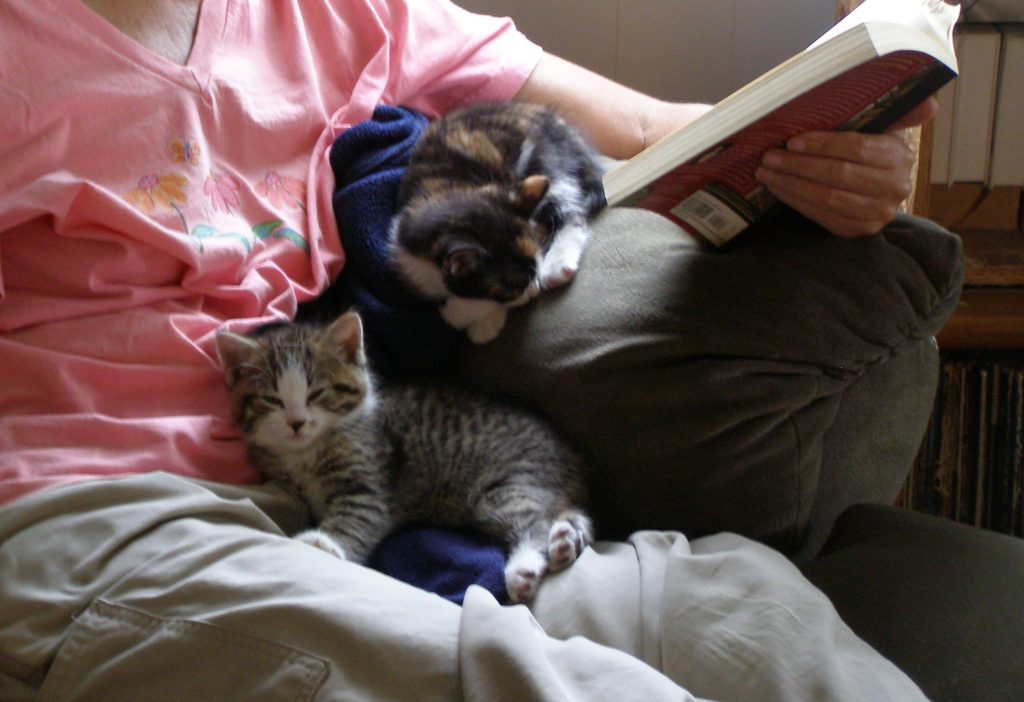
The second thing was our recent adoption of a pair of kittens. We both love cats, and our old cat died over the winter, so we had an empty place in our hearts, which these two have filled magnificently.
Ozzy & Izzy June, 2020
It’s been a long time since I’ve had babies to take care of, and it brings back a flood of memories and feelings, especially my desire to be a “good” mom. I notice how important it is to me that they be happy, healthy, safe, well-bonded and learn to differentiate between bare skin and clothing as they climb, play and explore. I want to do it right. I want to do it well. I spend time evaluating my patience, my efforts to keep them safe, my performance as litter box cleaner and fresh water procurer, my roles as playmate, limit-setter and comforter.
Am I a good kitten caregiver?
The third strand in this post comes from a book, Chocolat by Joanne Harris, who is one of my favorite writers.
“I don’t think there is such a thing as a good or bad Christian,” I told him. “Only good or bad people.”
Photo by Alex Iby on Unsplash
As I read that, I thought about the podcast I’d listened to, and my conclusion that perhaps there’s not such a thing as hate speech, just words used by haters. My practice of minimalism has taught me to simplify wherever possible, and it occurs to me we’re all many things to many people in life, and most of us are trying to be “good” friends, partners, family members, employees, and probably an infinite number of other roles. We fragment our identities into all these shards and pieces. What if we let go of all that and focused on being “good” humans? Wouldn’t being a “good” human across the board take care of everything else?
Then, of course, we have to decide what we mean by good and bad, but I’ve already opened that can of worms a couple of times, so I’m not going to go there again. Let’s forget about the term “good,” which means everything and nothing.
If I practice love instead of hate (including with myself), if I strive to be tolerant, respectful, authentic, responsible and keep my integrity intact, then I bring those qualities to everything I do every day, whether I’m working, hanging at home, playing with kittens, spending time with friends, interacting with family, or buying groceries. I don’t have to worry about being a “good” anything. I simply strive to be the best human I can be, whatever the circumstances, whatever the context.
Let it be said that not everyone has a desire to be “good.” I am all too well aware assuming everyone has my agenda is a fatal mistake. There are those who would love to see the world on fire.
Still, I believe most of us are trying to be a “good” … whatever, according to our definition of good. Sadly, especially when we think about religious and political pieces of identity, this is often where the hate begins.
It’s complicated. People are complicated. We’re also devious. Debating about what is and is not hate speech is a diversionary tactic leading nowhere. The issue is not words. Words don’t hate. The issue is our own hatred toward ourselves and others, and for that we are responsible. The issue is not our willingness or ability to fulfill expectations of what it means to be a “good” fill-in-the-blank. That’s nothing but pseudo self. Life is not a performance. The issue is what kind of humans do we choose to be? What kind of humans are we?
Certain ways of thinking support and feed my perfectionism, and other ways of thinking starve it. Being concerned with being a “good” this, that and the other is a lot of anxious work and encourages perfectionism, pseudo self, people pleasing, and a whole host of other unhelpful behavior patterns.
Photo by Stephen Leonardi on Unsplash
Approaching each day and activity with a desire to be my best and respect the needs and feelings of myself and others is not only simpler; it leaves me with energy and space to have fun, to love others wholeheartedly (even when they do climb up my bare leg with tiny pin-sharp claws), and to enjoy life.
I talk. I write. I listen to feedback about how my words affect others. I know I’m not a hater, and I don’t allow others to project their hatred onto me. I accept I have no power over readers or listeners who are determined to misunderstand and twist my words into hatred. I practice respect for myself and for others. Words used by haters divide and leave deep wounds. Words used by non-haters have the power to connect and heal.
If we are not humans who hate, our language will not be hateful. If I practice love, responsibility, patience, and tolerance, I’m a good-enough kitten caretaker. If I strive to be a “good” human (according to my definition), then I can forget about the individual performance of all those fragmented pieces of my identity.
Last week, Thursday approached, arrived and passed, and I had nothing. Nothing to post; no insights, inspiration or coherent questions. No journeys, organized notes, serenity or discipline.
Photo by Joshua Rawson-Harris on Unsplash
What I did have was the feeling I was inadequate, ridiculously undisciplined and failing to manage my stress and anxiety. I had a collection of entirely made-up apocalyptic stories about the future and a migraine headache. I had worries about friends and their families, people who were sick and couldn’t get seen or tested for coronavirus or anything else. I had rumors about numbers of infected community people that couldn’t be either confirmed or denied. I had pacing, restlessness, climbing the walls, apathy, and a feeling of futility and disconnection I called depression. I had hours invested in online Mahjongg solitaire.
I also had squirrels in the ceiling of my attic aerie, scampering, wrestling, playing, gnawing, and making soft sweeping noises that sounded very much like making a nest. By day, the noise was distracting, even if I did smile in sympathy because it sounded like they were having so much fun. The gnawing, however, was maddening, as we could neither locate the exact location of the animal(s) or the access point(s). It sounded like they were going to come through the wall into the room any minute.
By night, their noisy activity was beyond distracting. As I lay staring up at the ceiling over my bed, I thought bitterly they were having much more fun this spring than I am. They also had a lot more energy than me. Nice for some people to have a night of romance, play and planning for a family in a cozy, sheltered place.
Squirrels are rotten roommates.
My partner and I missed walking for a few days due to weather (cold, windy, and more snow — Aargh!), and just feeling out of sorts in general.
When we finally did get out again during a breezy but reasonably mild sunny afternoon, as we walked up the hill my partner asked me a question:
“Have you ever felt yourself to be a good girl?”
Wow. What a terrific question. Nobody had ever asked me that before. I had never asked myself that question before.
It didn’t take any thought.
Photo by freestocks.org on Unsplash
One of the first things I knew about myself is that I was not a good girl. I am not a good girl. Not in any sense of the word. I’m not a good female. I wasn’t a good daughter, sister, mother or wife (especially wife!).
After that immediate knee-jerk response, though, I really thought about the question, at which point I wondered what, exactly the definition of good is. A little bell began ringing in the back of my head. Hadn’t I written about good and bad in some other context lately?
As we walked that day, my partner and I played with the concept of being good or bad, how we form such pieces of identity, and how we are shaped and influenced by our self-definition. My partner said that being a “good girl” means being an obedientgirl.
Well. If that’s true, no wonder I’ve never been a good girl! My best friend couldn’t truthfully call me obedient. I noticed I immediately stopped feeling hopeless, worthless, tearful and miserable, thoroughly distracted by the conversation. In fact, I suddenly felt amused.
Somewhere inside me is a three-year-old who equates being good with feeling loved. I know, intellectually, that’s nonsense, but evidently I can’t quite get it emotionally. I keep thinking I’ve dealt with this thing as I’ve worked on my pernicious habit of people pleasing and deconstructed so many old beliefs and patterns, but a certain kind of stress and experience dumps me right back into my three-year-old self before I know what’s happening.
At that point, I temporarily forget every step of the long journey I’ve made in reclaiming myself and my power.
I went back and found my post about good and bad creative work. It made me smile, because as I wrote it, it never occurred to me to take the concepts of good and bad a step further and think about them as they apply to who we believe we are as people.
Here’s a brief review of the definitions of good and bad from Oxford Online Dictionary:
Good: “To be desired or approved of,” “giving pleasure, enjoyable or satisfying.” Bad: “Of poor quality or a low standard,” “not such as to be hoped for or desired; unpleasant or unwelcome.”
So what have we got? Two entirely subjective black-and-white descriptors, that’s what we’ve got. Furthermore, neither have a thing to do with unconditional love, which is the only kind worth giving or receiving, as far as I’m concerned. “Love” predicated on compliance and obedience isn’t love at all, it’s a toxic mimic and a control tactic.
If being good is being obedient, I have no interest in it. Neither do I have interest in being bad. Both are non-concepts. Good and bad have no power unless I have no power.
Goodness and badness are as impotent and limiting as compliance and obedience. There is no there there, no wildness, no creativity, no complexity, no gravid chaos, no resilience or flexibility, no authenticity, and no personal power.
Am I a good girl?
God, no! My whole life I’ve been so much more than that!
Sometimes these posts are like puzzles. I pick up fragments in the course of daily life, and I find they all belong to the same idea. Remember doing dot-to-dot puzzles as a kid? I’m never sure what the shape is I’m working on, but I turn the pieces of the puzzle around until I’m satisfied with a coherent (hopefully!) post. It’s fun.
Photo by Syd Wachs on Unsplash
If I was bent on delivering a learned lecture in this post, I would have titled it “Postmodernism.” I’m not interested in lecturing, though, or philosophizing, or exploring current ideas and trends in a scholarly way. Ick. If you’re not sure what postmodernism is, here’s a link. You can educate yourself and draw your own conclusions — always the best way!
As I researched postmodernism I came across a referral to “post-truth.” Huh? Post-truth is “relating to or denoting circumstances in which objective facts are less influential in shaping public opinion than appeals to emotion and personal belief.” (Oxford Online Dictionary)
YIKES!
Truth is a slippery concept, and I’m not interested in debating whether it’s “real” or not. The tension between objective facts, denial and beliefs is a can of worms I have no interest in opening. I do accept science-based inquiry and methodology, particularly if data can be replicated, the process is peer-reviewed, and the funding is clean and unbiased. For me, truth and learning are dynamic, flexible and organic. What might be true for me today may change tomorrow, but that doesn’t mean today’s truth is necessarily a lie.
I don’t accept that belief and truth are the same, and I don’t accept that feelings and thoughts are necessarily objective facts.
The puzzle pieces I have collected this week all fit into postmodernism, but, as usual, I come at it in my own unique (and slightly off-center) way. Here are the pieces, in no particular order:
Photo by frank mckenna on Unsplash
One of my four most important values and priorities in making choices is to see things clearly; in other words, not to argue with what is, be in denial, or wholly and unconditionally believe in my own stories, assumptions, and feelings. Understand, I validate, value and rely on my feelings, but I’m very aware they don’t always point to the truth. I might feel rejected, for example, but that doesn’t mean I am rejected. It doesn’t mean I’m not, either. The feeling points me toward something needing further exploration, that’s all.
When I say “see things clearly,” I mean accepting what is without fear, resistance, apology, or the need to rewrite or sanitize my experience.
The second puzzle piece is a conversation I had with an approximately 30-year-old man in which I described a relationship that was not working well and what I did about it. His comment was “harsh.” Intrigued, I asked if it would have been better if I’d lied to the other party, or continued the relationship in spite of believing it was unhealthy for both of us. He had no answer for that. I asked if he had a suggestion for a kinder or different way I could have communicated my truth clearly. He had no answer for that one, either. What I was left with was, from his point of view, it was wrong for me to feel the way I did and tell the simple truth about it, without shame or blame, honestly communicating my sadness, my need to part ways, and my caring for the other party.
I’ve thought a lot about this conversation. As regular readers know, I dislike labels and sweeping generalizations, but I wonder if part of his problem with my choice about ending my relationship has to do with the trend in his generation toward postmodernism; that is, that there is no truth, all stories are equal, and to speak “truth” is somehow hateful, bigoted, and/or mean. I’ve even been told stating the truth is “dehumanizing.” Wow.
From my point of view, identifying and speaking the truth is by far the kindest thing we can do for each other and ourselves. Communicating the truth means we are taking responsibility. It means we have the courage to have a difficult conversation face-to-face, rather than ghosting, making excuses, living a lie, or leaving someone with no closure. It means we are healthy enough to take care of ourselves and manage our time and energy, and authentic enough to be heartful and committed in what we choose to do with our lives.
Photo by Alex Iby on Unsplash
I realize, of course, that some people use the truth as a club, and take no trouble to employ clear, kind language. Shame and blame and refusing to take responsibility are not truthful. Pretending is not truthful. Making excuses is not truthful. Cultivating a pseudo self is not truthful.
The third piece of this particular puzzle was in a book titled Roadwork by Richard Bachman (a.k.a. Stephen King). Here it is:
“But Mary’s footsteps never faltered because a woman’s love is strange and cruel and nearly always clear-sighted, love that sees is always horrible love, and she knew walking away was right and so she walked …”
I’m a fan of King’s writing, and this quote really caught my eye. I stopped reading, bookmarked the quote, and thought about being a mother and all the agonizing choices one makes when raising a child. (The context of the quote has to do with a mother and child.)
It’s terribly difficult (and sometimes terribly painful) to be clear-sighted about our own children. We are forced to make decisions that tear us apart, always striving to do what we think is best and frequently missing the mark. Moreover, having children means we are forced to look at ourselves more clearly for their sake, and that process is humbling, painful, and occasionally terrifying.
I ask myself, is this how King experiences a woman’s love? If so, is it a woman’s love for her child he has his eye on, or a woman’s love in general? Is it terrible love because it’s “clear-sighted,” or because women who love are capable of making horribly difficult choices and sacrifices for the sake of those they love? Is it the love that’s “strange and cruel,” or the clear-sightedness of that love? Or both?
I recently wrote about unconditional love. Is that kind of clear-eyed love “horrible” because it’s so powerful?
Photo by Cristian Newman on Unsplash
I’ve mentioned before somewhere on this blog that in the Tarot deck, which has pre-Christian roots, The Devil symbolizes authentic experience. This indicates to me dealing with the truth is not a new challenge for human beings. Postmodernism is just another cyclical iteration we’ve come up with as we struggle with the truth, misinformation, outright lies, authenticity and pseudo self, the sincere desire of many to be kind and compassionate, and the equally sincere desire on the part of others to control cultural narratives and (dis)information. I’m the first to admire and practice kindness and compassion, but taken too far they become enabling, denial, codependence, pseudo self and abdication of our own self-defense and needs.
The last piece of the puzzle was this link I received to a piece of satire about the “divisiveness” of truth. Satire is not my gig (I have a sneaking suspicion it’s above my head), and I don’t normally enjoy it or pass it on, but this was certainly timely, and it demonstrates the (to me) crazy thinking postmodernism leads to.
It seems to me truth is connecting rather than divisive. I’m wary of anyone who responds to the presentation of an objective or science-based fact with a rant about divisiveness. Those who seek to persuade us there is no truth anywhere, that whatever we believe is Truth, are the ones who are actively divisive. Critical thinking is not about hate, fear, control or manipulation; it’s about seeing the world around us with curiosity and clarity.
Photo by Hailey Kean on Unsplash
So what’s the deal with the demonization of truth, or authenticity, or honesty, or facts, or whatever? Does it have to do with technological cultural influences? Is it connected to our broken educational system? Does our decreasing literacy (TLDR — too long, didn’t read) play a part? Do our burgeoning health problems, poor diets and ever-increasing toxin loads affect our ability to think well?
Have we become so fat, lazy and comfortable we simply don’t want to make the effort to learn, explore, reflect and think critically?
Are we so entitled and selfish we reject unpleasant or unwelcome truths that might threaten our status quo?
Sometimes the truth is painful, inconvenient, and difficult to hear and say. Are we so precious, pampered and cowardly we need everything sugar-coated and artificially flavored and colored in order to deal with it, never mind if it’s truth or lies? (Have you watched any commercials lately?)
I don’t know. The only power I have is what I do with my own life. In my own life, endeavoring to see things clearly, to understand, to excavate what’s true for me at any given point in time and put it into effective, clear, responsible language and action, are paramount. Objective facts matter. History matters. Science is important. I value literacy, learning, education and professional expertise.
I’ve spent much of my life people pleasing and enabling the destructive behavior of others. I’ve spent much of my life assiduously cultivating what I thought was an acceptable pseudo self. I lacked the courage and support to face my own truths in the privacy of my head, let alone speak them to others. I allowed others to bully, manipulate and punish me for seeking objective facts. I allowed myself to be the target of gaslighting and projection.
Websites store cookies to enhance functionality and personalise your experience. You can manage your preferences, but blocking some cookies may impact site performance and services.
Essential cookies enable basic functions and are necessary for the proper function of the website.
Name
Description
Duration
Cookie Preferences
This cookie is used to store the user's cookie consent preferences.
30 days
These cookies are needed for adding comments on this website.
Name
Description
Duration
comment_author
Used to track the user across multiple sessions.
Session
comment_author_email
Used to track the user across multiple sessions.
Session
comment_author_url
Used to track the user across multiple sessions.
Session
Statistics cookies collect information anonymously. This information helps us understand how visitors use our website.
Google Analytics is a powerful tool that tracks and analyzes website traffic for informed marketing decisions.
ID used to identify users for 24 hours after last activity
24 hours
_gat
Used to monitor number of Google Analytics server requests when using Google Tag Manager
1 minute
_gac_
Contains information related to marketing campaigns of the user. These are shared with Google AdWords / Google Ads when the Google Ads and Google Analytics accounts are linked together.
90 days
__utma
ID used to identify users and sessions
2 years after last activity
__utmt
Used to monitor number of Google Analytics server requests
10 minutes
__utmb
Used to distinguish new sessions and visits. This cookie is set when the GA.js javascript library is loaded and there is no existing __utmb cookie. The cookie is updated every time data is sent to the Google Analytics server.
30 minutes after last activity
__utmc
Used only with old Urchin versions of Google Analytics and not with GA.js. Was used to distinguish between new sessions and visits at the end of a session.
End of session (browser)
__utmz
Contains information about the traffic source or campaign that directed user to the website. The cookie is set when the GA.js javascript is loaded and updated when data is sent to the Google Anaytics server
6 months after last activity
__utmv
Contains custom information set by the web developer via the _setCustomVar method in Google Analytics. This cookie is updated every time new data is sent to the Google Analytics server.
2 years after last activity
__utmx
Used to determine whether a user is included in an A / B or Multivariate test.
18 months
_ga
ID used to identify users
2 years
_gali
Used by Google Analytics to determine which links on a page are being clicked