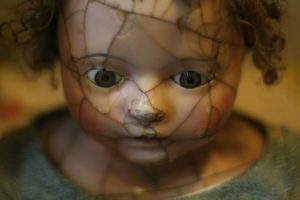
Dolls, like clowns, have a long and powerful history of symbolic meaning for human beings. We think of most dolls now as playthings for children, but dolls have always been much more than toys.
Photo by Aimee Vogelsang on Unsplash
The old word for doll was “poppet,” related to the English word “puppet.” In many cultures, dolls were used for spiritual rituals and magic, and as oracles. They are perhaps most famous as tools of black magic, but were also used for healing, fertility, and romantic and protective spells. From the Far East to Africa to the Americas, dolls have been an important social instrument for centuries.
There exist in the world a small handful of haunted dolls, both in museums and collections and for sale on sites like eBay. Several horror movies have been inspired by famous haunted dolls, such as Robert and Annabelle.
As a child I didn’t have dolls, and didn’t want them. A toy doll to mother and care for was not nearly as much fun as a pet, which we had an abundance, and nothing was as lovely a plaything for me as a book. Some things never change.
No, I didn’t have a doll until I was nearly 50 years old, when I decided I needed a very specific kind of doll for a very specific reason. Most traditional dolls were handmade out of whatever materials were available. As a child of the twentieth century, I went shopping online, trusting I would know her when I found her. I already knew her name.
Photo by Gary Bendig on Unsplash
I wanted a new doll resembling myself. I looked at hundreds of dolls, mostly hideous, plastic and cheap, trying to find good old-fashioned rag dolls or soft dolls. There are some, but they’re few and far between. Alas, there are no dolls depicting (ahem!) maturity. Most of them simper, lowering plastic eyelids over improbably shiny blue or brown eyes. They have equally shiny and synthetic hair and frilly clothes. It was a little like shopping for candy in the candy aisle during Halloween. Slick, artificial, patently synthetic color, all sugar and no substance. Certainly, I found no dolls with even one grey hair or crow’s feet around the eyes. I thought about making a dried apple doll, but it was a fleeting thought. For some reason, that wasn’t quite what I wanted.
I persisted until I found a plain rag doll with brown yarn hair tied into two bunches with ribbons and blue eyes. She wore a yellow dress and white felt shoes on primitive club-shaped feet.
I grew up doing all kinds of embroidery, cross stitch and needlework, but I never learned to use a sewing machine or do practical things like make clothing, so I had to ask for help to get more appropriate clothes made. I found a young woman who sewed and asked her to make my doll a pair of denim jeans and some kind of a top. I told her the doll was for a niece of mine who was something of a tomboy and a mountain kid. I didn’t want to admit the doll was mine.
Dolls are commonly used for therapy for adults and children. In my explorations, I’d run across the idea of working with one’s inner child many times, and I knew making a doll to represent oneself is a common therapeutic activity. As I’d never had any meaningful kind of relationship with dolls, this didn’t attract me.
Until it did. I’m not sure exactly why my interest in dolls changed at that particular point in my life. All I can really say is I was suddenly ready to figure out if I could love myself. A doll seemed an obvious way to externalize the parts of me that felt so chronically unloved and unwanted. Beyond that, I really didn’t think. I just felt the need, and obeyed it.
When the clothes were ready (jeans, a T-shirt and a zippered sweatshirt), I dressed the doll and cut her brown yarn hair short. After spending most of my life with long hair, I’d recently cut mine, more as an act of rebellion and self-mutilation than anything else.
Photo by Rain Wu on Unsplash
I cut the doll’s hair with a mixture of anger, resentment and grief, and a strange thing happened. Instead of looking at her with loathing, I had the completely unexpected and spontaneous thought that the short hair was cute. It wasn’t ugly. It didn’t make her look like an old hag, used up, dried up, sexless and powerless. That’s what I saw when I looked in the mirror at myself, but when I looked at the doll I saw something else entirely. As a child I had begged to be allowed to have long hair. I was eventually allowed to, when I was old enough to care for it. This was reasonable, as my hair is thick, curly and unruly, to put it mildly. For years, though, as a slim, short-haired, active child in the same tough jeans my brother wore, I was taken for a boy.
Somehow, looking down at that helpless rag doll and the short ends of yarn scattered around her, it seemed I was looking at a long-vanished version of myself, and I didn’t hate her. She wasn’t loathsome. She merely had short hair. I’d meant to hurt her, even mutilate her, but her innocence turned a hostile act into a reluctant feeling of wanting to protect her from any who would seek to hurt her, including myself.
This was a powerful moment. It was so powerful I doubted myself. What would people say if they knew I’d bought myself a doll and lied about it in order to get the clothes I wanted for her? What would they think of me? What did it say about me, these feelings of self-hatred mixed up with an uneasy need to protect? Protect the doll from me? Protect the doll from others? Protect myself?
I was confused, embarrassed and compelled. I kept the doll with me as I moved around my little log cabin, not to handle, but just to look at. Occasionally, I talked to her, in the same way I talked to the cat I belonged to at the time.
Then, one day, something distressed me. I was trying to calm down and think more clearly, and I saw the doll, sitting propped on a table. I picked her up and held her against my shoulder, patting her back and swaying on my feet in the age-old motions of comforting a baby. I had worked for years with chronic and terminally ill children and their families as a young woman and then raised two kids of my own. I love and understand children, and the familiarity of holding one again made me weep.
I was also instantly comforted, as though I myself was being held in spite of my age and ugliness. I’ve been aware all my life of the longing to be safe, secure and loved in someone’s arms, a longing I rarely admit, always endeavor to bury deep, and feel much shame about. Something about holding the doll assuaged that longing. In a strange sort of way, I was holding myself, or at least some part of myself.
I can’t explain the neurophysiological effect of being able to hold and comfort my doll. Perhaps a neurologist or a good psychiatrist could. What I do know is it’s been enormously and unexpectedly healing. The gnawing need for nonsexual physical reassurance and affection has been something I’ve learned to live with, never revealing it or expecting to have this need met. If I could not find it as a young, reasonably attractive woman, I’ll surely never find it now. I can’t hold myself, but I can hold my doll. I don’t always treat myself with unconditional love, but I can give it to my doll. In fact, I’m incapable of giving her anything else. I’ve always found it much, much easier to love others than myself. Loving others is a beautiful way to live, but it’s not always reciprocated or even recognized for what it is, and much of the love I’ve given has walked away from me, never to return. With the doll, somehow my love comes back into my own starving skin and heart.
Photo by freestocks.org on Unsplash
I’ve had the doll for about six years now. I’ve turned to her in times of fear, insomnia, emotional pain, panic attacks and PTSD. I’ve wept with her (and perhaps for her), rocked her, kissed her, practiced Havening with her, snuggled her and slept with her in my arms. Until now, I’ve kept her presence in my life a secret from all but one person. She’s been more useful to me than any psychological therapy or pharmaceuticals I’ve ever tried, with the single exception of emotional intelligence coaching.
I’m writing this post now because I thought it would be fun for Halloween, haunted dolls being a thing in our culture. As I write, however, I’m slightly sobered. I’m not prepared to debate whether haunted dolls or haunted anything else are “real.” The belief in such things is what fascinates me, along with the history of such objects, investigation into this kind of phenomena, and the way it captures our imaginations. What I will say is if an object or person can be haunted or possessed, I would assume intense energy or emotion is associated with such possession.
It’s not hard for me to understand why dolls, like clowns, have so captured our imaginations. I’m quite certain my doll is the most intimate object in my life. I would never want to see her in another’s hands. God forbid she ever takes it into her head to talk about my demons and vulnerabilities. I don’t mind if she wants to move around in my attic space, though, or even look out the windows, as other haunted dolls are alleged to have done.
I ran into a great question a few weeks ago: “What gives you courage?” I’ve been thinking about it ever since.
Courage, the ability to do something frightening or having strength in spite of pain or grief, is not the absence of fear. If we have no fear we have no need of courage.
Photo by Stefano Pollio on Unsplash
Fear, in my experience, is multifaceted. My most private fears are about my own wholeness and worth. Then, there’s the fear of external forces, like a coward with a gun in the supermarket; the judgement or criticism of a loved one; or a personal loss, injury or illness.
Yet another kind of fear is one I suspect many of us feel right now, a sort of ill-defined psychic shadow, a general feeling of insecurity about the state of our world and the future. I try not to give it too much attention, but it’s always there, like a thin cloud between me and the sun. I know the only place I have power is right here, right now, in this moment, and I’m glad I’m typing at the keyboard rather than staring out the window and wondering what tragedy or catastrophe will be brought to my attention next and where it will all end.
Photo by NASA on Unsplash
Is that a kind of courage, staying intentional in the moment and managing our own power?
Perhaps.
So, what keeps us going in times like these, in spite of our fear?
Oddly, the first thing I thought of was a poem I read as a teenager. All these years I’ve kept it and thought about the wagon wheel that did not break, the faithful dog, the innocent child. I’ve long forgotten where I came across it and I don’t know who wrote it.
Journal Note Long Ago
Crossing the wilderness or the sea I take with me nobody who is afraid nor do I want with me the memory of a man or woman who is afraid.
I am afraid enough myself now—there are shadows and ghosts enough now—in the meshes of my corpuscles—and so I must not ask others to go.
I keep the memory of a dog who was never afraid, a wagon whose wheels lasted, a child who had not lived long enough to know the meaning of the words Yesterday and Tomorrow.
The second thing that comes to mind about the source of my own courage also seems peculiar, but on second thought it might be a way of talking about faith. If and when I am able to identify The Right Thing To Do in any circumstance, fear ceases to have any power over me. I certainly feel it, and sometimes it seems I’ll be ground into oblivion by it, but as long as I’ve breath and a pulse I will do what I believe is right, come what may.
This is a trait fanatics and zealots of every stripe share with me, a fact which makes me pause and shudder. There is a difference, though, between a suicide bomber or the aforesaid coward with a gun and me. I don’t pretend to know what’s right for others, only myself. I’m not interested in having power over other people, forcing my ideology on those around me or taking out my frustrations on others.
My sense of The Right Thing To Do always involves my integrity and intuition, and is not weakened by the judgements and criticisms of those around me. My integrity and intuition are my own. Only I can maintain them. Without them, I am nothing.
When people talk about faith, I generally think of religion, which can be a staunch support for courage as well as a powerful motivator. However, most religions I’m familiar with require submission to a so-called higher authority, either human and/or sacred text (the author of which is frequently unclear and the original of which was written in a language and context I’m unfamiliar with). Many good people build their lives on a bedrock of religious faith and are sustained by it. That is not my way. I will not sacrifice my personal power to an external authority.
Photo by Lilly Rum on Unsplash
Information and learning give me courage. Literacy and curiosity are gateways to understanding, compassion and revelation. The beauty and complexity of our world and our universe, the remarkable experience of being human, the persistence of life, the perspective of history, the indomitable creativity of the human spirit — all these inspire me and give me courage.
My study and practice of minimalism has given me courage. The more objects and distractions I peel away from my space, time and energy, the stronger and more peaceful I become. Serenity, it turns out, has everything to do with living with less stuff, needing less money and concentrating on the undistracted and undiluted abundance of each moment. I don’t need nearly as much as I thought I did. Peace, joy, clarity and courage immediately flower in the space freed from stuff. I have what I need. I am what I need.
Photo by Nick Grappone on Unsplash
And that brings me to the last big ingredient in my particular recipe for courage. Learning to know, love and trust myself has given me courage. Part of this has to do with the gifts of aging. I’ve done a lot, seen a lot, made a lot of mistakes and collected a lot of scars. Every day I learn a little more and heal a little more. I have allowed my experience in life to expand my compassion, empathy, intuition, wisdom and ability to love. I’m a resilient, adaptable survivor, and I know, no matter what happens, I’ll do my best to my last breath.
A poem. The Right Thing To Do. Information and learning. Minimalism. Self-regard. Mix well.
I’ve been sitting in the breakdown lane this weekend, watching traffic pass me by, (all their cars work!) and wondering why my car, which has been just fine, has suddenly stopped functioning.
We’ve probably all done this at least once, literally speaking. Metaphorically speaking, we’ve all done it many times. We go along in our small world, and as far as we know everything is status quo and just what we expect, and then, suddenly, it isn’t. Things go off the rails and all we can think is WTF?
Sometimes I’m the one who has suddenly gone off the rails. Except, looking back, I realize it wasn’t sudden at all. Sometimes the breakdown was years in the making, but I wasn’t present enough with myself and my feelings to notice the gradual fraying and come up with a plan. Grimly, I hung on, hoping, waiting, hurting myself, arguing with what was, denying my experience, trying harder, drowning in shame, crippled by fear, until I absolutely could not hang on any longer and my last fingernail tore out.
Then I let go, after it was far too late to problem solve or help myself or anyone else involved.
I still regret I have not always had the support or resources to make different choices. I hurt myself, and I hurt others. I take responsibility for my behavior and clean up what I can, but some things just can’t be fixed — and perhaps shouldn’t be in any case.
Photo by Chris Barbalis on Unsplash
I think a lot about these sudden moments where things fall apart, either within us or between us. The breakdown lane is like a time out, an enforced pause. In a moment or two, the whole aspect of the day, the future, and my plans have changed. I realize I’m not in control. All I have is an unpleasant snarl of disappointed expectations, thwarted intentions, frustration, anger and a need to blame someone or something, including myself.
A broken car or piece of equipment is one thing. An interpersonal breakdown is another.
Few things are more painful than feeling unloved, unwanted or rejected by someone we care about. Hell, it’s painful when we feel those things from someone we don’t care about. Imagine being an immigrant in this country right now.
I have felt unloved, unwanted and rejected. I’ve also had loved ones tell me they feel unloved, unwanted or rejected by me. As I know that’s not how I feel about them, I question my certainty that others feel that way about me. If they’re misinterpreting my actions, words and choices, perhaps I’m doing the same thing.
Our feelings are real. The stories we make up about them may not be. In other words, I might feel rejected when the person I’m interacting with has no intention of sending that message. The way I express love and affection may be so different from someone else’s idea of how to express it that it’s lost in translation.
Photo by Evan Kirby on Unsplash
That doesn’t mean it’s not present.
I focus a great deal on language in this blog. I do that because words matter. They have layers of meaning. It seems to me nearly every interpersonal breakdown can be traced to a misunderstanding over a definition of terms. Getting at the bottom-line meaning of a word is as easy as looking it up:
Friend: “A person whom one knows and with whom one has a bond of mutual affection, typically exclusive of sexual or family relations.” (Oxford online dictionary)
Pretty simple, right? We all know what it means to be a friend and have a friend.
Except we don’t. We might agree on that basic definition, but I suspect we each assign a whole world of additional personal meaning to the word friend, and that world contains longings, memories, hopes and fears, expectations, deep needs, beliefs, and old scars and wounds.
I’ve been thinking about that. When I talk about, think about and participate in friendship, what does that mean to me? What is a friend, besides someone I know and with whom I have a bond of mutual affection?
It’s a great question. I wish I could ask everyone I know. I won’t, because for some reason this kind of question seems to make most people uncomfortable, but feel free to volunteer an answer!
At this point in my life, I’m not interested in constructing relationships out of expectations and an attachment to outcomes. I’ve always operated in a framework of both of those in my relationships, and it’s never worked. In the last four years I’ve taken a clear, cold look at my previously unconscious expectations of self and others and the myriad ways in which I’ve sabotaged myself and others with attachment to certain agendas and outcomes.
What I do instead (and a joyous, fascinating, loving process it is) is observe with curiosity and interest as relationships form and change. Viewed from this perspective, it’s like nurturing a child, a garden where we’ve planted seeds, an animal, or a piece of land. Freed from my extremely limited and limiting expectations and agenda, I can watch and appreciate all the unexpected, magnificent ways we are — and life is.
It’s the difference between saying: “This is who I (or the other) must or must not be,” and “Who are you?” or, even better, “I want everything you are and nothing you’re not.” Say that (and mean it) to yourself or someone you love every day and I guarantee your relationships will change for the better.
So, now, what do I mean by a friend?
A friend is someone with whom I can laugh, explore new information and ideas, excavate less-than-useful beliefs and patterns, learn and unlearn. A friend is someone with whom I engage in a contest of generosity. I want to ask questions, pull things out from under the bed and let the cat sniff at them, be wrong, problem solve, consider options. I want to practice boundaries, tolerance, respect and being real. I want to allow and be allowed. I want relationships that make my life bigger. I want to share reading, movies, music, memories, silence, work, nature, my truths. I want someone who says, “make yourself big!” while pursuing that same goal themselves.
(Not coincidentally, this is the kind of friend I strive to be to others.)
When I consider the above paragraph, and imagine each of us could write an equally long but different paragraph, the concept of friend goes rapidly from a simple one-sentence definition to something much more complicated and personal. This wouldn’t be so problematic if we were aware of it, but we’re not. We say friend, knowing exactly what we mean, and never considering the person we’re talking to, who’s also using the word, means something different.
Photo by Alex Iby on Unsplash
Then, one day, these two invisible sets of definitions, expectations and desired outcomes collide and we experience hurt, outrage, betrayal, anger, disappointment, rejection, fear, and disconnection.
I admit I have no fix for this ubiquitous problem. Even being aware of how differently we define terms doesn’t save me from ending up sitting in the breakdown lane. It would be good if the problematic words in any given relationship had a tag warning us of problems ahead if we aren’t careful to understand one another from the beginning.
On the other hand, that would take out the part where we sit in the breakdown lane trying to understand what just happened, how and if to fix it, and how our choices led to it. Uncomfortable as it is, I value that opportunity.
Sitting in the breakdown lane with my heartbeat and breath. Feeling my feelings. Curious about what will happen next. Confident that when it’s time to move on I’ll know it and do so. Considering what I might learn in this space. Getting bigger. Getting bigger. Getting bigger.
When I came to Maine in 2015, I had a short list of goals. One of them was to learn everything I could about relationship and connection. I had so many questions. Why did I feel I’d failed practically every relationship I’d ever had? What was different about the ones that did work well? If I was bad, ugly, unlovable and unworthy, why was that? Was it something I could fix? Or was that a false belief, and if so, where did it come from?
Why did it seem so impossible to find the kind of relationships I had always wanted to have with others?
All my life I’ve struggled with these questions.
I realize now all of us struggle with these questions, at least at some point and to some degree. It’s called being human.
Relationship is a skill, and most of us don’t have great models for how to do it appropriately and effectively. Relating well to others is messy because being human is messy. I learned, and believe, healthy connection is a primary human need and driver of behavior. I also learned to build and maintain better boundaries and separate what I have power over (myself) from places where I have no power (what others say, believe, think and do).
Over the last years, my partner and I have continued to be fascinated by the way in which we humans interact with each other as parents, family, partners, coworkers and members of the community. We observe ourselves and others and read with interest current research and insight into all the ways humans connect and disconnect, motivate and manipulate, perpetrate acts of violence and hate, build community and parent.
I’m an information junkie on some subjects, so I enjoy all this learning. I don’t want the information so I can speak learnedly or advise or persuade others. I’m not interested in labeling, judging, feeding my fear or getting bogged down in an empathy swamp. I have no ambition to be an expert in anything but my own life.
Photo by Bewakoof.com Official on Unsplash
What I want to do is see myself and others clearly. I want to understand what I don’t understand. I want to learn how to keep myself safe and meet my needs for connection.
I want to take better care of myself.
My partner and I sat in the sun this morning, watching the birds at the feeders and newly-wakened insects buzz around the rotting wood of the porch looking for summer quarters. I picked up paper and pen and we jotted down a list of things to look for when considering a relationship. I titled the list Rules of Engagement, but then crossed it off and retitled it Questions Before Engagement.
Demonstrate the desire to cooperate and connect (power-with) or win and be right (power-over)? (Carmine Leo)
Consistently treat themselves and others with respect and kindness in action and word?
Speak in either/or black/white terms, or do they appreciate shades of grey?
Employ blame and shame tactics or take responsibility for their own choices? If they take responsibility, do they take too much responsibility (a sign of weak boundaries)?
Employ DARVO tactics: Deny, attack, reverse victim and offender? Does he/she see him/herself as a victim?
Communicate clearly, honestly and consistently, or avoid responsibility (“I forgot”), gaslight, give inconsistent or mixed messages and refuse to answer questions?
Demonstrate consistency between what they say and what they do? Keep their word to self and others? (Chronic lateness, for example, is a red flag).
Leave you feeling good about yourself or as though you’re hopelessly bad and wrong and/or completely drained?
Have boundaries (even if messy) and respect yours (even if messy)?
Present themselves as a whole, healthy, independent person with something to contribute or are they needy and dependent and looking for someone to nurture or “fix” them? (Co-dependency is not a healthy relationship!)
Demonstrate a full range of feelings and appropriate expression and management of those feelings? Is their life one long drama and trauma? Do they flip abruptly from rage to affection and back again? Are they emotionally available?
Demonstrate flexibility, curiosity and the willingness to learn?
Provide an equal and reciprocal level of commitment, time and energy to the relationship that you do? (Carmine Leo) Are you doing CPR on a long-dead connection all by yourself? If so, why?
Last but not least: What does your intuition say? Do you feel safe with this person, physically, sexually, creatively, emotionally, financially? Listen/feel for a yes or a no and don’t second guess or negotiate a no! Extricate yourself and move on.
The strength in recognizing these questions and their answers does not derive from judging or labeling others. The power is in our own ability to navigate intelligently through the world of people we all live in. I myself have communicated poorly, been codependent, been self-destructive, made myself small, and had poor boundaries. I’ve also worked hard to learn to be more effective and heal. Now and then we’re all inflexible, or disrespectful, or unkind.
Photo by Toa Heftiba on Unsplash
Perfectionism is a black hole I refuse to get sucked into and certainly don’t expect from others. We need and form all kinds of relationships in life with all kinds of people. Certain behaviors from a colleague or roommate might be acceptable; the same behavior from a lover could be a deal breaker. There is no one size fits all in terms of relationship. We have to figure it out for ourselves.
We all have good days and bad days. This list is intended to specify red flags that might occur intermittently or consistently across time. A pattern of red flags is a sign to go carefully and stay present and aware with our interactions. There are millions of well-meaning people in the world. There are also millions of narcissists, borderline and other Cluster B personality-disordered people, psychopaths, sociopaths and other predators and vampires. It’s up to us to figure out how to spot them and avoid or free ourselves from them. Failure to do so wastes our time, energy and love.
I recently read an essay about honoring our past from one of the minimalism blogs I follow. I moved on to other things without saving it, but it continued to echo in my mind and I realized it held a deeper meaning for me than I first recognized. Of course, now I can’t find it again! Still, the blog is well worth exploring.
As I embrace minimalism , I spend time every day consciously assessing not only my internal clutter but also the objects around me. I’ve moved things around, put things away to see how my space or life felt without them, and let go of many objects and ideas.
Photo by Dan Gold on Unsplash
We carry a lot of our past around with us. One belief I’ve carried all my life is that it’s disloyal and even hateful to change, to grow, to yearn for more or to leave jobs, relationships or places. That belief (Who taught me that? Why do I believe that? Is that true?) has caused a lot of pain in my life. It’s made me fearful, ashamed and inauthentic. It’s encouraged me to be much less than I am.
The essay I read proposes almost the opposite idea. The author expresses deep gratitude for her past experience and the people who influenced her, and she honors them by going forward into the future.
What a disconcerting idea! At the same time I recognize some kind of truth in it, a truth I don’t discern in my own beliefs about honoring the past.
As a mother, I want to see both my sons being bigger than I am. That doesn’t mean I want to see them with more to have and to do. I want them to have more to be.
Photo by Bill Williams on Unsplash
I want them to fly free, the memory of our time together and the strength of my love and our connection the wind beneath their wings taking them onward and upward.
Yet I don’t give myself the same permission. I’m not sure I’ve ever taken a big step forward in my own growth, health and understanding without feeling it’s at the expense of someone else’s happiness and well-being. It always seems wrong — a betrayal, an abandonment or a rejection.
When it comes down to a choice between my own needs and the needs and demands of others. I never seem to be able to accommodate both myself and those around me. Until very recently, I’ve inevitably chosen to meet the needs of others rather than my own.
Today is built on all our yesterdays. If I lived in an empty room with nothing in it, my past would still have shaped today. I’d still remember my personal history, my family, my children, old friends and places, beloved animals, old activities and interests. Past loves and influences wouldn’t disappear from my life without my things. Forgotten or remembered, my past would still be with me and within me.
I can’t live in the past, though, any more than I can in the future. I can only live now.
I love this attic workspace, but one day I’ll leave it, as I left my beloved little home in Colorado four and a half years ago. It’s not the lack of love, respect or gratitude moving me into the future. It’s the ebb and flow of my life, the call of possibility, the itch of curiosity. My future self calls out to me, holding out her hands in encouragement, and I must answer the call.
Maybe our cultural obsession with things is about fear, or greed, or numbness or nostalgia. Maybe it’s about all those and others, too. I don’t know. But the idea that the best way to honor the past is to be fully in the present and consent to move ahead into the future seems blessedly simple, uncomplicated and unencumbered.
I’ve always longed for security. I’ve longed for relationships that don’t change, love and tenderness I can count on, the ability to give and receive promises and vows that never break.
I’ve also longed to be wild and free, to live a life that feels real and true, to be with others who both give and receive unconditional love and don’t seek power over those around them.
Objects will give me neither security nor freedom. Today I have a few favorite things I wear, use or live with. Some are new favorites and some are old favorites, handed down from my family.
Everything else is just stuff that’s here. I don’t really notice it unless I think about it, but I don’t need all these things and they’re weighing me down. A year from now my current favorites might no longer serve and I’ll let them go in turn.
As I write about it, this process sounds healthy, normal and natural. As I do it, guilt and shame tear at me. It seems to me that even growing up was hurtful; a deliberate betrayal and abandonment of my family. The least I can do is hang on to all the objects inherited or gifted by earlier generations.
But why? Does hanging on to such things really demonstrate love, respect or gratitude? Would my great-great grandmother expect me to cherish and care for something that belonged to her but has no meaning for me? If she did expect it, are her expectations more important than my wants and desires? Would she want me to make my life a shrine to her memory or go forward into my own life and follow my own path? What honors the memory of our ancestors the best?
Honoring the past by moving toward the future. Could it be that clean and easy? Could it be that elegant? If I live a life of meaning and purpose that does not include reverence for every object, tradition and idea I was brought up with or exposed to, are the ghosts of my past pleased or will they turn away and disown me?
Maybe it doesn’t matter. I know what I need to do.
Websites store cookies to enhance functionality and personalise your experience. You can manage your preferences, but blocking some cookies may impact site performance and services.
Essential cookies enable basic functions and are necessary for the proper function of the website.
Name
Description
Duration
Cookie Preferences
This cookie is used to store the user's cookie consent preferences.
30 days
These cookies are needed for adding comments on this website.
Name
Description
Duration
comment_author
Used to track the user across multiple sessions.
Session
comment_author_email
Used to track the user across multiple sessions.
Session
comment_author_url
Used to track the user across multiple sessions.
Session
Statistics cookies collect information anonymously. This information helps us understand how visitors use our website.
Google Analytics is a powerful tool that tracks and analyzes website traffic for informed marketing decisions.
ID used to identify users for 24 hours after last activity
24 hours
_gat
Used to monitor number of Google Analytics server requests when using Google Tag Manager
1 minute
_gac_
Contains information related to marketing campaigns of the user. These are shared with Google AdWords / Google Ads when the Google Ads and Google Analytics accounts are linked together.
90 days
__utma
ID used to identify users and sessions
2 years after last activity
__utmt
Used to monitor number of Google Analytics server requests
10 minutes
__utmb
Used to distinguish new sessions and visits. This cookie is set when the GA.js javascript library is loaded and there is no existing __utmb cookie. The cookie is updated every time data is sent to the Google Analytics server.
30 minutes after last activity
__utmc
Used only with old Urchin versions of Google Analytics and not with GA.js. Was used to distinguish between new sessions and visits at the end of a session.
End of session (browser)
__utmz
Contains information about the traffic source or campaign that directed user to the website. The cookie is set when the GA.js javascript is loaded and updated when data is sent to the Google Anaytics server
6 months after last activity
__utmv
Contains custom information set by the web developer via the _setCustomVar method in Google Analytics. This cookie is updated every time new data is sent to the Google Analytics server.
2 years after last activity
__utmx
Used to determine whether a user is included in an A / B or Multivariate test.
18 months
_ga
ID used to identify users
2 years
_gali
Used by Google Analytics to determine which links on a page are being clicked