On the heels of last week’s post about unplugging, I had a conversation with friends about social media and what, exactly, it means to be social. What is a healthy balance of social and solitary? How do we determine if our social lives are appropriate?
Photo by Bewakoof.com Official on Unsplash
Predictably, I want to start this exploration with definitions, all provided by Oxford Online Dictionary:
Social: Relating to society or its organization; needing companionship and therefore best suited to living in communities.
Society: The aggregate of people living together in a more or less ordered community; the situation of being in the company of other people.
The root of social and society is Latin, and it means companionship.
Companionship: A feeling of fellowship or friendship.
We are not normally taught to identify our needs, beyond the obvious survival needs of air, food, water and shelter. Most people believe what we need is money. If we had enough money, everything would be happy ever after. We believe that because our capitalist culture depends on our believing it and continuing to fuel the economy with our spending.
Almost none of our true needs can be bought, however. Here’s a link to the best resource I’ve found online for thinking about needs.
Photo by Juan Pablo Rodriguez on Unsplash
Being social creatures, we also depend on those around us to demonstrate or tell us what we should need, what’s normal to need, or what’s appropriate to need. We’re neurobiologically wired to blend in with the herd, which probably helped us survive another day in the beginning. Individuals who could not or would not adhere to the collective lost the power and protection of the community. That’s why tribal shaming continues to be such a powerful and annihilating weapon.
I observe around me a vast continuum of social abilities and needs. Some people are quite extroverted and social. Others are positively hermits, and most of us fall somewhere in between. We also know some people have differently wired brains than the majority, and struggle with social cues and skills. Still others of us are more sensitive than the norm (whatever that is) and are easily overstimulated and overwhelmed in social situations.
So what does it mean to be appropriately, healthily, normally social?
The answer depends on the individual asking the question. The happiest and healthiest balance between connection, authenticity and contribution for each individual is as unique as our fingerprint, and it changes. What we need at 20 may not be what we need at 40, or 60. Life changes, we change, and our needs change.
it’s fascinating to remember Facebook was created by a brilliant young college man who struggled with social skills; specifically, finding sexual partners. In the beginning, Facebook was, in essence, a prehistoric dating app, and just about as sensitive and romantic! Of course, most college men aren’t looking for sensitivity or romance. They’re looking for sex.
In 15 years (isn’t that amazing?) our social intercourse has been entirely transformed. Some say our amazing connectivity is an enormous step forward. Others are beginning to ask important questions about the effectiveness and/or appropriateness of social media. Is it a useful tool we can master and control, or is at weapon that steals our power? Is it a positive advance that enlightens, informs and connects, demonstrably creating a happier, healthier, more compassionate society, or is it manipulative, divisive, addictive, and destructive?
It seems to me social media is exactly like a gun. It’s a neutral entity that can be used for either good or ill, depending on who is wielding it and why.
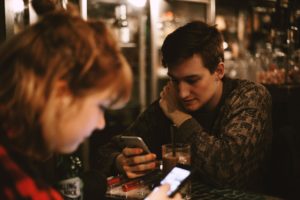
Social media is huge. I doubt anyone would disagree with that. However, people still form societies or communities around shared values, activities and belief systems in the real world. Social media, however, has changed face-to-face interaction as well; we’ve all observed people inhabiting the same room or even the same couch, each engrossed in the small screen and keypad in their hand or on their lap. Families do it. Married people do it. People do it on dates. Friends do it. Parents do it while ostensibly watching and supporting their children during swim lessons (a particular pet peeve of mine), or other activities. Is social media making these relationships healthier?
One of my problems with social media is the emphasis on external validation. This circles the conversation back around to authenticity and pseudo self. If we rely on external validation to tell us we’re okay (whatever that means to us), we’re not in our power. We’re focused on what others think of us rather than what we think of us. We’re wound up in external expectations of what our needs should be rather than what they actually are and figuring out how to meet them.
I wrote recently about normalizing obesity. Giving our power to social media is normal. That doesn’t mean it’s healthy or effective. Popularity does not mean valuable, desirable or useful.
Photo by Freddie Marriage on Unsplash
Technology in general and social media in particular are deliberately designed to be addictive, because our participation fuels marketing and consumerism via the data we provide with everything we do on social media platforms and the Internet. As so many people are now realizing, including me, the constant compulsion to check our social media accounts, dating apps, e-mail accounts, etc. means we are no longer making conscious choices. We’re driven by addiction.
Let’s go back to companionship, defined above as a feeling of fellowship or friendship. Consider Facebook. Remember, the creator of the platform struggled socially. He developed, as part of the platform, the ability to form a group of “friends.”
What did he mean? Was he describing a group of people who shared and reciprocated feelings of companionship and fellowship? Or was he describing a group of college men, not necessarily having ever met one another, joining together to figure out how to get laid more effectively and efficiently?
Facebook “friends” redefined friendship, and I’m not sure anyone really noticed or questioned it.
A friend is a person whom one knows. What does it mean to know another person?
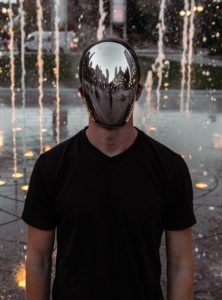
When we look someone up on Facebook and scroll through their posts, pictures and conversations, can we conclude we “know” them? The obvious answer is no, of course not. The beauty of social media of all types is we get to present to the world the person we wish to be, or at least the person we wish others to believe we are. Our pseudo self, in other words.
Authenticity and intimacy require honesty. Honesty requires risk and trust. Honesty and trust build healthy friendships. Healthy friendships demand we have the ability to befriend ourselves first. Our real selves, not our pseudo selves.
Photo by Alex Iby on Unsplash
When was the last time you saw a photo of a party on Facebook in which everyone is posed and smiling and it looks like a great time, but the post says the party was a waste of time, somebody got drunk and threw up behind the couch, Bob and Sue had a screaming match, Debbie brought her loathsome homemade snack mix, and the dog peed on someone’s coat? Even the people who were there, know what happened and didn’t enjoy themselves are gratified to see the picture posted so everyone else can see what a great party they went to on Friday night.
After all, if they had spent a quiet evening at home in saggy sweat pants with a glass of wine and a book, everyone would think they were pathetic. Or lonely. Or boring. Or not social enough. What’s the point of a selfie depicting that? And if our activity (or lack thereof) is not worth a selfie, then it must not be worth anything at all, because no one can give us a heart or a thumbs up or a like. No one can see how okay, happy, healthy and popular we are.
If no one can see and validate us, we must not be real. If we want or need something we can’t post about, take a picture of or share with the world (something like privacy, for example!), we must be bad and wrong. Shamefully broken. Facing a lonely, embittered, loveless and friendless future.
I’m not necessarily saying either pseudo self or social media are inherently bad. I don’t think they are, unless we believe they represent authenticity.
Can we form healthy societies and relationships, including with ourselves, if we are unwilling or unable to be authentic? Can intimacy (I’m not talking about sex. Forget about sex.) exist without honesty?
I can’t see how. If you think the answer is yes, convince me!
Photo by Toa Heftiba on Unsplash
Is interacting with others via social media actually social at all, or is it a toxic mimic for friendship and companionship? Again, I think this depends on the user and his or her intentions and needs. I know people who are active, to one degree or another, on social media and also have authentic, satisfying and supportive relationships and connections in the real world. I reiterate I don’t think social media is some kind of a demon. We don’t have to give it our power. We don’t have to buy the infrastructure that supports it, and we don’t have to use the platforms on which it takes place. We don’t have to allow it to control us.
What we do need to do is to wrest ourselves from the hypnotic, mindless influence and compulsion it holds over us and be present with the way we use it. Are we numbing out, scrolling through Facebook, because we’re bored, hungry, tired, worried, having a pity party, depressed, lonely, or anxious? Are we taking selfies and posting them feverishly in order to hide behind our pseudo self? Are we needing the validation of others, and if so, why?
Here are some good questions we can ask ourselves as we consider our social/emotional needs:
What energizes me?
What am I grateful for?
What’s not working for me, and why?
If we can’t answer these questions, we’ve lost track of our authentic selves. We can find ourselves again, but we need to be quiet and undistracted in order to do it. Calling ourselves home is not a selfie activity. That’s only the beginning, though. We need to answer these questions honestly, even if we never admit the answers to another living soul. Well, maybe a cat or a dog. Or a goldfish. We need to consent to know our own truth. Then, we have to build strength and trust in ourselves, in our needs and desires, in our scars and mistakes, in our resilience and wisdom. Only then can we dwell in our own power, which allows us the presence to notice when we’re stepping out of it.
Photo by Leon Liu on Unsplash
This is a good time to review and explore our social needs and lives. Winter is coming. Whose fire do we want to sit around, and who do we want to invite to our hearths? Which of our social interactions leave us renewed, enlarged, comforted, and feeling loved and supported? Which leave us drained, diminished and doubting ourselves? Is our time with social media truly social time, or is it something else in disguise?
You’re the only one who knows the answers to these questions.
Jiddu Krishnamurti said, “It is no measure of health to be well-adjusted to a profoundly sick society.”
I first heard that quote five years ago. It gave me comfort, because it allowed the possibility that my feeling of isolation and alienation at the time was a normal response. The problem, I find, with taking too much responsibility is one stops excavating interpersonal challenges. Instead, we assume it’s all our fault because we know we’re broken. This attitude effectively blocks further inquiry into what the people around us are up to. If we can be taught or manipulated into believing we’re the core of the problem in social interaction, our shame and guilt give those around us a free pass to behave however they like and treat us however they wish. No matter what happens, they can count on us to blame ourselves.
A friend of mine recently pointed out a lot of social media buzz about normalizing obesity. As I am not on social media, I did some research into memes and articles about this issue, and everything I saw made me think of the Krishnamurti quote.
Here again I see sloppy language. Almost every source agrees carrying too much weight on our frame is unhealthy. Unhealthy, as in bad for one’s health. Not ugly, stupid, lazy, lacking self-control, or a whole host of other slurs, taunts and unkind criticisms many overweight people have endured their whole lives.
Obesity is unhealthy. The fact that we have so many people struggling with obesity in this country doesn’t change unhealthy to healthy because it’s so common. A growing population of obese people signals a profoundly unhealthy society. Normal, as in usual, typical or expected, does not imply useful, healthy, functional or positive.
Is normal a goal, or is it merely a cop-out? Is normal something we aspire to because it makes us bigger, or is it something we have to make ourselves smaller in order to fit into? Who gets to decide what is usual, typical or expected? What are the consequences of choosing not to be usual, typical or expected?
Photo by whoislimos on Unsplash
I can answer that one. Consequences include tribal shaming, deplatforming, silencing and other violent, destructive and coercive responses.
Normal is one of those words we define ourselves. Normal describes something not aberrant or abnormal. Abnormal is the absence of normal. That distinction can be useful, but in a limited way. Conflating normality with Good and abnormality or different with Bad (or vice versa) is mindless, black-and-white groupthink, the kind of ideology driving genocide, religious persecution and racism.
Our culture and context help us define normal, but if our society is profoundly sick, to be well-adjusted and “normal” within it is to be profoundly sick.
This is particularly true when I look at money. I’m noticing an ever-widening gap between money and value in my own life and in the lives around me. Until recently, I thought of all resource as money, and a life without some magical amount of money I never defined and could never access would be a safe, successful life.
Photo by Evan Kirby on Unsplash
But money is only one kind of resource, and for me it’s the weakest kind. This thinking is definitely not normal by our cultural standards, but I believe it’s becoming more common. Minimalism is a growing trend, and those of us who explore and practice it are very clear about the relative value of money, time, contribution, experience, relationships, creativity, relaxation and joy. If earning money burns up all our other resources, we can’t replace them. Money won’t buy them back for us. A tree, an afternoon in the sun, a lap full of a child, the arms of a friend, the ability to lend someone a helping hand, are all beyond the power of money.
I don’t say money is bad or useless. I am dismayed, however, at what a God we’ve made out of it in this culture. During my lifetime the middle class has disappeared and the chasm between those very few who have significant financial resource and the billions of us who don’t seems likely to tear the planet apart.
A lot of sad people out there think money is power. It’s not. Our power is in our intelligence, our hearts, and our souls, not in our bank accounts. We have to make ourselves increasingly small and, ironically, impoverished, in order to adjust well to our deteriorating and unsustainable capitalist consumer culture.
In this house, we’re frequently in need of money to pay bills, buy groceries, keep up with car costs, buy a new pair of swim goggles, and buy a new fan for the furnace (our old one is beginning to sound like an airplane falling out of the sky when it kicks on). Most of the time, we don’t have money when we want it, but we manage to have what we need when it’s essential.
I used to feel terrified, ashamed, and like a failure because of my lack of financial resource. My relationship with money ruled my life. My hunger for more was never satisfied. When I had more I caught up with all my expenses and then I was broke again. It was a game I could never win.
I see now it’s a gameno one ever wins, yet we all go on compulsively playing it, chasing the lie that enough money will provide us with love, success, healing, healthy relationships, confidence, power, and a sense of purpose and meaning. We’re so busy playing the game we have no time to recognize or welcome into our lives the things that do have the power to give us what we want.
Ultimately, accumulating money for its own sake is an expression of impotence. What’s more sterile and pointless than a lot of digits sitting in an account? The tool of money is useless unless we put it to work. If (when) the economy crashes, a piece of paper with our account information on it will be of less use than toilet paper.
Photo by Gabriel Jimenez on Unsplash
What will matter is our ability to form loving, compassionate connections with others and our willingness to collaborate sustainably with Planet Earth. Our ability to both teach and learn will be important. Our skills and integrity will be important. Our laughter and creativity will be essential. If we can translate whatever financial resource we have into these things, we’ve made good use of our money. We’ve invested in sustainability and resilience, real resource for real life.
Frequent readers know how much I enjoy playing with frames. If we feel rebellious, noncompliant, alienated and crazy, perhaps the problem is not us at all. Perhaps the problem is we’re trying to fit into a profoundly sick society, and the fact that we can’t means we’re retaining some measure of health, even in the face of tremendous social pressure.
Those rebellious, noncompliant, alienated and I-feel-crazy ones are the people I’m writing for. Those are my people. Their courage, compassion and generosity are the wind beneath my wings. Our shared truths, tears, scars, love and broken places shape a womb where a healthier life for all can be nurtured.
I ran into a great question a few weeks ago: “What gives you courage?” I’ve been thinking about it ever since.
Courage, the ability to do something frightening or having strength in spite of pain or grief, is not the absence of fear. If we have no fear we have no need of courage.
Photo by Stefano Pollio on Unsplash
Fear, in my experience, is multifaceted. My most private fears are about my own wholeness and worth. Then, there’s the fear of external forces, like a coward with a gun in the supermarket; the judgement or criticism of a loved one; or a personal loss, injury or illness.
Yet another kind of fear is one I suspect many of us feel right now, a sort of ill-defined psychic shadow, a general feeling of insecurity about the state of our world and the future. I try not to give it too much attention, but it’s always there, like a thin cloud between me and the sun. I know the only place I have power is right here, right now, in this moment, and I’m glad I’m typing at the keyboard rather than staring out the window and wondering what tragedy or catastrophe will be brought to my attention next and where it will all end.
Photo by NASA on Unsplash
Is that a kind of courage, staying intentional in the moment and managing our own power?
Perhaps.
So, what keeps us going in times like these, in spite of our fear?
Oddly, the first thing I thought of was a poem I read as a teenager. All these years I’ve kept it and thought about the wagon wheel that did not break, the faithful dog, the innocent child. I’ve long forgotten where I came across it and I don’t know who wrote it.
Journal Note Long Ago
Crossing the wilderness or the sea I take with me nobody who is afraid nor do I want with me the memory of a man or woman who is afraid.
I am afraid enough myself now—there are shadows and ghosts enough now—in the meshes of my corpuscles—and so I must not ask others to go.
I keep the memory of a dog who was never afraid, a wagon whose wheels lasted, a child who had not lived long enough to know the meaning of the words Yesterday and Tomorrow.
The second thing that comes to mind about the source of my own courage also seems peculiar, but on second thought it might be a way of talking about faith. If and when I am able to identify The Right Thing To Do in any circumstance, fear ceases to have any power over me. I certainly feel it, and sometimes it seems I’ll be ground into oblivion by it, but as long as I’ve breath and a pulse I will do what I believe is right, come what may.
This is a trait fanatics and zealots of every stripe share with me, a fact which makes me pause and shudder. There is a difference, though, between a suicide bomber or the aforesaid coward with a gun and me. I don’t pretend to know what’s right for others, only myself. I’m not interested in having power over other people, forcing my ideology on those around me or taking out my frustrations on others.
My sense of The Right Thing To Do always involves my integrity and intuition, and is not weakened by the judgements and criticisms of those around me. My integrity and intuition are my own. Only I can maintain them. Without them, I am nothing.
When people talk about faith, I generally think of religion, which can be a staunch support for courage as well as a powerful motivator. However, most religions I’m familiar with require submission to a so-called higher authority, either human and/or sacred text (the author of which is frequently unclear and the original of which was written in a language and context I’m unfamiliar with). Many good people build their lives on a bedrock of religious faith and are sustained by it. That is not my way. I will not sacrifice my personal power to an external authority.
Photo by Lilly Rum on Unsplash
Information and learning give me courage. Literacy and curiosity are gateways to understanding, compassion and revelation. The beauty and complexity of our world and our universe, the remarkable experience of being human, the persistence of life, the perspective of history, the indomitable creativity of the human spirit — all these inspire me and give me courage.
My study and practice of minimalism has given me courage. The more objects and distractions I peel away from my space, time and energy, the stronger and more peaceful I become. Serenity, it turns out, has everything to do with living with less stuff, needing less money and concentrating on the undistracted and undiluted abundance of each moment. I don’t need nearly as much as I thought I did. Peace, joy, clarity and courage immediately flower in the space freed from stuff. I have what I need. I am what I need.
Photo by Nick Grappone on Unsplash
And that brings me to the last big ingredient in my particular recipe for courage. Learning to know, love and trust myself has given me courage. Part of this has to do with the gifts of aging. I’ve done a lot, seen a lot, made a lot of mistakes and collected a lot of scars. Every day I learn a little more and heal a little more. I have allowed my experience in life to expand my compassion, empathy, intuition, wisdom and ability to love. I’m a resilient, adaptable survivor, and I know, no matter what happens, I’ll do my best to my last breath.
A poem. The Right Thing To Do. Information and learning. Minimalism. Self-regard. Mix well.
I just made a note in my daily abbreviated journal: “Don’t think. Just do it!” Yesterday was a day off, and I spent it feeling futile because of what I experience as financial limitations in every direction.
Interestingly, and hilariously, if I could only look at it from that angle, this day of futility was perfectly illustrated by a tiny wasp.
In this house we rescue most insects and put them back outside, even knowing they’re probably back in the house before we are. This is especially true for pollinators, and we believe this particular species of wasp is solitary and does help with pollination. The problem is I have severe reactions to most insect venom, and a sting means a course of steroids and weeks of pain, swelling and itching.
Photo by Craig Whitehead on Unsplash
When I saw the wasp in my upstairs attic space, my partner came up and caught it and released it outside. Twenty minutes later, a tiny wasp buzzed by me, making for the window I sit next to as I write. We caught it and released it. Twenty minutes later … you get the picture.
I got a roll of duct tape and started putting tape around the window air conditioner unit I’m using, as well as around every widening gap and crack in the old window trim, and tears in the screen.
In spite of my efforts, every twenty minutes or so a single wasp came from the direction of the window with the AC unit in it and headed toward the other window. Was it the same determined wasp, or a different one? Impossible to tell. It was certainly the same species.
I found and taped a gap in the ceiling where the chimney from the wood stove below my workspace rises through the attic. After the next flyby, I noticed a wide gap between the bottom of an exterior wall and the floor. We thought maybe there was a nest in the wall (this has happened in the past with yellow jackets in that place). My partner found an old piece of trim in the barn and we blocked that gap.
A few minutes later, another little wasp appeared.
It was surreal. It was maddening. Given the day I was having inside my head, it was bitterly funny.
Photo by Joshua Rawson-Harris on Unsplash
It went on all day, as I spun my wheels and tried to get back on track and do some good writing, some submissions, draft this post — anything productive creatively. After the first three times, I caught the damn things (thing) myself. We released them (it) in different locations, thinking that might make a difference. I even tried shutting them (it) between the window and screen, at which point they (it) disappeared, either finding their (its) way out through the many gaps in the screen or coming back into the attic through cracks in the window frame.
You’re probably asking why we didn’t just kill them (it). When a stinging social insect is killed, it often releases a pheromone alerting the colony to defend itself. We were pretty sure this little creature was solitary, as we only saw one at a time, but if there is a nest in the wall and we killed the wasp inside the room, we didn’t want the whole colony boiling into my workspace.
Aside from that, we the people will not survive if we continue to wipe out all the pollinators.
It’s easy to take a life. I routinely smear mosquitoes and black flies with great glee, and we never meet a tick without taking its head off or drowning it in soapy water. I’m also not a fan of fleas, another ubiquitous little bloodsucker here in Maine that lives in the grass but is more than happy to relocate into the house via shoes, socks, pant legs and pets. We cherish our bat colony and our bug-eating birds, as well as the dragonflies and other creatures that help keep the insect population down.
That being said, these small stinging wasps are not aggressive, nor are they looking for blood. They don’t carry disease, as far as we know. They do pollinate and many species help clean up rotting tissue and offal. I don’t hold my sensitivity to their venom against them, and they sting as self-defense, not for fun, the way a yellow jacket will. It just didn’t seem necessary to kill them. It.
Photo by Alex Iby on Unsplash
As the day ended, so did the flybys. I never did get going creatively. Some days are like that. I did some cleaning, some laundry, some reading, and went through an exercise routine. I thought about futility. I wondered what mysterious instinct was guiding those little wasps, or the one. How were they, or was it, getting in, and why did this seem like such a good place to be? Why the persistent action that took them (it) from the freedom of the summer world to buzz fruitlessly in an attic against a pane of glass?
Further, why do I myself so often feel sunk in futility? How do I step off into that mental morass, and how do I pull myself out of it? Dealing with the wasp(s) all day made visible the fruitlessness I occasionally feel internally. Hearing and seeing a wasp. Catching it with a plastic cup and a piece of cardboard. Going down the stairs and outside. Releasing it. Coming back up the stairs. Rinse and repeat every 20 minutes. There was something seductive about the inevitable futility of it all. Or do I mean the futile inevitability?
It seems to me I’m just as ineffective at times as that (or those) determined little insect(s), and just as mindlessly driven.
This morning I started by writing myself that note: “Don’t think. Just do it!” About twenty minutes into my submission process, a little wasp buzzed by me. I opened the window for it and trapped it between the closed window and the screen. Refusing to be distracted, I continued working. About twenty minutes later, a wasp flew by me, buzzed around the window for a couple of minutes, and then headed back towards the window with the AC in it. I stayed in my chair and went on working.
Sometime later I came to the surface, got up, and looked for the wasp(s). No sign of one, either trapped in the window or in the room. I have met my daily goal for submissions. It is not a day of futility. I hope the wasp(s) are on to better things as well. I still have no idea how they’re coming in. Or getting out.
This summer is about resource. I’ve never picked a one-word summer intention before, but today I realize it’s been thrust upon me, willy-nilly. The Summer of Resource.
Photo by Landon Martin on Unsplash
I’ve been working with the idea of minimalism, which forces one to take stock of resource in the wide sense. What is resource? Oxford online dictionary defines resource as “a stock or supply of … assets that can be drawn on by a person … in order to function effectively.”
When I think about resource, it’s a jigsaw puzzle, and like a jigsaw puzzle, every piece counts if one wants to end up with the whole picture. When I hear the word “assets,” money is the first thing that comes to mind. Then there are external natural resources, which are also closely tied to money and more finite every minute.
In a capitalist economy, that’s as far as most people explore resource. What’s the bottom financial line? What’s the cost versus benefit projection? What’s the tax picture? How expensive is firewood, oil, electricity and food? What is the interest rate? How affordable is housing?
Photo by Senjuti Kundu on Unsplash
Sadly, this is a short-sighted and nonsustainable view of resource. It’s also incomplete, because it doesn’t include intangibles that can’t be quantified in terms of monetary value, and so become invisible. These include space, time, creativity, soulfulness, heartfulness, love and compassion. Also, more subtly, faith, patience, playfulness, innocence and integrity, some of which qualities are targets of active contempt in this culture.
How do we quantify the resource of a life, any kind of a life?
Pick a closet in your house. Open the door. What’s the square footage of that space resource? What’s in the closet? Any item you don’t want and/or don’t use is not a resource. It’s just junk clogging up you space. “It’s mine,” “I’ve had it all my life,” “I paid a lot of money for this,” “my favorite aunt gave it to me” and “some day I might need it” are not indicators of resource. A resource helps us function effectively, remember? Any item we don’t use but hang onto anyway isn’t helping us function effectively. Our shoe collection, baseball card collection or belly button lint collection might temporarily give us pleasure, bolster our self-esteem, distract us or even be a financial investment (probably not the belly button lint, but remember Pet Rocks?), but our collections frequently cost money to acquire and demand space, time and management. They own us as much as we own them.
Even money, inappropriately managed, becomes an ineffective resource.
We are constantly assaulted by sophisticated marketing persuading us to buy products that will make our lives better. Most of us know intellectually we’re being manipulated, but the lure is irresistible. We’re so hungry for love, for healthy relationships, for comfort, for distraction, for beauty. It’s an empty promise, though. We buy, but we’re still hungry, so we buy more, like the good little brainwashed consumers we’ve become.
Many folks here in Maine harvest wood off their land in exchange for financial resource. Some harvest sustainably, but most clear cut. People sell what resource they can in order to stay afloat financially. I understand. I’ve done it, too. That destroyed forest, however, is — was — a natural resource of unimaginable complexity on a finite and increasingly depleted planet. Systems scientists are only now beginning to glimpse the intricate interconnections between life on Earth — all life on Earth, not just human life.
Photo by Gary Bendig on Unsplash
Life is resource.
Clear cutting a few acres of wood might help us face the immediate necessity to buy firewood this summer and heating oil over the winter. We can quantify those costs. We can’t quantify what the loss of those few acres are in terms of healthy land, water, air, and the innumerable forms of life destroyed with the trees. We don’t know exactly how the destruction of a few acres here in central Maine contributes to cumulative global breakdown and change, because we’re not aware of all the complexities of our dynamic living global system. It’s too big to think about, too far away. Many of us are simply trying to survive another day or week or month in the long spaces between paychecks. We’re far too overwhelmed and desperate to try to grapple with the whole picture. After all, if we can’t get through today there is no tomorrow.
What will the last tree be worth in dollars? In possibility? In beauty?
I can’t think about resource without thinking about sustainability. Working 60-hour weeks might provide comfortable financial resource, but it’s not sustainable. Using up money, time, space, patience, and even things like hope faster than we create or save them means we’ll run out, and when we run out of resource our lives stop functioning effectively — fast. Then we’re forced to shape a new life, whether we’re prepared to or not.
Renewable resources need time to renew. Few of us feel as though we have enough time, and what time we do have is sucked up in earning money, dealing with the consequences of how we manage it, and relationships. It’s possible to set aside time for self-care and creativity, but it requires discipline and boundaries. It’s possible to grow food and harvest natural resources sustainably, but not as long as we value money over all other resource and our population continues to be in overshoot.
Photo by Quino Al on Unsplash
Like everyone else, I have needs and limited resource available to help meet them, but if my life is too cluttered, noisy and/or busy, I lose track of both my needs and my resource. I forget I’m more than my ability to pay the bills, more than the numbers in my bank accounts. The practice of minimizing helps me remember to appreciate and protect all my resource, and make clear choices about sustaining and strengthening what I have so it supports who I am.
Minimalism encourages a kind of inside-out thinking. Not “I need a bigger house,” but “I need less stuff in this house.” Not “I need more money,” but “I want to spend less money.” Not “I need more time,” but “I want to do less with the time I have.”
Less, not more. The goal is to have what we need, but not more than we need.
What investments will truly increase my resource, financial, emotional, creative and intellectual? Only I can say. I’m the only expert on my own needs. I’m the only one who can identify the unrecognized or poorly managed resource in my life and implement different choices. No advertisement, expert, tweet, social media post or self-help book knows more about me than I do myself, and none can make choices for me. It’s all on me.
Rats.
It will be an interesting summer. I’m letting go of objects, some in exchange for money. I’m liquidating a financial asset to pay debts and invest in my ability to spend less. I’m investing time, energy, faith and hope in my creative work.
I think about effective living all the time. What, exactly, do I need to have and do to live effectively, and what do I have and do that are not helping me achieve that goal? What does “effective” mean to me? What does my particular expression of being require to thrive? What are my total resources, and how renewable or sustainable are they? How can they best be invested in order to create more?
Websites store cookies to enhance functionality and personalise your experience. You can manage your preferences, but blocking some cookies may impact site performance and services.
Essential cookies enable basic functions and are necessary for the proper function of the website.
Name
Description
Duration
Cookie Preferences
This cookie is used to store the user's cookie consent preferences.
30 days
These cookies are needed for adding comments on this website.
Name
Description
Duration
comment_author
Used to track the user across multiple sessions.
Session
comment_author_email
Used to track the user across multiple sessions.
Session
comment_author_url
Used to track the user across multiple sessions.
Session
Statistics cookies collect information anonymously. This information helps us understand how visitors use our website.
Google Analytics is a powerful tool that tracks and analyzes website traffic for informed marketing decisions.
ID used to identify users for 24 hours after last activity
24 hours
_gat
Used to monitor number of Google Analytics server requests when using Google Tag Manager
1 minute
_gac_
Contains information related to marketing campaigns of the user. These are shared with Google AdWords / Google Ads when the Google Ads and Google Analytics accounts are linked together.
90 days
__utma
ID used to identify users and sessions
2 years after last activity
__utmt
Used to monitor number of Google Analytics server requests
10 minutes
__utmb
Used to distinguish new sessions and visits. This cookie is set when the GA.js javascript library is loaded and there is no existing __utmb cookie. The cookie is updated every time data is sent to the Google Analytics server.
30 minutes after last activity
__utmc
Used only with old Urchin versions of Google Analytics and not with GA.js. Was used to distinguish between new sessions and visits at the end of a session.
End of session (browser)
__utmz
Contains information about the traffic source or campaign that directed user to the website. The cookie is set when the GA.js javascript is loaded and updated when data is sent to the Google Anaytics server
6 months after last activity
__utmv
Contains custom information set by the web developer via the _setCustomVar method in Google Analytics. This cookie is updated every time new data is sent to the Google Analytics server.
2 years after last activity
__utmx
Used to determine whether a user is included in an A / B or Multivariate test.
18 months
_ga
ID used to identify users
2 years
_gali
Used by Google Analytics to determine which links on a page are being clicked