I stumbled across a parenting advice column in the online publication Slate recently. It caught my eye because the columnist responds to the parent’s question with another question: Whose needs are we talking about here, yours (the parent’s) or the child’s?
Photo by Jordan Whitt on Unsplash
The columnist describes this question as one of the best pieces of parenting advice she ever received. I’ll go further and say it’s one the best pieces of relationship advice I’ve come across.
I’m a parent, a sister and a daughter. All are difficult roles I feel I’ve failed to play adequately, although I consistently ignored my own needs in favor of what I understood as my family’s needs and expectations.
Ironically, I recognize now my greatest failure by far in life has been a failure to honor myself and my own needs. Whether or not we can please others in any consistent way is debatable, but I discover accepting responsibility for pleasing myself, though it feels odd and unaccustomed, fills me with joy and gratitude. My wants and needs are simple and few, and honoring them has been enormously healing.
This new behavior is also a source of anguish beyond words.
The anguish arises from a conflict many of us face at one time or another — a conflict of values. I value connection and being of service to others, which involves compassion, respect, tolerance and unconditional love. I also, for the first time, value myself. I’m stunned at the destruction that occurs when these values collide with the values of others.
Photo by Edu Lauton on Unsplash
Is it necessary to choose between meeting our own needs and meeting the needs of others? I suspect part of the answer to that question lies in the specific needs themselves and how we view them as a culture. Perhaps it’s just my bad luck that I’m a misfit. My need to not be tied to social media and a cellphone, for example, is just as important to me as the needs of others to be firmly embedded in social media and keep their cellphones in hand, but my need is not culturally supported. Fair enough. The fact that I’m slightly out of step from most other people in my culture is not a newsflash, nor is it something that requires fixing or changing. I view diversity and deviance from the social norm as strengths, not weaknesses.
As I’ve begun to stand up for my own needs, I’ve been told I’m cowardly, selfish, destructive and hurtful to those I love best, disappointing, stubborn and inadequate. I’ll own stubborn. I don’t take responsibility for being disappointing; it’s not my job to meet the expectations of others. As for the rest of those characterizations, they’re so far off the mark of who I am that I can’t take them seriously, although they cut me to the heart.
I don’t view managing needs as an exercise in all or nothing. I can usually come up with several ways to meet my own needs and support others in theirs. More often than not, however, I’m forced into an all-or-nothing framework, which feels like manipulation or intimidation, or both. That’s why the accusation of cowardice makes me shake my head. Refusing to give in to such tactics is not the act of a coward.
Why do we tolerate and support behavior that demands others be responsible for meeting our needs, but attack those who take responsibility for meeting their own? Talk about a sick society!
The hardest thing about being unsupported in meeting one’s needs is the lack of recourse. Trying to explain to those who aren’t interested or are committed to misunderstanding or taking our choices personally is a waste of time and energy. Our only power lies in the choice between bowing to external pressure and abandoning ourselves or living with authenticity and integrity and accepting the consequences. I know what my choice is, but sometimes I don’t know how to survive the pain of it.
Photo by Hailey Kean on Unsplash
I wonder how many people are in exactly this spot; how many people move through their days and nights trying desperately to manage a balance between their own needs and everyone else’s, or agonizing over the tension between caring for others and caring for themselves when needs are not in harmony.
As human beings, we lead complex emotional lives. Needs are not the only variable. Boundaries can be very difficult to negotiate. We’re frequently unaware of how important reciprocity is in our various relationships. Ideals such as unconditional love and always being present for someone, no matter what, are lovely in theory, but do we owe unconditional love and support to those who don’t give it to us? Is it our job, in any role, to consistently put the other’s needs first in order to prove our love or justify being alive, or an employee, or a family member?
As a woman, I can’t think about needs without considering emotional labor. In any given relationship, who is doing the emotional labor of listening, practicing authenticity, organizing, scheduling, thinking ahead, staying in touch, practicing absolute loyalty, providing unconditional love or other kinds of support and nurture, managing feelings, and balancing needs? If that work is not shared or reciprocal, relationships wither and die, or the one burdened with the emotional labor does. There it is again — that choice, that terrible choice. Do we take action to save ourselves, even from our most beloved, in such a case, or do we ignore our needs and keep going until there’s nothing left of us because we are women who love?
Needs are not wrong, or a matter of shame. We all have them; we have a perfect right to get them well and truly met AND our needs are as important and not more important than the needs of others. We’re not all honest about our needs, however, especially needs to control and maintain power over others. Too often, we assume others have the same needs we do. Those of us who want to live and let live and assume others are after the same outcome are frequent targets for personality-disordered people looking for prey, power, fuel or other benefits.
Whose need is this? Answered honestly, the question opens a door to better parenting and better relationships in general. The question is an invitation to intimacy, respect, power-with, problem solving, tolerance and unconditional love. It also shines the bright and sometimes terrible light of clarity on our agendas for others and theirs for us, and the true quality and health of our relationships. If we can’t or won’t identify, respect and support our own needs alongwith the needs of others, we’ll surely extinguish ourselves as a species.
My partner and I have been watching back episodes of Nova for several weeks now on PBS. Last evening, as we watched “What’s Living In You?” and “Can We Make Life?” I realized that part of why I like the show so much is that it’s filled with people from all over the world who know they don’t know … and they want to know.
Photo by Frank Okay on Unsplash
This is a direct contrast to some interactions I had this week with people who know … everything. They know what happened; they know everyone’s motivations and secrets; they know exactly what everyone else should think, do and say. They have no interest in anyone else’s point of view or experience. They ask no questions seeking understanding or more information. They don’t have to. They already know, and any information that doesn’t fit their story is an attack, a lie, or a threat.
In these posts I’ve referenced Kathryn Schultz’s book, Being Wrong, a fascinating and funny look at the myriad ways in which we’re all wrong, every day, though some folks seem to feel their lives depend upon winning and being right. Even when forced to admit we’ve been wrong about something, we avoid thinking or talking about it, concentrating instead on all the ways we were, are, and will be right!
We live in a world in which knowing is highly valued. Uncertainty or even, God forbid, admitting or contemplating the vast cosmos of what we don’t know, is seen by some as weakness. I suspect, however, that what’s really going on is simply fear. It makes us uncomfortable to think about how much we don’t know. If we discover things, we might have to make different choices, and most of us don’t want to do that. It’s too much work.
Photo by Jonathan Simcoe on Unsplash
Fear doesn’t empower me, and neither does being right or wrong, or knowing or not knowing, Power is in the inquiry, in the questions, in the curiosity about ourselves, each other and our world. Power is in our ability to learn, unlearn and relearn — also called resilience — as we navigate our lives. We’re all both right and wrong, ignorant and knowledgeable, whether we admit it or not, but not everyone can ask a good question. Not everyone is able to propose an hypothesis and see it through to becoming a theory.
One of my greatest frustrations in life is with people who don’t want to know. What is that? How can anyone choose to be willfully ignorant? I don’t mean we all need to be interested in everything, as though life is one unending mechanistic reductionist set of classes. I mean we all need to be interested … period. In ourselves and the quality of our lives and experience. In others and the qualities of their lives and experiences. In our home, Planet Earth, and how to take care of it. In problem solving and innovation. In relationships and connection. In choices and consequences. In patterns, history and creativity.
Photo by Bryan Minear on Unsplash
The old map-makers drew maps of the discovered world, labeling the undiscovered areas “Terra incognita” or “Here be dragons.” What is the difference between someone who stays strictly within the confines of what the majority accepts as known and those of us who poke and pry; open forbidden doors, jars and boxes; look through microscopes and telescopes; and sail, ride, walk, stumble or crawl in search of dragons?
It boggles my mind to imagine some people find safety in not knowing, in not understanding. How can we make effective choices if we’re missing information? How can we heal, or learn to do better? How can we break dysfunctional patterns in our behavior? How can we have healthy, authentic relationships with ourselves or anyone else?
The hardest part of this issue for me is how disconnected I feel from people who say they don’t want to know. I think of life as an adventure, and I want playmates. I want to share what I’ve learned and learn more. I want to live the questions. I want to explore, reframe, turn beliefs and ideas inside out and upside down. I want to master new tools and skills. I feel sad when people in my life can’t — or won’t — play with me. It’s hard to feel my curiosity and questions are threatening to others. It silences me, and when I have to be silent, or less than I am, I’m bored.
Photo by frank mckenna on Unsplash
The older I get, the less I realize I know. The older I get, the more willing I am to be wrong. The older I get, the more comfortable and confident I am with my ability to research, read, synthesize, understand, experiment, challenge and learn. I notice how angry that makes some people, and how intolerant some folks are of questions, especially uncomfortable questions.
Terra incognita. What a wonderful phrase. Anything could be there, anything at all. I’ll send you a postcard with a footprint of a dragon.
I’ve been exploring the concept of scapegoating. The information I’ve uncovered so far indicates the idea originates in the Bible, though I won’t be surprised if I discover pre-Christian roots to the practice.
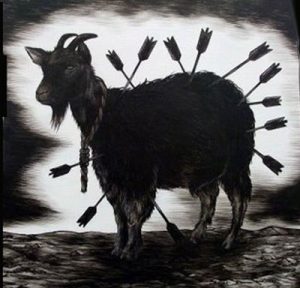
Briefly, in Biblical times, two goats were chosen when the community felt it needed cleansing. One was a sacrificial goat, which was killed to appease the Divine. The other goat was symbolically laden with the so-called “sins” of the people and driven into the desert to die, thus eradicating the sin.
Sigh. What a ridiculous coping mechanism. If only it was that easy! Eradicating real or perceived “sins” by assigning them to innocent animals and then killing them strikes me as immature, cowardly, impotent, and completely ineffective.
As an aside, in my experience those who thunder about the “sins” of others are the most destructive and guilty of all. Just ignore the man behind the curtain!
The role of a scapegoat seems to be essential to human society. We scapegoat individuals and we scapegoat groups. One of the reasons I’m more and more resistant to labels is they support and feed our ability to scapegoat others. Scapegoating is the root of genocide.
Scapegoating is abusive, and it’s a psychological trick, a distraction, a projection and a manipulation. Worst of all, it’s dishonest.
It’s also, frequently, murder, by which I mean the deliberate destruction (or attempted destruction) of an innocent. Ironically, family systems that scapegoat children often choose the most sensitive, empathetic, loving and talented child (often the healthiest family member) and set out to begin a systematic long-term campaign of destruction of that child so others within the family can avoid taking responsibility for their own lives.
Photo by Travis Bozeman on Unsplash
One can spend all day online exploring scapegoating. It’s depressing research. Those who are scapegoated have a horrendous experience of pain, isolation and rejection that frequently leads them into addiction and other self-harming behaviors, and cripples their ability to form healthy relationships, particularly with themselves, and make positive contributions. Many scapegoats do, in fact, go metaphorically out into the desert or wilderness and die.
But not all of them.
Let us not forget that of the two, the scapegoat is the one who survives. The sacrificial goat is out of time and out of choices, but not the scapegoat.
Photo by Jeremy Bishop on Unsplash
What happens when the scapegoat is spit upon, reviled, cursed and turned away, staggering and stumbling under everyone’s unacknowledged shadows, darkness, and feelings? What happens in the lonely black cold of the desert night, in the blazing, thirsty grit of the desert sun?
A long, slow death by inches from despair, isolation, thirst and hunger?
Do scapegoats meet other scapegoats, and if so, do they compare notes and experiences and support one another in surviving and healing, or do they, in their turn, scapegoat those they meet and perpetuate their own misery and damage?
OR do they meet an Angel, or another aspect of the Divine? Perhaps they reclaim and reanimate themselves. Maybe dreams and visions come to them. Maybe a fearsome Hag or an animal guide teaches them to find or create water in the desert. Perhaps a desert mouse or a scorpion appears and relieves the scapegoat of all that does not belong to it, either burying the toxic waste of others in the clean, hot sand of the desert or, better yet, sending the poison back to its source(s).
Perhaps scapegoats meet the Devil in the desert. Do you know the meaning of The Devil card in the Tarot? Authentic experience. Some people fear authentic experience more than anything else in the world, and they’ll do anything to silence, destroy or stifle it. Who is more feared or hated than the Whistle Blower, the One Who Tells Their Truth?
Maybe tribal shaming and exile are in fact a release from prison and a doorway to personal power. Maybe the desert has been waiting to embrace the scapegoat for an eternity, waiting with gifts and spirits and guides, waiting with wisdom, patience and healing.
When we flush the toilet, we don’t expect to see the contents again. Occasionally, something goes wrong and we do see the contents again! Very disconcerting. Imagine being a bearded patriarch with a paunch and a fine embroidered cloak of arrogance and entitlement. The beard hides a weak chin and the paunch hides a frightened, impotent, controlling personality that is unable to be wrong, learn or grow. In order to relieve the chronic stress of maintaining a pseudo self and constant unacknowledged fear, the patriarch symbolically loads a goat with all his unwanted psychological and emotional shadow and darkness (which he has just increased) and drives it away with rocks and blows.
Now imagine the goat returns some time later, strong and broad-shouldered. It dances in the moonlight on stardust hooves outside the city walls. Its thick, silky coat stirs in the desert wind. The twists and spirals of its horns gleam like marble sculpture. Free and unburdened, the scapegoat has become a wild, enduring, sensual creature of primal instinct and power.
The patriarch, by contrast, has become smaller, weaker, and more wretched.
I’ve reached two conclusions about scapegoats and scapegoating.
The first is scapegoating doesn’t work. Not only is it ineffective, it’s weak, and, frankly, I’m embarrassed for those who engage in it. People who scapegoat others are only drawing attention to their own meagre hearts and intellect. They can’t meet their own gaze in the mirror; they prefer to displace and project their self-hatred, fears and feelings onto others.
The second conclusion I’ve reached is the day we are driven into the desert from the gates of our loved ones or our homes as scapegoats may also be the day we are reborn into something fine and powerful, something wild and resilient and enduring.
On the first part of the journey I was looking at all the life There were plants and birds and rocks and things There was sand and hills and rings The first thing I met was a fly with a buzz And the sky with no clouds The heat was hot and the ground was dry But the air was full of sound
I’ve been through the desert on a horse with no name It felt good to be out of the rain In the desert you can remember your name ‘Cause there ain’t no one for to give you no pain La, la …
After two days in the desert sun My skin began to turn red After three days in the desert fun I was looking at a river bed And the story it told of a river that flowed Made me sad to think it was dead
You see I’ve been through the desert on a horse with no name It felt good to be out of the rain In the desert you can remember your name ‘Cause there ain’t no one for to give you no pain La, la …
After nine days I let the horse run free ‘Cause the desert had turned to sea There were plants and birds and rocks and things there was sand and hills and rings The ocean is a desert with it’s life underground And a perfect disguise above Under the cities lies a heart made of ground But the humans will give no love
You see I’ve been through the desert on a horse with no name It felt good to be out of the rain In the desert you can remember your name ‘Cause there ain’t no one for to give you no pain La, la …
I’ve been considering confidence for some time through the lens of minimalism. As I transition from clearing unneeded objects from my life (relatively easy) to clearing unwanted behavior patterns, habits and beliefs from my life (hard!), I follow the same basic tenets: How can I replace two or more similar but limited internal tools with one multi-purpose tool?
Photo by Bryan Minear on Unsplash
I’ve always had a messy relationship with confidence. At this point in my life, I’m confident of my own worth, but have no confidence anyone else will view me as worthy. Truthfully, this doesn’t bother me as much as it used to. Aside from a few close and longstanding relationships, I don’t much care what most of the world thinks of me. I realize now most people aren’t spending a minute thinking about me at all. Most of us are primarily preoccupied with ourselves!
I see confidence as a choice. The Latin root of the word means “have full trust” (Oxford Online Dictionary), and trust is certainly a choice. Confidence, like success, can be tried on like a hat. What I discover is choosing confidence for a day or even an hour significantly diminishes my internal clutter.
If I choose to be confident, perfectionism is no longer relevant. Neither are shame or anyone else’s expectations, judgements or criticisms. Defenses and pseudo self are no longer needed. Outcomes cease to feel like a matter of life or death. I don’t need to win, be right or exercise my outrage. I don’t need to explain, justify, or make sure everyone understands what I’m up to. Choosing confidence means letting go of all that, which means reducing my mental and emotional clutter, which means more peace, more time and more energy.
As I’ve been thinking about confidence, I’ve also been teaching swim lessons at work to children from infancy to nine or ten. I discovered as a teenager working with children teaches me as much as it does them. That was true when I was a teenager in the pool, in hospitals, in schools, as I parented, and now, again, in the pool.
I suspect confidence is built from a combination of nature and nurture. Some people seem to be inherently more confident than others. On the other hand, it’s not hard to mutilate a child’s confidence. Sustained criticism will do it. Careless language will do it. Refusing to acknowledge a child’s wants, needs and feelings will do it. Mockery and teasing will do it. Rigid and unrealistic expectations will do it.
I can tell within five minutes if I’m dealing with a confident or mistrustful child. Confident kids may be shy, hesitant, or wary of a new environment and a new person, but they’re willing to trust, explore and try. Mistrustful kids cry, act out, refuse to engage, or (most heartbreaking of all) stoically endure, rigid with tension and terror. A child who shrinks from my touch and cowers in fear of being dragged bodily into deep water and left to drown has certainly been forced by someone they trusted to do things he or she was not ready to do.
Photo by Tanja Heffner on Unsplash
As a swim teacher, I notice how much effort and energy mistrust costs us, not only the one lacking confidence, but everyone around them. A mistrustful, frightened child requires constant reassurance and encouragement. Their fear makes them more at risk in the water (and elsewhere) than their lack of skill. A confident child may frequently need to be hauled up from water over their heads by the scruff of the neck, spluttering and coughing, but as soon as they’ve snorted the water out of their nose, they’re ready to try again.
At the end of the lesson, all the kids are tired, but some are tired because they wriggled and flopped and kicked and bubbled with such enthusiasm and willingness they wore themselves out, while others are exhausted from lack of confidence and the firm belief they can’t. Carlos Castanada said, “We either make ourselves miserable, or we make ourselves strong. The amount of work is the same.”
Confidence, I’m pleased to report, can certainly be repaired, and not only in those of us who are nicely mature! Confidence is contagious. I have a four-year-old in one lesson who spends a great deal of time comforting and reassuring another child who lacks confidence. The confident child encourages the mistrustful one, demonstrating skills first to show they’re fun and easy, and promising “Miss Jen will keep us safe.”
From the lofty eminence of adulthood, I can reassure a child I will not break trust with him or her in the water, but a peer is in a much more powerful position with such reassurance, particularly a peer who is willing to go first. A child whose confidence has been injured is at a distinct disadvantage in all areas of life and learning. Building confidence is possible, but it takes time, consistency, and patience with kids whose trust has been violated in the past.
We can’t learn if we believe we can’t. Being willing to try or to learn requires a teacher who never sees failure and only focuses on progress and effort, no matter how small. A child who is afraid to blow bubbles in the water gets praised to the skies if he or she can be coaxed to dip their chin in the water. Even if that’s the only progress they make in a lesson, it’s a huge step for a frightened child who lacks confidence. Blowing bubbles will come when the child is ready. I’m confident of that, I repeat it aloud with confidence in front of the child and his or her parents, and invariably, a lesson or two later, that same child is blowing bubbles with great glee, in between accidental inhalations of pool water. Buoyed by praise, celebration and high fives, the child develops some confidence, but it took the other kids in the lesson, the swim teachers, and watching staff and parents to do it.
Photo by a-shuhani on Unsplash
Lack of confidence is very expensive, and very cluttered. Confidence, the single quality of the feeling or belief that one can rely on someone or something (Oxford Online Dictionary) can replace a whole host of ineffective and energy-consuming thoughts and beliefs.
It’s obvious to me that consciously choosing confidence is the simplest thing to do. As has frequently happened in the past, children show me the way, and I do my best to return the favor, not only as a teacher, but also as a parent, friend and coworker. When others believe and trust in us, we are empowered. When we believe and trust in ourselves, we are empowered.
Broken confidence can be repaired. In fact, it must be repaired if we are to thrive. Not everyone in our lives deserves or earns our trust, of course, but if we are unwilling to trust ourselves, we are truly lost in the darkness without a guiding light.
“Confidence is going after Moby Dick in a rowboat and taking the tartar sauce with you.” ― Zig Ziglar
Jiddu Krishnamurti said, “It is no measure of health to be well-adjusted to a profoundly sick society.”
I first heard that quote five years ago. It gave me comfort, because it allowed the possibility that my feeling of isolation and alienation at the time was a normal response. The problem, I find, with taking too much responsibility is one stops excavating interpersonal challenges. Instead, we assume it’s all our fault because we know we’re broken. This attitude effectively blocks further inquiry into what the people around us are up to. If we can be taught or manipulated into believing we’re the core of the problem in social interaction, our shame and guilt give those around us a free pass to behave however they like and treat us however they wish. No matter what happens, they can count on us to blame ourselves.
A friend of mine recently pointed out a lot of social media buzz about normalizing obesity. As I am not on social media, I did some research into memes and articles about this issue, and everything I saw made me think of the Krishnamurti quote.
Here again I see sloppy language. Almost every source agrees carrying too much weight on our frame is unhealthy. Unhealthy, as in bad for one’s health. Not ugly, stupid, lazy, lacking self-control, or a whole host of other slurs, taunts and unkind criticisms many overweight people have endured their whole lives.
Obesity is unhealthy. The fact that we have so many people struggling with obesity in this country doesn’t change unhealthy to healthy because it’s so common. A growing population of obese people signals a profoundly unhealthy society. Normal, as in usual, typical or expected, does not imply useful, healthy, functional or positive.
Is normal a goal, or is it merely a cop-out? Is normal something we aspire to because it makes us bigger, or is it something we have to make ourselves smaller in order to fit into? Who gets to decide what is usual, typical or expected? What are the consequences of choosing not to be usual, typical or expected?
Photo by whoislimos on Unsplash
I can answer that one. Consequences include tribal shaming, deplatforming, silencing and other violent, destructive and coercive responses.
Normal is one of those words we define ourselves. Normal describes something not aberrant or abnormal. Abnormal is the absence of normal. That distinction can be useful, but in a limited way. Conflating normality with Good and abnormality or different with Bad (or vice versa) is mindless, black-and-white groupthink, the kind of ideology driving genocide, religious persecution and racism.
Our culture and context help us define normal, but if our society is profoundly sick, to be well-adjusted and “normal” within it is to be profoundly sick.
This is particularly true when I look at money. I’m noticing an ever-widening gap between money and value in my own life and in the lives around me. Until recently, I thought of all resource as money, and a life without some magical amount of money I never defined and could never access would be a safe, successful life.
Photo by Evan Kirby on Unsplash
But money is only one kind of resource, and for me it’s the weakest kind. This thinking is definitely not normal by our cultural standards, but I believe it’s becoming more common. Minimalism is a growing trend, and those of us who explore and practice it are very clear about the relative value of money, time, contribution, experience, relationships, creativity, relaxation and joy. If earning money burns up all our other resources, we can’t replace them. Money won’t buy them back for us. A tree, an afternoon in the sun, a lap full of a child, the arms of a friend, the ability to lend someone a helping hand, are all beyond the power of money.
I don’t say money is bad or useless. I am dismayed, however, at what a God we’ve made out of it in this culture. During my lifetime the middle class has disappeared and the chasm between those very few who have significant financial resource and the billions of us who don’t seems likely to tear the planet apart.
A lot of sad people out there think money is power. It’s not. Our power is in our intelligence, our hearts, and our souls, not in our bank accounts. We have to make ourselves increasingly small and, ironically, impoverished, in order to adjust well to our deteriorating and unsustainable capitalist consumer culture.
In this house, we’re frequently in need of money to pay bills, buy groceries, keep up with car costs, buy a new pair of swim goggles, and buy a new fan for the furnace (our old one is beginning to sound like an airplane falling out of the sky when it kicks on). Most of the time, we don’t have money when we want it, but we manage to have what we need when it’s essential.
I used to feel terrified, ashamed, and like a failure because of my lack of financial resource. My relationship with money ruled my life. My hunger for more was never satisfied. When I had more I caught up with all my expenses and then I was broke again. It was a game I could never win.
I see now it’s a gameno one ever wins, yet we all go on compulsively playing it, chasing the lie that enough money will provide us with love, success, healing, healthy relationships, confidence, power, and a sense of purpose and meaning. We’re so busy playing the game we have no time to recognize or welcome into our lives the things that do have the power to give us what we want.
Ultimately, accumulating money for its own sake is an expression of impotence. What’s more sterile and pointless than a lot of digits sitting in an account? The tool of money is useless unless we put it to work. If (when) the economy crashes, a piece of paper with our account information on it will be of less use than toilet paper.
Photo by Gabriel Jimenez on Unsplash
What will matter is our ability to form loving, compassionate connections with others and our willingness to collaborate sustainably with Planet Earth. Our ability to both teach and learn will be important. Our skills and integrity will be important. Our laughter and creativity will be essential. If we can translate whatever financial resource we have into these things, we’ve made good use of our money. We’ve invested in sustainability and resilience, real resource for real life.
Frequent readers know how much I enjoy playing with frames. If we feel rebellious, noncompliant, alienated and crazy, perhaps the problem is not us at all. Perhaps the problem is we’re trying to fit into a profoundly sick society, and the fact that we can’t means we’re retaining some measure of health, even in the face of tremendous social pressure.
Those rebellious, noncompliant, alienated and I-feel-crazy ones are the people I’m writing for. Those are my people. Their courage, compassion and generosity are the wind beneath my wings. Our shared truths, tears, scars, love and broken places shape a womb where a healthier life for all can be nurtured.
Websites store cookies to enhance functionality and personalise your experience. You can manage your preferences, but blocking some cookies may impact site performance and services.
Essential cookies enable basic functions and are necessary for the proper function of the website.
Name
Description
Duration
Cookie Preferences
This cookie is used to store the user's cookie consent preferences.
30 days
These cookies are needed for adding comments on this website.
Name
Description
Duration
comment_author
Used to track the user across multiple sessions.
Session
comment_author_email
Used to track the user across multiple sessions.
Session
comment_author_url
Used to track the user across multiple sessions.
Session
Statistics cookies collect information anonymously. This information helps us understand how visitors use our website.
Google Analytics is a powerful tool that tracks and analyzes website traffic for informed marketing decisions.
ID used to identify users for 24 hours after last activity
24 hours
_gat
Used to monitor number of Google Analytics server requests when using Google Tag Manager
1 minute
_gac_
Contains information related to marketing campaigns of the user. These are shared with Google AdWords / Google Ads when the Google Ads and Google Analytics accounts are linked together.
90 days
__utma
ID used to identify users and sessions
2 years after last activity
__utmt
Used to monitor number of Google Analytics server requests
10 minutes
__utmb
Used to distinguish new sessions and visits. This cookie is set when the GA.js javascript library is loaded and there is no existing __utmb cookie. The cookie is updated every time data is sent to the Google Analytics server.
30 minutes after last activity
__utmc
Used only with old Urchin versions of Google Analytics and not with GA.js. Was used to distinguish between new sessions and visits at the end of a session.
End of session (browser)
__utmz
Contains information about the traffic source or campaign that directed user to the website. The cookie is set when the GA.js javascript is loaded and updated when data is sent to the Google Anaytics server
6 months after last activity
__utmv
Contains custom information set by the web developer via the _setCustomVar method in Google Analytics. This cookie is updated every time new data is sent to the Google Analytics server.
2 years after last activity
__utmx
Used to determine whether a user is included in an A / B or Multivariate test.
18 months
_ga
ID used to identify users
2 years
_gali
Used by Google Analytics to determine which links on a page are being clicked