Sometimes these posts are like puzzles. I pick up fragments in the course of daily life, and I find they all belong to the same idea. Remember doing dot-to-dot puzzles as a kid? I’m never sure what the shape is I’m working on, but I turn the pieces of the puzzle around until I’m satisfied with a coherent (hopefully!) post. It’s fun.
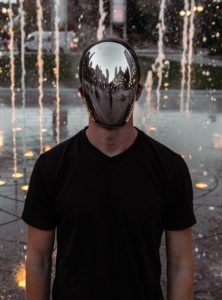
Photo by Syd Wachs on Unsplash
If I was bent on delivering a learned lecture in this post, I would have titled it “Postmodernism.” I’m not interested in lecturing, though, or philosophizing, or exploring current ideas and trends in a scholarly way. Ick. If you’re not sure what postmodernism is, here’s a link. You can educate yourself and draw your own conclusions — always the best way!
As I researched postmodernism I came across a referral to “post-truth.” Huh? Post-truth is “relating to or denoting circumstances in which objective facts are less influential in shaping public opinion than appeals to emotion and personal belief.” (Oxford Online Dictionary)
YIKES!
Truth is a slippery concept, and I’m not interested in debating whether it’s “real” or not. The tension between objective facts, denial and beliefs is a can of worms I have no interest in opening. I do accept science-based inquiry and methodology, particularly if data can be replicated, the process is peer-reviewed, and the funding is clean and unbiased. For me, truth and learning are dynamic, flexible and organic. What might be true for me today may change tomorrow, but that doesn’t mean today’s truth is necessarily a lie.
I don’t accept that belief and truth are the same, and I don’t accept that feelings and thoughts are necessarily objective facts.
The puzzle pieces I have collected this week all fit into postmodernism, but, as usual, I come at it in my own unique (and slightly off-center) way. Here are the pieces, in no particular order:
Photo by frank mckenna on Unsplash
One of my four most important values and priorities in making choices is to see things clearly; in other words, not to argue with what is, be in denial, or wholly and unconditionally believe in my own stories, assumptions, and feelings. Understand, I validate, value and rely on my feelings, but I’m very aware they don’t always point to the truth. I might feel rejected, for example, but that doesn’t mean I am rejected. It doesn’t mean I’m not, either. The feeling points me toward something needing further exploration, that’s all.
When I say “see things clearly,” I mean accepting what is without fear, resistance, apology, or the need to rewrite or sanitize my experience.
The second puzzle piece is a conversation I had with an approximately 30-year-old man in which I described a relationship that was not working well and what I did about it. His comment was “harsh.” Intrigued, I asked if it would have been better if I’d lied to the other party, or continued the relationship in spite of believing it was unhealthy for both of us. He had no answer for that. I asked if he had a suggestion for a kinder or different way I could have communicated my truth clearly. He had no answer for that one, either. What I was left with was, from his point of view, it was wrong for me to feel the way I did and tell the simple truth about it, without shame or blame, honestly communicating my sadness, my need to part ways, and my caring for the other party.
I’ve thought a lot about this conversation. As regular readers know, I dislike labels and sweeping generalizations, but I wonder if part of his problem with my choice about ending my relationship has to do with the trend in his generation toward postmodernism; that is, that there is no truth, all stories are equal, and to speak “truth” is somehow hateful, bigoted, and/or mean. I’ve even been told stating the truth is “dehumanizing.” Wow.
From my point of view, identifying and speaking the truth is by far the kindest thing we can do for each other and ourselves. Communicating the truth means we are taking responsibility. It means we have the courage to have a difficult conversation face-to-face, rather than ghosting, making excuses, living a lie, or leaving someone with no closure. It means we are healthy enough to take care of ourselves and manage our time and energy, and authentic enough to be heartful and committed in what we choose to do with our lives.
Photo by Alex Iby on Unsplash
I realize, of course, that some people use the truth as a club, and take no trouble to employ clear, kind language. Shame and blame and refusing to take responsibility are not truthful. Pretending is not truthful. Making excuses is not truthful. Cultivating a pseudo self is not truthful.
The third piece of this particular puzzle was in a book titled Roadwork by Richard Bachman (a.k.a. Stephen King). Here it is:
“But Mary’s footsteps never faltered because a woman’s love is strange and cruel and nearly always clear-sighted, love that sees is always horrible love, and she knew walking away was right and so she walked …”
I’m a fan of King’s writing, and this quote really caught my eye. I stopped reading, bookmarked the quote, and thought about being a mother and all the agonizing choices one makes when raising a child. (The context of the quote has to do with a mother and child.)
It’s terribly difficult (and sometimes terribly painful) to be clear-sighted about our own children. We are forced to make decisions that tear us apart, always striving to do what we think is best and frequently missing the mark. Moreover, having children means we are forced to look at ourselves more clearly for their sake, and that process is humbling, painful, and occasionally terrifying.
I ask myself, is this how King experiences a woman’s love? If so, is it a woman’s love for her child he has his eye on, or a woman’s love in general? Is it terrible love because it’s “clear-sighted,” or because women who love are capable of making horribly difficult choices and sacrifices for the sake of those they love? Is it the love that’s “strange and cruel,” or the clear-sightedness of that love? Or both?
I recently wrote about unconditional love. Is that kind of clear-eyed love “horrible” because it’s so powerful?
Photo by Cristian Newman on Unsplash
I’ve mentioned before somewhere on this blog that in the Tarot deck, which has pre-Christian roots, The Devil symbolizes authentic experience. This indicates to me dealing with the truth is not a new challenge for human beings. Postmodernism is just another cyclical iteration we’ve come up with as we struggle with the truth, misinformation, outright lies, authenticity and pseudo self, the sincere desire of many to be kind and compassionate, and the equally sincere desire on the part of others to control cultural narratives and (dis)information. I’m the first to admire and practice kindness and compassion, but taken too far they become enabling, denial, codependence, pseudo self and abdication of our own self-defense and needs.
The last piece of the puzzle was this link I received to a piece of satire about the “divisiveness” of truth. Satire is not my gig (I have a sneaking suspicion it’s above my head), and I don’t normally enjoy it or pass it on, but this was certainly timely, and it demonstrates the (to me) crazy thinking postmodernism leads to.
It seems to me truth is connecting rather than divisive. I’m wary of anyone who responds to the presentation of an objective or science-based fact with a rant about divisiveness. Those who seek to persuade us there is no truth anywhere, that whatever we believe is Truth, are the ones who are actively divisive. Critical thinking is not about hate, fear, control or manipulation; it’s about seeing the world around us with curiosity and clarity.
Photo by Hailey Kean on Unsplash
So what’s the deal with the demonization of truth, or authenticity, or honesty, or facts, or whatever? Does it have to do with technological cultural influences? Is it connected to our broken educational system? Does our decreasing literacy (TLDR — too long, didn’t read) play a part? Do our burgeoning health problems, poor diets and ever-increasing toxin loads affect our ability to think well?
Have we become so fat, lazy and comfortable we simply don’t want to make the effort to learn, explore, reflect and think critically?
Are we so entitled and selfish we reject unpleasant or unwelcome truths that might threaten our status quo?
Sometimes the truth is painful, inconvenient, and difficult to hear and say. Are we so precious, pampered and cowardly we need everything sugar-coated and artificially flavored and colored in order to deal with it, never mind if it’s truth or lies? (Have you watched any commercials lately?)
I don’t know. The only power I have is what I do with my own life. In my own life, endeavoring to see things clearly, to understand, to excavate what’s true for me at any given point in time and put it into effective, clear, responsible language and action, are paramount. Objective facts matter. History matters. Science is important. I value literacy, learning, education and professional expertise.
I’ve spent much of my life people pleasing and enabling the destructive behavior of others. I’ve spent much of my life assiduously cultivating what I thought was an acceptable pseudo self. I lacked the courage and support to face my own truths in the privacy of my head, let alone speak them to others. I allowed others to bully, manipulate and punish me for seeking objective facts. I allowed myself to be the target of gaslighting and projection.
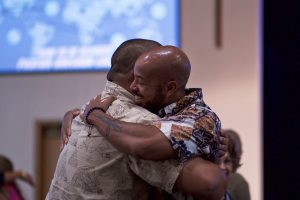
Last evening, I was part of a remarkable conversation about hugs.
Yes, hugs.
I’ve written before about my hunger for touch and the shame that goes with it. A longing for touch is always with me to some degree, ebbing and flowing with my social context, but I hide it and rarely speak of my need. Keeping it secret is, of course, self-protective. I’m ashamed of my need and what others will think of it, but we also live in a culture that distorts much of our rightful and healthy sexuality and sensual expression. A woman who craves physical affection and reassurance is exceedingly vulnerable and very likely to be misunderstood.
I’m also respectful of the boundaries of others; unfortunately, many people are badly wounded around unwanted and/or inappropriate touch. I myself am confused about the interaction of abuse, touch and sex, and I know many others are as well.
Yet I maintain touch is one of the core needs we all have, and I know touch deprivation is a condition that has been extensively studied. As human beings, we don’t develop normally if we’re touch deprived or otherwise dislocated from our neurobiological need for skin-to-skin contact.
This is an issue I deal largely with inside my own head, although I have mentioned it in writing. I haven’t discussed it among friends. If we reveal how ugly and pathetic we are, we won’t have friends, right?
Sigh. No. Not right. We all have secrets like this, and true friends don’t turn away from our warts and scars. Also, I get bored by my own fear and the tension between being real and being accepted. To hell with it.
Last night, I found myself standing outside in the early winter evening with two others talking about, of all things, hugs. The harsh light at the apex of the barn roof fell on us, making strange, stark shadows on our faces,
Photo by Erika Giraud on Unsplash
I was stunned (first) and amused (later) to discover a hug meant something entirely different to each of us. I’m constantly poking at the different meanings we have for words and concepts, and I’m acutely aware of the confusion and conflation of things like respect and agreement. Why should the experience and interpretation of either giving or receiving a hug be any different?
I suppose it’s such a deep, painful and private issue I’ve simply never given it enough airtime to realize touch, too, has many different meanings. The only meaning I’ve been able to see is my own, and I realize now my meaning is very unsophisticated and black and white:
Touch means love. If there is no touch, there is no love. If my touch is rejected, my love is rejected, which I take personally and make into a rejection of me, naturally!
So there we stood in the icy driveway, having just disembarked from the car. I said (and realized as I said it how true it is, though I never expressed it this way before) a hug is the best “I love you,” I can express. I’ve always been able to say (and hear!) far more physically than I can with words.
Photo by Nicole Mason on Unsplash
My friend (another woman) said she learned to think of hugs as a sign of weakness.
Another friend (a man) said to him a hug, or most other kinds of physical contact, are a threat of pain, violence or abuse.
Wow. The three of us stood there, looking at each other. I was reminded of how little we know or guess about what goes on below the surface of others, even others we know and care about. I was humbled by their honesty, touched by their vulnerability, grateful for the reminder we all carry around pain and confusion over something in our heads and hearts. I wanted (of course!) to take them both in my arms, but refrained (also of course).
It’s amazing to understand the best, most compassionate and loving gift I can give another might feel to the recipient like a threat, or endanger their sense of strength and independence. My intention may be completely lost in translation.
Photo by Ian Espinosa on Unsplash
When I think about the times I’ve felt rejected or rebuffed as I interact with people who aren’t comfortable with touch, I suddenly realize their discomfort is likely not about me at all. I no longer get to be the star in my soap opera (nobody loves me, I’m old, I’m ugly, I’m untouchable). Maybe, in fact, others don’t want to make me feel weak, or threatened, or who knows what else!
I can’t help but giggle about this.
I can’t say more about my personal thoughts and feelings right now. It was one of those brief but amazing conversations I can’t stop thinking about. It didn’t lead me to a grand and glorious conclusion, it just revealed aspects of touch I hadn’t been aware of before.
Social touch is extremely complicated and essential to healthy human functioning. I discover, as I research, the discipline of psychotherapy is beginning to look at the importance of touch as a tool for connection and emotional healing. We know touch can play a role in physiological healing. Touch is an essential part of nonverbal communication. Different cultures have different social rules about touch. A couple of generations of American parents were taught to avoid holding or cuddling infants and children (don’t spoil your child); thankfully, we are changing our beliefs about that now, but that doesn’t help the generations of disbonded and attachment-disordered children who are now adults and struggling. Skin hunger and touch deprivation are a huge problem for elderly populations.
Photo by Stefano Pollio on Unsplash
We also live in a #MeToo atmosphere in which the previously hidden pain of thousands of victims of inappropriate touch is becoming visible. As healing and validating as our recognition and outrage over this kind of abuse is, it leaves many people nervous about giving or receiving any kind of touch from anyone unless it’s sexual (as in consensual between two adults), making us ever more isolated, ashamed, and skin hungry.
I wish I had answers for myself and others, but I don’t. Somehow, we have to find a way forward with healthy boundaries, consent, communication and respect as we honor our deep physical, emotional and neurological need for nonsexual touch.
Crystal Casket by Rowan Wilding
Innocent, yet somehow run afoul of a jealous queen A sly drop of poison introduced A taint that can never be erased. So polluted, then, they built me a crystal casket, Protecting the world from my touch. I rise and clothe my outcast body, day by day Concealing shameful curse But at night I return naked to my crystal casket. The moon bathes me in her cool silver milk Ebbing and flowing like a slow heartbeat in the ravishing night. I lie with my hands folded on my chest (Their small warm weight comforts my empty heart) And watch the sky storm with stars Galaxies in my eyes. Neither shroud of rain nor quilt of snow can touch me, shut away But I love them from within my crystal casket. No faithful guardian watches over me, a lighted lantern at his feet. No prince arrives, seeking a poisoned kiss. I was never black as ebony, red as blood and white as snow. Now I’m spiderwebbed with age and moon-milk Cool inside my crystal casket while midnight passions wheel around me Dark flowers and fruits, musk and nectar, texture and taste and scent
I’ve noticed that I’ve been using the term “unconditional love” in some of my most recent posts. I wondered why. I’ve never thought much about the term, or what it means, until the last year or so.
One of the things I most appreciate about life is the fascinating journey of it all. When I came to Maine, I knew exactly what I wanted. I was sure it was here, waiting for me, the love I’d been looking for all my life.
I was wrong.
Rather, I was not wrong. What I was wrong about was how that love would present itself, how it would look and feel and be expressed. I realize now part of what I was searching for was unconditional love, and it is indeed here.
But it was there, in my old place in Colorado, too. The possibility of unconditional love has been with me every day of my life, and my inability to understand that meant I also did not recognize unconditional love that others gave me.
You see, it had to start with my ability to extend it to myself, and I never was able to do that until recently.
Photo by Nicole Mason on Unsplash
Unconditional love is best defined by its opposite — conditional love. Love is “an intense feeling of great affection (Oxford Online Dictionary).” Conditional love is the intense feeling of affection we give to others as long as they are compliant with our expectations.
In other words, as long as the one we “love” behaves in a manner we approve of, we “love” them. If our “loved” one makes choices, develops beliefs or expresses themselves in ways we disapprove of, we withhold or withdraw our love. Conditional love always comes with iron chains attached to it.
Much of the confusion around what unconditional love is has to do with our individual beliefs about how to express and receive love. “An intense feeling of great affection” can probably be communicated in as many ways as there are human beings, and that’s where the trouble starts. We don’t just want to be loved. We want that love to be communicated in specific ways, or we reject it. We also want to demonstrate our love for others in specific ways they may reject.
A further layer of confusion occurs because sometimes we identify our desire for power, control, codependency, romance and other benefits as “love.”
Conditional love is a manipulative tool used to benefit the one who claims to be the lover.
Photo by Chris Ensey on Unsplash
Unconditional love is a state of being in which love is extended to others selflessly, with no thought of reciprocity or benefit to the lover. Unconditional love is free. It’s not payment of a debt, and it doesn’t have to be proven. It’s a spiritual practice, an offering we choose to make over and over. Sometimes it’s completely invisible and unappreciated. We can unconditionally love people who don’t meet a single one of our needs.
When we think about love, are we thinking more about giving it or receiving it? I admit I’ve spent most of my life thinking about receiving love (or not receiving it in the form I wanted!) rather than giving it. I also admit I haven’t always recognized the love I have received. Further, I haven’t always recognized the difference between toxic relationships and giving and receiving healthy love.
On the other hand, I know a lot about codependency!
I don’t want to admit unconditional love is impossible to give others if we can’t give it to ourselves, because the truth is I just figured out how to do that and I was a new parent (the parent-child bond is the most important place for unconditional love) 30 years ago. I have never experienced the depth and intensity of the love I felt as a new parent, either before or since, but I’m only now growing into my ability to extend truly unconditional love to my (now adult) children.
Photo by Liane Metzler on Unsplash
When I was a new parent with young children, I took it for granted the love I felt for them would always be returned in a way I could understand and appreciate. It wasn’t a condition of my love that they do so, but it certainly was an unconscious and deeply-rooted expectation. Since the moment of conception, they were my priority and the center of my world, and I assumed, without really thinking about it, we would remain the most important, intimate and trusted people in one another’s lives.
My love for them was not and is not conditional. I know that now after receiving some brutal and much-needed reality checks! As they have stepped into their adult lives and the inevitable challenges and journeys life brings to us all, I’ve understood they are not responsible for responding to my love in any particular way, and I’ve also understood the fact of their continuing love for me, expressed in their own unique ways rather than the ways I expect and want!
Our longing for love can be all-consuming, and sometimes we sacrifice everything we are and have in order to find it. Unless we can unconditionally love ourselves, we become absolutely dependent on those around us to convince us we’re loved. Our dependency leads us into pseudo self, self-destructive choices, enabling and despair.
Nothing and no one can replace our love for ourselves. No one can love us and express that love to us in a meaningful way better than we can, not a child, not a lover, not a family member or friend. Our desperate external search is a waste of time and energy. It also exhausts and depletes the people around us and results in a painful pattern of broken relationships. Nothing is more futile than trying to prove our love to someone.
Unconditional love does not mean love without boundaries. It doesn’t mean relinquishing the power to say no (or yes). It doesn’t mean there’s no physical distance between ourselves and those we love. It doesn’t mean we agree on everything. It doesn’t mean we accept abuse or manipulation, or enable destructive behavior.
Unconditional love is clear-eyed; it doesn’t argue with what is. We accept ourselves and others in all our weaknesses, wounds and struggles. However we need to be, we love ourselves through it. However others need to be, it’s okay with us, AND we reserve the right to take care of ourselves, whatever the circumstances.
My practice of minimalism has helped reveal to me my desire and ability to extend unconditional love. In order to practice it, I have to release expectations of myself and others, my grievances and grudges, my scorecards, my pseudo self, and some of my stories and beliefs. I need to give up trying to control others, being a victim or a martyr, or being concerned about what others think of me.
Most important and difficult of all, I must take responsibility for my own needs and choices, choosing to love myself, day by day, unconditionally, because I know I’m doing the best I can in life and I’m worthy of the same compassion, kindness, respect, loyalty and support I give to others.
As adults, it’s not the love and recognition we long for and demand from others that makes us whole, heartful and soulful. It’s the unconditional love we give ourselves that allows us to make positive contributions, shape healthy relationships, and lead effective lives.
We stand on the threshold of a new year. We could approach this fresh start with unconditional love for ourselves, for some of those around us, and for life in general. We could release our fears and expectations about the future and retain a simple intention of unconditionally loving whatever the new year brings to us, difficult challenges and changes as well as unexpected opportunities and joys.
My partner and I have been watching back episodes of Nova for several weeks now on PBS. Last evening, as we watched “What’s Living In You?” and “Can We Make Life?” I realized that part of why I like the show so much is that it’s filled with people from all over the world who know they don’t know … and they want to know.
Photo by Frank Okay on Unsplash
This is a direct contrast to some interactions I had this week with people who know … everything. They know what happened; they know everyone’s motivations and secrets; they know exactly what everyone else should think, do and say. They have no interest in anyone else’s point of view or experience. They ask no questions seeking understanding or more information. They don’t have to. They already know, and any information that doesn’t fit their story is an attack, a lie, or a threat.
In these posts I’ve referenced Kathryn Schultz’s book, Being Wrong, a fascinating and funny look at the myriad ways in which we’re all wrong, every day, though some folks seem to feel their lives depend upon winning and being right. Even when forced to admit we’ve been wrong about something, we avoid thinking or talking about it, concentrating instead on all the ways we were, are, and will be right!
We live in a world in which knowing is highly valued. Uncertainty or even, God forbid, admitting or contemplating the vast cosmos of what we don’t know, is seen by some as weakness. I suspect, however, that what’s really going on is simply fear. It makes us uncomfortable to think about how much we don’t know. If we discover things, we might have to make different choices, and most of us don’t want to do that. It’s too much work.
Photo by Jonathan Simcoe on Unsplash
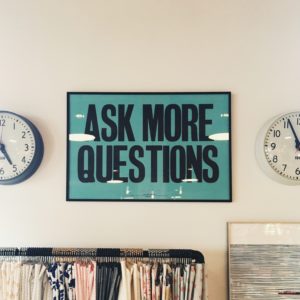
Fear doesn’t empower me, and neither does being right or wrong, or knowing or not knowing, Power is in the inquiry, in the questions, in the curiosity about ourselves, each other and our world. Power is in our ability to learn, unlearn and relearn — also called resilience — as we navigate our lives. We’re all both right and wrong, ignorant and knowledgeable, whether we admit it or not, but not everyone can ask a good question. Not everyone is able to propose an hypothesis and see it through to becoming a theory.
One of my greatest frustrations in life is with people who don’t want to know. What is that? How can anyone choose to be willfully ignorant? I don’t mean we all need to be interested in everything, as though life is one unending mechanistic reductionist set of classes. I mean we all need to be interested … period. In ourselves and the quality of our lives and experience. In others and the qualities of their lives and experiences. In our home, Planet Earth, and how to take care of it. In problem solving and innovation. In relationships and connection. In choices and consequences. In patterns, history and creativity.
Photo by Bryan Minear on Unsplash
The old map-makers drew maps of the discovered world, labeling the undiscovered areas “Terra incognita” or “Here be dragons.” What is the difference between someone who stays strictly within the confines of what the majority accepts as known and those of us who poke and pry; open forbidden doors, jars and boxes; look through microscopes and telescopes; and sail, ride, walk, stumble or crawl in search of dragons?
It boggles my mind to imagine some people find safety in not knowing, in not understanding. How can we make effective choices if we’re missing information? How can we heal, or learn to do better? How can we break dysfunctional patterns in our behavior? How can we have healthy, authentic relationships with ourselves or anyone else?
The hardest part of this issue for me is how disconnected I feel from people who say they don’t want to know. I think of life as an adventure, and I want playmates. I want to share what I’ve learned and learn more. I want to live the questions. I want to explore, reframe, turn beliefs and ideas inside out and upside down. I want to master new tools and skills. I feel sad when people in my life can’t — or won’t — play with me. It’s hard to feel my curiosity and questions are threatening to others. It silences me, and when I have to be silent, or less than I am, I’m bored.
Photo by frank mckenna on Unsplash
The older I get, the less I realize I know. The older I get, the more willing I am to be wrong. The older I get, the more comfortable and confident I am with my ability to research, read, synthesize, understand, experiment, challenge and learn. I notice how angry that makes some people, and how intolerant some folks are of questions, especially uncomfortable questions.
Terra incognita. What a wonderful phrase. Anything could be there, anything at all. I’ll send you a postcard with a footprint of a dragon.
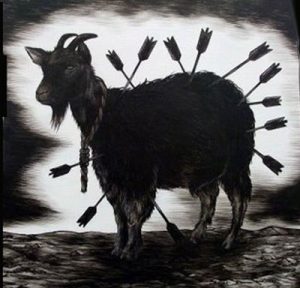
I’ve been exploring the concept of scapegoating. The information I’ve uncovered so far indicates the idea originates in the Bible, though I won’t be surprised if I discover pre-Christian roots to the practice.
Briefly, in Biblical times, two goats were chosen when the community felt it needed cleansing. One was a sacrificial goat, which was killed to appease the Divine. The other goat was symbolically laden with the so-called “sins” of the people and driven into the desert to die, thus eradicating the sin.
Sigh. What a ridiculous coping mechanism. If only it was that easy! Eradicating real or perceived “sins” by assigning them to innocent animals and then killing them strikes me as immature, cowardly, impotent, and completely ineffective.
As an aside, in my experience those who thunder about the “sins” of others are the most destructive and guilty of all. Just ignore the man behind the curtain!
The role of a scapegoat seems to be essential to human society. We scapegoat individuals and we scapegoat groups. One of the reasons I’m more and more resistant to labels is they support and feed our ability to scapegoat others. Scapegoating is the root of genocide.
Scapegoating is abusive, and it’s a psychological trick, a distraction, a projection and a manipulation. Worst of all, it’s dishonest.
It’s also, frequently, murder, by which I mean the deliberate destruction (or attempted destruction) of an innocent. Ironically, family systems that scapegoat children often choose the most sensitive, empathetic, loving and talented child (often the healthiest family member) and set out to begin a systematic long-term campaign of destruction of that child so others within the family can avoid taking responsibility for their own lives.
Photo by Travis Bozeman on Unsplash
One can spend all day online exploring scapegoating. It’s depressing research. Those who are scapegoated have a horrendous experience of pain, isolation and rejection that frequently leads them into addiction and other self-harming behaviors, and cripples their ability to form healthy relationships, particularly with themselves, and make positive contributions. Many scapegoats do, in fact, go metaphorically out into the desert or wilderness and die.
But not all of them.
Let us not forget that of the two, the scapegoat is the one who survives. The sacrificial goat is out of time and out of choices, but not the scapegoat.
Photo by Jeremy Bishop on Unsplash
What happens when the scapegoat is spit upon, reviled, cursed and turned away, staggering and stumbling under everyone’s unacknowledged shadows, darkness, and feelings? What happens in the lonely black cold of the desert night, in the blazing, thirsty grit of the desert sun?
A long, slow death by inches from despair, isolation, thirst and hunger?
Do scapegoats meet other scapegoats, and if so, do they compare notes and experiences and support one another in surviving and healing, or do they, in their turn, scapegoat those they meet and perpetuate their own misery and damage?
OR do they meet an Angel, or another aspect of the Divine? Perhaps they reclaim and reanimate themselves. Maybe dreams and visions come to them. Maybe a fearsome Hag or an animal guide teaches them to find or create water in the desert. Perhaps a desert mouse or a scorpion appears and relieves the scapegoat of all that does not belong to it, either burying the toxic waste of others in the clean, hot sand of the desert or, better yet, sending the poison back to its source(s).
Perhaps scapegoats meet the Devil in the desert. Do you know the meaning of The Devil card in the Tarot? Authentic experience. Some people fear authentic experience more than anything else in the world, and they’ll do anything to silence, destroy or stifle it. Who is more feared or hated than the Whistle Blower, the One Who Tells Their Truth?
Maybe tribal shaming and exile are in fact a release from prison and a doorway to personal power. Maybe the desert has been waiting to embrace the scapegoat for an eternity, waiting with gifts and spirits and guides, waiting with wisdom, patience and healing.
When we flush the toilet, we don’t expect to see the contents again. Occasionally, something goes wrong and we do see the contents again! Very disconcerting. Imagine being a bearded patriarch with a paunch and a fine embroidered cloak of arrogance and entitlement. The beard hides a weak chin and the paunch hides a frightened, impotent, controlling personality that is unable to be wrong, learn or grow. In order to relieve the chronic stress of maintaining a pseudo self and constant unacknowledged fear, the patriarch symbolically loads a goat with all his unwanted psychological and emotional shadow and darkness (which he has just increased) and drives it away with rocks and blows.
Now imagine the goat returns some time later, strong and broad-shouldered. It dances in the moonlight on stardust hooves outside the city walls. Its thick, silky coat stirs in the desert wind. The twists and spirals of its horns gleam like marble sculpture. Free and unburdened, the scapegoat has become a wild, enduring, sensual creature of primal instinct and power.
The patriarch, by contrast, has become smaller, weaker, and more wretched.
I’ve reached two conclusions about scapegoats and scapegoating.
The first is scapegoating doesn’t work. Not only is it ineffective, it’s weak, and, frankly, I’m embarrassed for those who engage in it. People who scapegoat others are only drawing attention to their own meagre hearts and intellect. They can’t meet their own gaze in the mirror; they prefer to displace and project their self-hatred, fears and feelings onto others.
The second conclusion I’ve reached is the day we are driven into the desert from the gates of our loved ones or our homes as scapegoats may also be the day we are reborn into something fine and powerful, something wild and resilient and enduring.
On the first part of the journey I was looking at all the life There were plants and birds and rocks and things There was sand and hills and rings The first thing I met was a fly with a buzz And the sky with no clouds The heat was hot and the ground was dry But the air was full of sound
I’ve been through the desert on a horse with no name It felt good to be out of the rain In the desert you can remember your name ‘Cause there ain’t no one for to give you no pain La, la …
After two days in the desert sun My skin began to turn red After three days in the desert fun I was looking at a river bed And the story it told of a river that flowed Made me sad to think it was dead
You see I’ve been through the desert on a horse with no name It felt good to be out of the rain In the desert you can remember your name ‘Cause there ain’t no one for to give you no pain La, la …
After nine days I let the horse run free ‘Cause the desert had turned to sea There were plants and birds and rocks and things there was sand and hills and rings The ocean is a desert with it’s life underground And a perfect disguise above Under the cities lies a heart made of ground But the humans will give no love
You see I’ve been through the desert on a horse with no name It felt good to be out of the rain In the desert you can remember your name ‘Cause there ain’t no one for to give you no pain La, la …
Websites store cookies to enhance functionality and personalise your experience. You can manage your preferences, but blocking some cookies may impact site performance and services.
Essential cookies enable basic functions and are necessary for the proper function of the website.
Name
Description
Duration
Cookie Preferences
This cookie is used to store the user's cookie consent preferences.
30 days
These cookies are needed for adding comments on this website.
Name
Description
Duration
comment_author
Used to track the user across multiple sessions.
Session
comment_author_email
Used to track the user across multiple sessions.
Session
comment_author_url
Used to track the user across multiple sessions.
Session
Statistics cookies collect information anonymously. This information helps us understand how visitors use our website.
Google Analytics is a powerful tool that tracks and analyzes website traffic for informed marketing decisions.
ID used to identify users for 24 hours after last activity
24 hours
_gat
Used to monitor number of Google Analytics server requests when using Google Tag Manager
1 minute
_gac_
Contains information related to marketing campaigns of the user. These are shared with Google AdWords / Google Ads when the Google Ads and Google Analytics accounts are linked together.
90 days
__utma
ID used to identify users and sessions
2 years after last activity
__utmt
Used to monitor number of Google Analytics server requests
10 minutes
__utmb
Used to distinguish new sessions and visits. This cookie is set when the GA.js javascript library is loaded and there is no existing __utmb cookie. The cookie is updated every time data is sent to the Google Analytics server.
30 minutes after last activity
__utmc
Used only with old Urchin versions of Google Analytics and not with GA.js. Was used to distinguish between new sessions and visits at the end of a session.
End of session (browser)
__utmz
Contains information about the traffic source or campaign that directed user to the website. The cookie is set when the GA.js javascript is loaded and updated when data is sent to the Google Anaytics server
6 months after last activity
__utmv
Contains custom information set by the web developer via the _setCustomVar method in Google Analytics. This cookie is updated every time new data is sent to the Google Analytics server.
2 years after last activity
__utmx
Used to determine whether a user is included in an A / B or Multivariate test.
18 months
_ga
ID used to identify users
2 years
_gali
Used by Google Analytics to determine which links on a page are being clicked