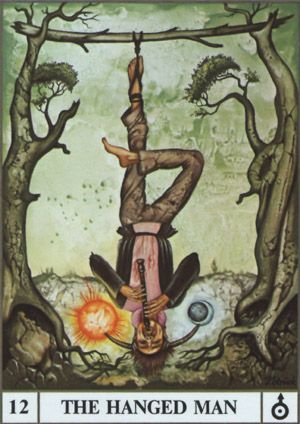
This week I’m contemplating The Hanged Man, a Major Arcana card in the Tarot deck. The traditional meaning of the card is “life in suspension.” Not coincidentally, The Hanged Man is the title of my first book.
The Hanged Man
The Tarot illustrates archetypes, and archetypes, like stories, have many rich facets and shades. The meaning of such symbols is never cut and dried, and archetypes can always be understood in layers and intuitive connections.
For many years I’ve worked with Tarot cards every six weeks, and at least half the time I pull The Hanged Man out of a deck of 78 cards, thoroughly shuffled and cut, for a 10-card spread. It’s obvious this particular card carries an important message for me.
Life in suspension. What does that mean?
First, I have to decide what “life” means.
Life: Doing, having, being.
For 50 years I believed I had to make up for the fact of my being by doing and having. It’s only recently I’ve begun to support and appreciate my need and desire to just be. Gradually, I’m changing my focus and attention from having and doing to being.
Thinking or talking about just being — feeling, playing, expressing, being in my body, following my interests and desires — seems either ridiculously shallow or criminal, I’m not sure which. Maybe both together.
On the other hand, having and doing can certainly be shallow in the long run, and provide only a brief period of comfort and pleasure, at best.
Life in suspension. Being in suspension? As in I’m too busy doing and having to be?
Photo by Ryan Moreno on Unsplash
That doesn’t sound good.
In my world, doing doesn’t count unless the doing is perfectly done. As perfection is a goal I never achieve, spending most of my time and energy doing seems like a bad investment.
As I explore and adopt minimalism, having is less and less important.
That brings us back to being.
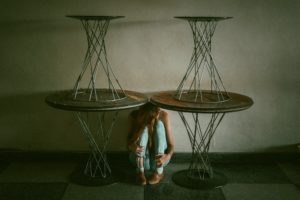
Life in suspension describes those times during which we feel stuck. We might be in a job that doesn’t challenge us, an unhealthy relationship, or an addiction. We might feel trapped in indecision, fear, grief or financial struggles. We can spend years, decades, lifetimes with pieces of our lives in suspension while we wrestle with our demons.
The entirety of our lives is generally not in suspension at the same time. We might be very pleased to have healed a health problem, yet still have struggles with money. We might be happy at work but stuck in our personal relationships, or vice versa. We might function for years with a hidden addiction, or wrestle chronically with our weight.
The thing about being stuck is it doesn’t feel competent, attractive, effective or like success.
It feels like failure.
On the heels of failure are the hounds of guilt, shame and isolation.
Photo by Elijah Hail on Unsplash
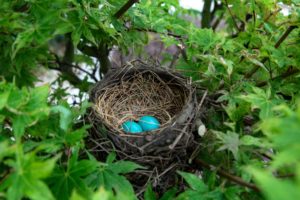
But during those messy periods when our lives are in suspension and our feelings painful, what sort of invisible, underground growth and change is happening? What is hidden in that suspended interval that is regenerative, creative and fertile?
The Hanged Man wears an enigmatic smile in many Tarot decks. He’s hanging from one leg from the branch of a tree. Why does he smile? Why isn’t he thrashing and cursing, trying to get loose? Why is he peaceful? How did he get there, and how long must he hang? What will happen to him after he’s unfettered? Who hung him there in the first place, and why?
Life in suspension sounds like nothing is happening. Everything has stopped. Yet one of the things we can say about life with complete confidence is that it’s always changing.
I realize now my book, The Hanged Man, is at heart an examination of lives in suspension, or at least partly so. What happens to a mother who has murdered her children? That’s a life not so much in suspension as shattered, but what of her grief, her shame and her pain? How does one continue after such an event? What happens to a man who flees his home, his parents and his young wife, and is not able to stop running? What happens after we die? What’s happening while we’re waiting for spring, or for the baby to be born, or for a death?
Times of despair, illness, injury, grief, exile, and failure can make us feel stuck. We can’t seem to fix, change or get away from the tree in which we’re hanging upside down. Nothing seems to be happening and our discomfort goes on and on. Others fear us, or are repelled or uncomfortable because of our trouble. Failure of any sort is contagious. Nobody wants to be infected.
Photo by Talles Alves on Unsplash
Yet suspended intervals are common to us all. We might pretend they’re not happening and hide them from others, but who hasn’t been through a time of failure, either one catastrophic event or many smaller ones? Who hasn’t spent time mired in grief, rage, addiction or indecision? Who hasn’t lost themselves in confusion or been paralyzed by fear?
That’s why The Hanged Man is such a powerful archetype.
The suspended interval doesn’t seem like rich ground for stories at first glance, but I’ve always been more attracted to the less popular and less prized side of life. I like the blood, the sweat and the wet spot. I like the harsh realities of bone and ash.
Years ago I started creatively exploring lives in suspension without ever thinking about it in those terms. It was a careless kind of play, inspired by my storytelling material. What happened to the characters from the beautiful old traditional tales I was telling after — or even before — the story I knew? When Rapunzel escaped the tower, where did she go? What did she do? What became of the prince the little mermaid loved?
Why is that rascally hanged man smiling?
In the suspended interval, decades long, of hiding my writing because I felt it was a shameful, unproductive waste of time and it earned no money, I accidentally started writing a book. Or, I should say, a series of books.
It didn’t seem like much was happening while I was living those years, though. I was just hanging on, living my life.
Now that life I was experiencing while nothing much was happening has become nearly two thousand pages of creative work.
This summer is about resource. I’ve never picked a one-word summer intention before, but today I realize it’s been thrust upon me, willy-nilly. The Summer of Resource.
Photo by Landon Martin on Unsplash
I’ve been working with the idea of minimalism, which forces one to take stock of resource in the wide sense. What is resource? Oxford online dictionary defines resource as “a stock or supply of … assets that can be drawn on by a person … in order to function effectively.”
When I think about resource, it’s a jigsaw puzzle, and like a jigsaw puzzle, every piece counts if one wants to end up with the whole picture. When I hear the word “assets,” money is the first thing that comes to mind. Then there are external natural resources, which are also closely tied to money and more finite every minute.
In a capitalist economy, that’s as far as most people explore resource. What’s the bottom financial line? What’s the cost versus benefit projection? What’s the tax picture? How expensive is firewood, oil, electricity and food? What is the interest rate? How affordable is housing?
Photo by Senjuti Kundu on Unsplash
Sadly, this is a short-sighted and nonsustainable view of resource. It’s also incomplete, because it doesn’t include intangibles that can’t be quantified in terms of monetary value, and so become invisible. These include space, time, creativity, soulfulness, heartfulness, love and compassion. Also, more subtly, faith, patience, playfulness, innocence and integrity, some of which qualities are targets of active contempt in this culture.
How do we quantify the resource of a life, any kind of a life?
Pick a closet in your house. Open the door. What’s the square footage of that space resource? What’s in the closet? Any item you don’t want and/or don’t use is not a resource. It’s just junk clogging up you space. “It’s mine,” “I’ve had it all my life,” “I paid a lot of money for this,” “my favorite aunt gave it to me” and “some day I might need it” are not indicators of resource. A resource helps us function effectively, remember? Any item we don’t use but hang onto anyway isn’t helping us function effectively. Our shoe collection, baseball card collection or belly button lint collection might temporarily give us pleasure, bolster our self-esteem, distract us or even be a financial investment (probably not the belly button lint, but remember Pet Rocks?), but our collections frequently cost money to acquire and demand space, time and management. They own us as much as we own them.
Even money, inappropriately managed, becomes an ineffective resource.
We are constantly assaulted by sophisticated marketing persuading us to buy products that will make our lives better. Most of us know intellectually we’re being manipulated, but the lure is irresistible. We’re so hungry for love, for healthy relationships, for comfort, for distraction, for beauty. It’s an empty promise, though. We buy, but we’re still hungry, so we buy more, like the good little brainwashed consumers we’ve become.
Many folks here in Maine harvest wood off their land in exchange for financial resource. Some harvest sustainably, but most clear cut. People sell what resource they can in order to stay afloat financially. I understand. I’ve done it, too. That destroyed forest, however, is — was — a natural resource of unimaginable complexity on a finite and increasingly depleted planet. Systems scientists are only now beginning to glimpse the intricate interconnections between life on Earth — all life on Earth, not just human life.
Photo by Gary Bendig on Unsplash
Life is resource.
Clear cutting a few acres of wood might help us face the immediate necessity to buy firewood this summer and heating oil over the winter. We can quantify those costs. We can’t quantify what the loss of those few acres are in terms of healthy land, water, air, and the innumerable forms of life destroyed with the trees. We don’t know exactly how the destruction of a few acres here in central Maine contributes to cumulative global breakdown and change, because we’re not aware of all the complexities of our dynamic living global system. It’s too big to think about, too far away. Many of us are simply trying to survive another day or week or month in the long spaces between paychecks. We’re far too overwhelmed and desperate to try to grapple with the whole picture. After all, if we can’t get through today there is no tomorrow.
What will the last tree be worth in dollars? In possibility? In beauty?
I can’t think about resource without thinking about sustainability. Working 60-hour weeks might provide comfortable financial resource, but it’s not sustainable. Using up money, time, space, patience, and even things like hope faster than we create or save them means we’ll run out, and when we run out of resource our lives stop functioning effectively — fast. Then we’re forced to shape a new life, whether we’re prepared to or not.
Renewable resources need time to renew. Few of us feel as though we have enough time, and what time we do have is sucked up in earning money, dealing with the consequences of how we manage it, and relationships. It’s possible to set aside time for self-care and creativity, but it requires discipline and boundaries. It’s possible to grow food and harvest natural resources sustainably, but not as long as we value money over all other resource and our population continues to be in overshoot.
Photo by Quino Al on Unsplash
Like everyone else, I have needs and limited resource available to help meet them, but if my life is too cluttered, noisy and/or busy, I lose track of both my needs and my resource. I forget I’m more than my ability to pay the bills, more than the numbers in my bank accounts. The practice of minimizing helps me remember to appreciate and protect all my resource, and make clear choices about sustaining and strengthening what I have so it supports who I am.
Minimalism encourages a kind of inside-out thinking. Not “I need a bigger house,” but “I need less stuff in this house.” Not “I need more money,” but “I want to spend less money.” Not “I need more time,” but “I want to do less with the time I have.”
Less, not more. The goal is to have what we need, but not more than we need.
What investments will truly increase my resource, financial, emotional, creative and intellectual? Only I can say. I’m the only expert on my own needs. I’m the only one who can identify the unrecognized or poorly managed resource in my life and implement different choices. No advertisement, expert, tweet, social media post or self-help book knows more about me than I do myself, and none can make choices for me. It’s all on me.
Rats.
It will be an interesting summer. I’m letting go of objects, some in exchange for money. I’m liquidating a financial asset to pay debts and invest in my ability to spend less. I’m investing time, energy, faith and hope in my creative work.
I think about effective living all the time. What, exactly, do I need to have and do to live effectively, and what do I have and do that are not helping me achieve that goal? What does “effective” mean to me? What does my particular expression of being require to thrive? What are my total resources, and how renewable or sustainable are they? How can they best be invested in order to create more?
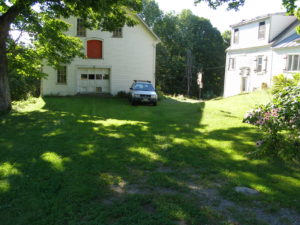
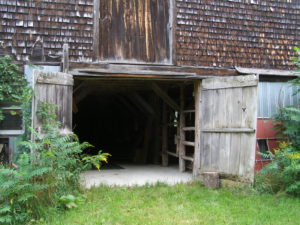
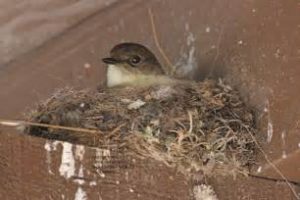
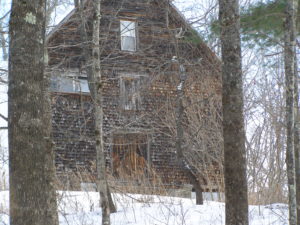
One of my favorite things about this land we live on is the old barn. Circa 1832 in the original part, it dwarfs the house and consists of four stories topped by an attic space under the roof. The cellar contains several rough animal stalls and is the occasional residence of a skunk, raccoon, woodchuck or grumpy porcupine. Phoebes nest every year in the cellar and first floor rafters. We store wood on the first floor. The second and third floors were an old hay mow and now are a repository for discarded furniture, miscellaneous remnants of wood, and old windows and doors. This is New England. These Yankees keep everything!
The barn is a tenement for rodents, bats, insects and birds, along with creatures like the aforesaid porcupine, who wander into the cellar in search of shelter.
Barn Cellar
When I moved to Maine, I stored some of my things in the barn; things I didn’t have room for in the house but wanted more accessible than the storage unit. Now that I’ve moved out of the storage unit and everything is here on the property, I’m determined to go through each box and discard what is no longer useful.
I work in the second story of the barn. The south wall contains a row of windows, several of which are broken. The west wall also has a broken window, and plentiful bat guano on the floor under it tells us this is their favored access point.
My hours in that space are strange, almost otherworldly. I sit on an old round lidded metal bucket that once contained popcorn. My table is the lid of a large plastic storage bin. I unpack the boxes I taped and labeled more than four years ago in Colorado, in a different life and half a world away. The barn is alive with stirrings and fugitive drafts. The wood floor dips and sways, creaking underfoot and showing cracks between the planks. The scent of apple blossoms floats in through the windows, along with the sounds of insects and the sweet calls of the phoebes as they hunt those insects. Once I’ve settled down quietly to work, squirrels, mice and chipmunks forget my presence and begin to scurry overhead and in the walls around me. I know bats are clustered under the roof, a floor and a half above me. Light comes in through countless cracks and crevices in the walls. The roof leaks in many places.
The body of the barn is loosening and thinning, much like my own skin; as it does so it’s becoming rewoven into nature.
I’ve gone through boxes and boxes of beading material, sewing supplies, wreathmaking tools and elements, camping gear, seasonal decorations and kitchen items. The quiet barn fills with my memories as I review where I’ve been and recognize the steps bringing me to this place and this moment.
Photo by Anna Dziubinska on Unsplash
We love increase in this culture. The journey of childhood to adulthood. Increasing income in order to increase spending power. Upscaling, upgrading, updating, trading in. Increased choice, increased technological power and speed, increased likes and friends, increased access to “information” and entertainment. Bigger, better, newer, faster, more.
Now, suddenly I find myself strangely captured by the beauty of decrease. Perhaps what I’m feeling is a kind of surrender, a letting go. The barn lets go of its glass window panes, its nails, its roof shingles, the mortar in its foundations. As the fabric of its structure thins, life pours into it. The world inhabits it. The boundaries between the building and its setting are softening.
Winter barn
Observing this process of gradually increasing boundary ecstasy is breathtakingly, almost piercingly beautiful. My appreciation of its magic mingles with tears, memories and nostalgia as I unwrap and handle my things, once so beloved and important in my life, now boxed and stored.
As I load up the car and donate to our local charities, sell or give away what I no longer need, the storage space in the barn gradually empties. Sunlight fingers the floor where a stack of boxes stood. An errant breeze swirls dust into a brief glittering cloud.
Is empty space, or an empty moment, ever really empty? Can it be? Is a quiet afternoon without distraction or entertainment sterile and boring, or filled with peace and possibility we no longer recognize or welcome but starve for nonetheless?
Watching the reflection of moving leaves or water and sunlight on a bare wall feeds my creativity and joy in a way the finest piece of manmade art never could.
As I empty my life of so many objects, it becomes like the barn. I allow the cracks of long use, weathering and aging to show. I allow my memories and experience to mingle with the light, the moving air and the life outside my boundaries and barriers. I feel less isolated and more grateful, less anxious and more peaceful.
What is a life defined by the spaces between objects and tasks rather than the objects and tasks themselves? What is life in the spaces between our debts, bank balance and paychecks? What are the gifts hidden in decrease, in the slow passage of time, in loosening skin and softening bone? How much creativity and wisdom fill the spaces between our obligations, habits and addictions?
What hidden infinities lie in the spaces between each tick of the clock, each heartbeat and each breath? How much light can come into me as I widen the cracks in my physical envelope? More importantly, how much of my light can shine out into the darkness around me?
I recently read an essay about honoring our past from one of the minimalism blogs I follow. I moved on to other things without saving it, but it continued to echo in my mind and I realized it held a deeper meaning for me than I first recognized. Of course, now I can’t find it again! Still, the blog is well worth exploring.
As I embrace minimalism , I spend time every day consciously assessing not only my internal clutter but also the objects around me. I’ve moved things around, put things away to see how my space or life felt without them, and let go of many objects and ideas.
Photo by Dan Gold on Unsplash
We carry a lot of our past around with us. One belief I’ve carried all my life is that it’s disloyal and even hateful to change, to grow, to yearn for more or to leave jobs, relationships or places. That belief (Who taught me that? Why do I believe that? Is that true?) has caused a lot of pain in my life. It’s made me fearful, ashamed and inauthentic. It’s encouraged me to be much less than I am.
The essay I read proposes almost the opposite idea. The author expresses deep gratitude for her past experience and the people who influenced her, and she honors them by going forward into the future.
What a disconcerting idea! At the same time I recognize some kind of truth in it, a truth I don’t discern in my own beliefs about honoring the past.
As a mother, I want to see both my sons being bigger than I am. That doesn’t mean I want to see them with more to have and to do. I want them to have more to be.
Photo by Bill Williams on Unsplash
I want them to fly free, the memory of our time together and the strength of my love and our connection the wind beneath their wings taking them onward and upward.
Yet I don’t give myself the same permission. I’m not sure I’ve ever taken a big step forward in my own growth, health and understanding without feeling it’s at the expense of someone else’s happiness and well-being. It always seems wrong — a betrayal, an abandonment or a rejection.
When it comes down to a choice between my own needs and the needs and demands of others. I never seem to be able to accommodate both myself and those around me. Until very recently, I’ve inevitably chosen to meet the needs of others rather than my own.
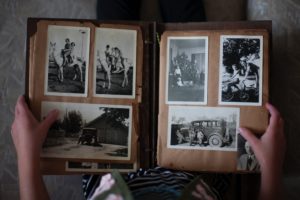
Today is built on all our yesterdays. If I lived in an empty room with nothing in it, my past would still have shaped today. I’d still remember my personal history, my family, my children, old friends and places, beloved animals, old activities and interests. Past loves and influences wouldn’t disappear from my life without my things. Forgotten or remembered, my past would still be with me and within me.
I can’t live in the past, though, any more than I can in the future. I can only live now.
I love this attic workspace, but one day I’ll leave it, as I left my beloved little home in Colorado four and a half years ago. It’s not the lack of love, respect or gratitude moving me into the future. It’s the ebb and flow of my life, the call of possibility, the itch of curiosity. My future self calls out to me, holding out her hands in encouragement, and I must answer the call.
Maybe our cultural obsession with things is about fear, or greed, or numbness or nostalgia. Maybe it’s about all those and others, too. I don’t know. But the idea that the best way to honor the past is to be fully in the present and consent to move ahead into the future seems blessedly simple, uncomplicated and unencumbered.
I’ve always longed for security. I’ve longed for relationships that don’t change, love and tenderness I can count on, the ability to give and receive promises and vows that never break.
I’ve also longed to be wild and free, to live a life that feels real and true, to be with others who both give and receive unconditional love and don’t seek power over those around them.
Objects will give me neither security nor freedom. Today I have a few favorite things I wear, use or live with. Some are new favorites and some are old favorites, handed down from my family.
Everything else is just stuff that’s here. I don’t really notice it unless I think about it, but I don’t need all these things and they’re weighing me down. A year from now my current favorites might no longer serve and I’ll let them go in turn.
As I write about it, this process sounds healthy, normal and natural. As I do it, guilt and shame tear at me. It seems to me that even growing up was hurtful; a deliberate betrayal and abandonment of my family. The least I can do is hang on to all the objects inherited or gifted by earlier generations.
But why? Does hanging on to such things really demonstrate love, respect or gratitude? Would my great-great grandmother expect me to cherish and care for something that belonged to her but has no meaning for me? If she did expect it, are her expectations more important than my wants and desires? Would she want me to make my life a shrine to her memory or go forward into my own life and follow my own path? What honors the memory of our ancestors the best?
Honoring the past by moving toward the future. Could it be that clean and easy? Could it be that elegant? If I live a life of meaning and purpose that does not include reverence for every object, tradition and idea I was brought up with or exposed to, are the ghosts of my past pleased or will they turn away and disown me?
Maybe it doesn’t matter. I know what I need to do.
I recently read an article from The Minimalists titled “Prepared to Walk Away.” The Minimalists is a blog about simplifying all aspects of our lives by reducing our physical, mental and technological clutter. For most who embrace this way of living, the first challenge is to declutter. The flip side of decluttering is mindful acquisition, and that’s the part of the essay that really caught my attention.
Some people think of minimalism as something practiced by wealthy elites who live in large, white, coldly antiseptic, ultra-modern spaces. It’s trendy right now to declutter and organize, an interesting push back against the relentless consumerism of the twentieth century. I hate clutter and love to be organized, but that isn’t what most attracts me to the practice of minimalism.
What I have my eye on are the intangibles in life, the stories, beliefs and habits accompanying us through our days. How and why do we acquire such things? How much of the acquisition is conscious rather than unconscious, and how heavily are we influenced by the people around us and their stories, beliefs and habits?
It seems to me the vast majority of our mental clutter is carelessly acquired or thrust upon us as an obligation. We humans are powerful in our ability to absorb influence, and we’re fatally prone to addiction. Our consumer culture has exploited these weaknesses mercilessly, from alcohol, sugar and cigarettes to video games, social media and the Internet. The media grooms us from childhood to be mindless recipients of stimulation to buy, to believe and to comply.
Critical thinking is unfashionable, to say the least. I look around me and see shriveled attention spans. Fewer and fewer people seem to respect or even recognize peer-reviewed, verifiable, fact-based science from the idiotic and ignorant ravings of malcontents, manipulators and madmen who peddle hatred, bigotry and misinformation to the masses from television, radio, the internet and social media.
Thus, we’re positioned, mouths agape, eyes reflecting the sparkle and shine of baubles and distractions, minds numb, stumbling through life with one eye on some kind of a screen at all times, while words and assertions assault us from every direction from thousands of gaping mouths and talking heads and millions of busy fingers.
Mindfulness? You’re kidding. Who has the time, quiet and space to even think about what mindfulness means, let alone practice it? How many people feel that the only way they can face their life is to avoid mindfulness at all costs?
Decluttering a closet is one thing. Can we sort through our ideas and habits and discard what’s unattractive, outgrown, outdated or worn out? It’s agonizing to consider a piece of clothing, especially a costly one that seemed like such an exciting deal when we got it, and realize we don’t wear it, don’t like it or it doesn’t go with anything else we wear. We’ve invested money in that item. It’s in good shape and of good quality. We can’t just discard it. What a waste! We’ll never get our investment back out of it.
Photo by Patrick Brinksma on Unsplash
Ideas, habits and beliefs are even harder to walk away from. We might not have spent money in acquiring them, but they tie us to our tribe, our workplace, our church, our family and our community. They influence our favorite social media platforms, our news and radio purveyors and our identities. Our addictions cement us into communities of other addicts, or at least into communities which enable our addictions.
We know everything about holding on: holding on to power; holding on to identity; holding on to our beliefs; holding on to stuff, either because we want to or someone else expects us to; holding on to grievance, outrage and fear. What we don’t seem to understand is how holding on locks us into place. We can’t grow. We refuse to learn. Fear has killed our natural curiosity and drive to explore.
On the other hand, a willingness to discard any object or intangible in our lives, if necessary, means we consent to grow, change, learn and be flexible and resilient.
Mindful acquisition is a conscious activity, an agreement we make with ourselves to buy that new item or explore a new idea or relationship, fully prepared to walk away if the item, idea or relationship become, at any time, a detriment rather than an asset.
It’s easy to think about objects in terms of money. Beliefs and habits are less concrete, yet our habits cost us far, far more than what we lose when we discard an expensive coat we just don’t wear. Talk to anyone who has tried to be in relationship with a workaholic or a substance, screen or gamer addict about the cost of our behavior. Money is, after all, only a symbol of value we agree to use. Our intangible clutter costs us relationships, connection, our health and sometimes our lives.
At first look, it seems being willing to walk away from relationships weakens our ability to connect. In fact, I think in the long run it strengthens healthy bonds. If I know both I and the other party are prepared to walk away, I’m responsible for making a choice, over and over again, to stay, nurture and invest in a healthy connection — for both of us.
Photo by Cameron Kirby on Unsplash
Practicing mindful acquisition requires me to pay close attention to the thoughts, beliefs, ideas and habits I give time and energy to or consider adopting. Do they increase my power and joy or diminish it? How does my mental and emotional clutter interact with my relationships and ability to communicate and contribute? How do these intangibles affect my heath and energy?
The irritating thing about personal power management is that it takes work and mindfulness. We can’t stay asleep at the wheel. Sure, reclaiming our stolen, lost or dormant power is a rush, but then we have to be responsible for our needs, priorities and choices, choices about what enters our lives and choices about what we discard or walk away from.
Our lives are limited. At 55, I’m beginning to feel the edges. I want to minimize my clutter, from items to intangibles. I want to let light and space into my home and serenity and clarity into my head and heart. I want to feel the flow of energy in the form of money, love and creativity without distraction.
Websites store cookies to enhance functionality and personalise your experience. You can manage your preferences, but blocking some cookies may impact site performance and services.
Essential cookies enable basic functions and are necessary for the proper function of the website.
Name
Description
Duration
Cookie Preferences
This cookie is used to store the user's cookie consent preferences.
30 days
These cookies are needed for adding comments on this website.
Name
Description
Duration
comment_author
Used to track the user across multiple sessions.
Session
comment_author_email
Used to track the user across multiple sessions.
Session
comment_author_url
Used to track the user across multiple sessions.
Session
Statistics cookies collect information anonymously. This information helps us understand how visitors use our website.
Google Analytics is a powerful tool that tracks and analyzes website traffic for informed marketing decisions.
ID used to identify users for 24 hours after last activity
24 hours
_gat
Used to monitor number of Google Analytics server requests when using Google Tag Manager
1 minute
_gac_
Contains information related to marketing campaigns of the user. These are shared with Google AdWords / Google Ads when the Google Ads and Google Analytics accounts are linked together.
90 days
__utma
ID used to identify users and sessions
2 years after last activity
__utmt
Used to monitor number of Google Analytics server requests
10 minutes
__utmb
Used to distinguish new sessions and visits. This cookie is set when the GA.js javascript library is loaded and there is no existing __utmb cookie. The cookie is updated every time data is sent to the Google Analytics server.
30 minutes after last activity
__utmc
Used only with old Urchin versions of Google Analytics and not with GA.js. Was used to distinguish between new sessions and visits at the end of a session.
End of session (browser)
__utmz
Contains information about the traffic source or campaign that directed user to the website. The cookie is set when the GA.js javascript is loaded and updated when data is sent to the Google Anaytics server
6 months after last activity
__utmv
Contains custom information set by the web developer via the _setCustomVar method in Google Analytics. This cookie is updated every time new data is sent to the Google Analytics server.
2 years after last activity
__utmx
Used to determine whether a user is included in an A / B or Multivariate test.
18 months
_ga
ID used to identify users
2 years
_gali
Used by Google Analytics to determine which links on a page are being clicked